
The morning after LANAP, a patient may notice fading numbness, pink saliva, and a tender bite, then feel tempted to pull the lip back and inspect the gums. An online search can make that uncertainty worse when one recovery sheet allows brushing and another says to leave the treated area alone.
Understanding what to expect after LANAP surgery starts with a distinction: feeling better and finishing healing aren't the same thing. Recovery happens in stages, and the treating periodontist's written instructions take priority over any general internet timeline.
Table of Contents
- Your Recovery Timeline From Day One
- How the Treated Gum Keeps Healing
- Pain Swelling and Bleeding in the First Week
- Activity Rest and Habits for Faster Healing
- Eating and Cleaning While the Clot Settles
- Follow-Up Visits After the Laser Day
- What a Later Reassessment Can Show
- Call or Book When Healing Changes Course
Your Recovery Timeline From Day One
What many patients notice after LANAP
These are typical recovery phases, not a promised course. Full-mouth treatment and treatment around selected teeth may require different home-care plans.
| Phase | What many patients notice | Usual focus |
|---|---|---|
| First 24 hours | Numbness fades, light oozing, mild soreness | Rest, cool soft foods, medicines as directed, no straws or smoking |
| Days 2 to 3 | Swelling or tenderness may peak | Soft foods, lighter activity, call if pain or swelling worsens |
| Days 4 to 10 | Discomfort often eases; gums may look dark or feel sensitive | Clean only as written; treated-area brushing may still be on hold |
| About day 10 to week 3 | Tissue feels firmer; some plans restart brushing and flossing | Follow-up check; thicken foods only after clearance |
| 1 to 3 months | Chewing is often more comfortable; pockets still remodel | Plaque control and the start of periodontal maintenance |
| 6 to 12 months | Early attachment gains may hold if inflammation stays down | Professional maintenance and risk-factor care |
The patient's written instructions win whenever they differ from this table. A restriction may apply only to the surgical area, or it may apply more broadly after full-mouth treatment, so unclear wording deserves a call rather than a guess.
Comfort and healing follow different schedules
Many patients have modest discomfort, but LANAP recovery isn't necessarily pain-free. A review of LANAP literature described limited bleeding, swelling, and postoperative discomfort in the studies examined, while emphasizing that the evidence base remained limited.
A comfortable breakfast or an easier day at work doesn't establish that the treated tissues can tolerate normal chewing. Diet and hygiene restrictions protect an area that may still be fragile even when soreness has eased.
The early priority is protection. Later, the emphasis shifts toward controlling plaque and monitoring whether the gums remain stable around the teeth.
Practical rule: Improvement in symptoms isn't permission to advance food textures, brushing, or exercise ahead of the written plan.
A timeline should support decisions, not create deadlines
A patient who still needs soft food while another patient has returned to thicker meals hasn't necessarily fallen behind. The amount of treatment, the original bone loss, and the condition of individual teeth all affect the next safe step.
Periodontal Associates of Delaware plans LANAP care at its Wilmington, Newark, and Dover offices using the FDA-cleared PerioLase MVP-7. Its guide to whether laser gum surgery is worth considering can help patients prepare questions about treatment benefits, limitations, and aftercare.
Individual results vary. A small study's average improvement isn't a personal guarantee, and a recovery calendar can't replace an examination.
How the Treated Gum Keeps Healing
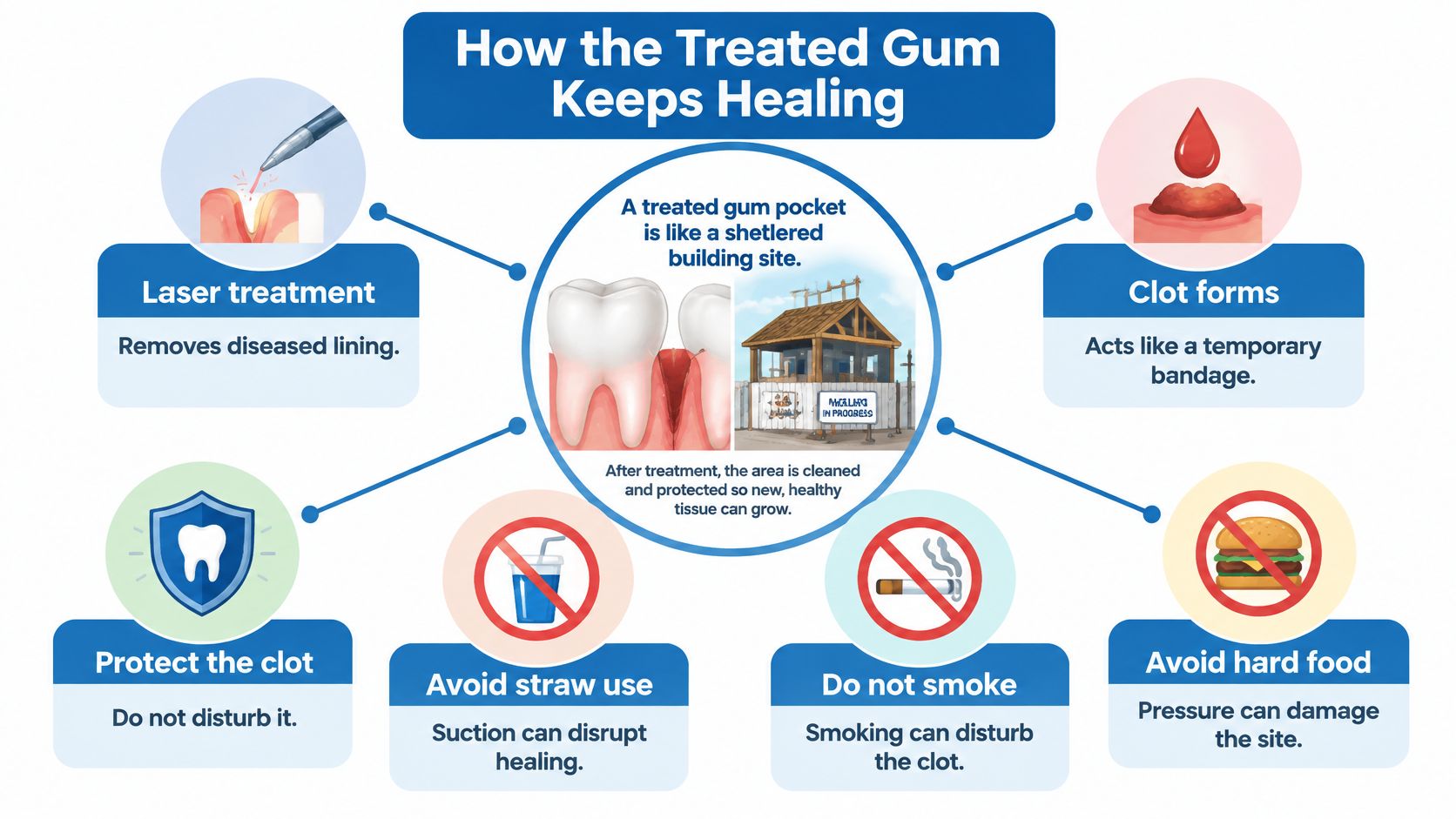
A treated gum pocket is like a sheltered building site. After the laser removes diseased lining, a clot acts as a temporary bandage while the body begins repairing the area.
That bandage needs protection. Suction from a straw, smoking, hard food, or early scrubbing can disturb the healing site instead of helping it recover.
What happens beneath a comfortable surface
Consider a patient whose gums no longer ache during ordinary conversation. The surface may feel calmer, but the tissues supporting the teeth are still changing, so comfort alone doesn't establish that attachment has matured.
In a prospective clinical study, researchers followed 930 periodontal sites in 8 patients with advanced periodontitis for 9 months after full-mouth LANAP; mean pocket depth decreased from 4.62 ± 2.29 mm to 3.14 ± 1.48 mm, approximately 1.48 mm, with a statistically significant change (P < .05). The study was small, so these measurements illustrate possible improvement rather than predict an individual result.
The same publication discusses a separate 12-month follow-up in which attachment improvements present at 6 weeks remained generally stable at 1 year, although plaque and bleeding increased modestly. That pattern helps explain why early improvement and ongoing disease control must be evaluated separately.
Why similar-looking mouths can heal differently
A periodontal pocket is the space measured between the tooth and surrounding gum. Its starting depth matters, but so do root shape, existing bone loss, and whether the problem affects selected sites or much of the mouth.
Healing also depends on factors outside the treatment itself:
- Tooth anatomy: Root grooves and difficult-to-reach spaces can make cleaning harder.
- Treatment extent: Selected-area and full-mouth procedures don't necessarily need identical restrictions.
- General health: Diabetes control can affect the body's repair response.
- Daily habits: Smoking and persistent plaque can undermine tissue stability.
Early comfort is encouraging, but it isn't proof that attachment is finished or lost bone has returned.
The useful expectation is staged improvement, not an instant cure. The periodontist can explain when probing and X-rays will provide meaningful information without unnecessarily disturbing healing tissues.
Patients should compare later findings with their own baseline measurements. Matching a personal recovery to a study average overlooks the differences that determine which teeth need closer observation or additional care.
Pain Swelling and Bleeding in the First Week
Less invasive doesn't mean symptom-free. LANAP may involve modest soreness, but patients shouldn't be promised a particular pain score or a swelling-free recovery.
A 2024 randomized split-mouth clinical trial involving 20 participants reported mean discomfort of 2.40 ± 0.50 for LANAP versus 3.20 ± 0.61 for the comparison treatment. Those scores belong to that study's pain scale, not a universal scale that predicts how an individual will feel.
Soreness is different from a worsening pattern
Some patients notice tenderness when chewing rather than sharp pain at rest. Following the recommended medication plan and avoiding a hard bite on treated tissues may make meals more comfortable.
Swelling may initially increase before easing. Bruising can appear along the cheek or jaw, and teeth may feel different when they meet because the supporting tissues remain inflamed.
Mild temperature sensitivity can also occur. However, a suddenly high bite or a noticeable increase in tooth looseness deserves assessment rather than an assumption that everything is normal.
| Finding | How it should be interpreted |
|---|---|
| Lightly pink saliva early in recovery | May reflect small amounts of postoperative oozing |
| Steady bright bleeding or repeated mouth-filling blood | Requires prompt contact with the treating team |
| Tenderness that gradually becomes easier to manage | Can fit an improving recovery |
| Pain that returns or intensifies after improvement | Needs a call rather than waiting for routine follow-up |
Appearance alone isn't enough to diagnose healing. A dark-looking area shouldn't be scraped, wiped away, or tested with a fingernail.
Medication requires a clear plan
The safest pain-control approach is the one reviewed with the treating periodontist. The choice may depend on other prescriptions, allergies, medical conditions, and whether sedation was used.
- Avoid doubling ingredients: Different products may contain the same pain reliever.
- Check before adding medicines: Aspirin or another anti-inflammatory may not be appropriate alongside the prescribed plan.
- Keep alcohol out of medication decisions: Alcohol can interact with medicines and interfere with safe recovery.
- Report problems promptly: A medicine that isn't helping or causes troublesome side effects requires advice.
Patients shouldn't independently stop an ongoing prescribed medicine, including medically prescribed aspirin, or change doses. Suspected serious medication reactions require urgent medical guidance.
A useful symptom report describes whether discomfort is improving, where it occurs, and whether eating, swallowing, or sleep has changed. That information helps the treating team decide whether reassurance, a medication review, or an examination is needed.
Activity Rest and Habits for Faster Healing
Rest is the main job immediately after LANAP. The aim isn't to force faster healing, but to avoid preventable bleeding, irritation, and strain.
Many postoperative plans temporarily restrict strenuous exercise, heavy lifting, hot tubs, and saunas. Sleeping with the head slightly raised may help with comfort and swelling.
Return to activity by clearance, not ambition
Desk work and light household tasks may be manageable before a physically demanding shift. Patients who received sedation must follow their driving restrictions, and anyone with lingering numbness or medication-related impairment should wait until safe and cleared.
These habits support recovery:
- Leave the gums alone: Fingers, tongue pressure, and repeated inspection can irritate treated tissue.
- Maintain fluids: Drink regularly within the allowed diet.
- Avoid tobacco and vaping: Neither belongs in a healing routine.
- Manage diabetes: Continue the agreed glucose-monitoring and treatment plan, especially when meals change.
- Protect sleep: Fatigue can make soreness harder to manage.
- Limit chewing pressure: Keep food away from treated areas when the plan requires it.
Travel, gym workouts, and contact sports deserve specific clearance. A patient scheduled for a demanding workday should explain the lifting, bending, or driving involved rather than asking whether returning to work is allowed.
Before resuming an activity: The treating team needs to know what the activity actually involves.
Individual results vary, and the periodontist's written plan sets the timing.
Eating and Cleaning While the Clot Settles
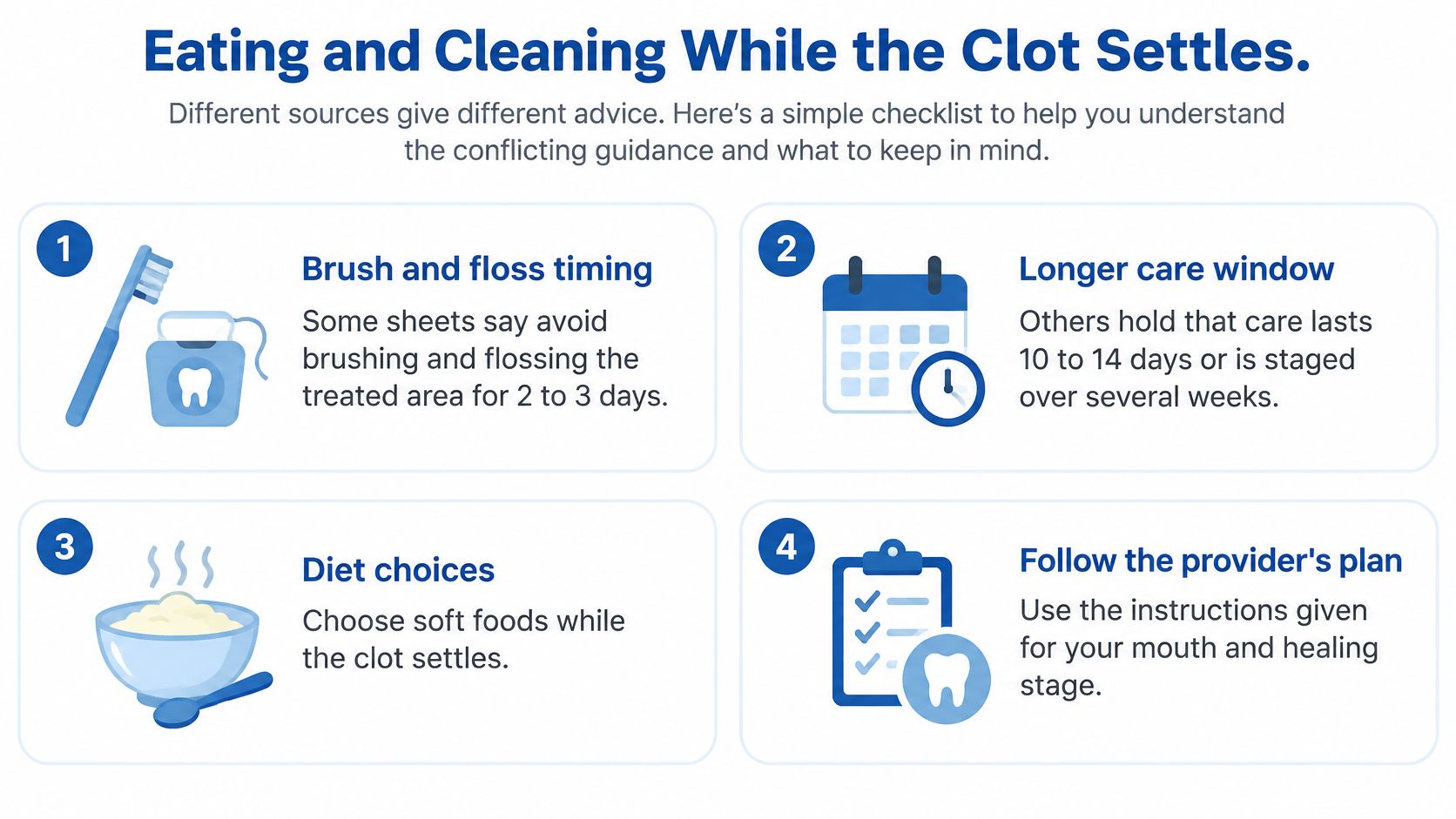
A meal that feels comfortable on the first day may scrape the treated gums a few days later. Food texture and cleaning restrictions usually change in stages, but the schedule depends on the written instructions from the periodontist who performed the procedure.
Food stages after LANAP
| Window | Foods many plans allow | Leave out until cleared |
|---|---|---|
| First 1 to 3 days | Cool liquids taken without a straw, yogurt, eggs, smooth mashed foods if allowed | Hot, spicy, crunchy, or seedy foods, alcohol if restricted, smoking or vaping |
| Days 4 to 14 | Soft proteins, pasta, cooked vegetables, thicker foods only if the plan allows | Chips, nuts, crusty bread, popcorn, anything that scrapes the gums |
| After clearance | A gradual return toward usual textures | Foods that still hurt, plus tobacco at every stage |
Published postoperative protocols differ on when brushing, flossing, and food progression should begin. The treating periodontist's written plan should set the schedule for the procedure performed. A restriction on cleaning the treated area does not automatically mean the entire mouth must go uncleaned.
A workable home routine
Preserve nutrition. Cool yogurt, smooth blended foods, and allowed soft proteins can help maintain calories and protein. If the plan calls for liquids, choose nourishing options rather than relying on water and juice alone.
Use a spoon or cup, not a straw. Smoothies should be free of seeds or hard pieces and thin enough to avoid chewing.
Avoid foods that scrape. Chips, nuts, popcorn, and crusts can irritate delicate tissue. Keep smoking and vaping out of the routine, and avoid alcohol whenever the medication or surgical plan restricts it.
Coordinate meals and medicine. If medication must be taken with food, an allowed soft meal may be enough. If nausea or vomiting prevents you from taking doses, call the treating team rather than skipping treatment without advice.
Clarify what can be cleaned. Ask whether untreated teeth can be brushed and whether flossing has separate restrictions. Once treated-area cleaning is allowed, use a soft toothbrush and the technique shown by the periodontist rather than scrubbing.
Follow the rinsing instructions. An unapproved rinse or forceful swishing may conflict with the aftercare plan.
Questions that prevent avoidable mistakes
Before leaving, ask which teeth can be brushed, when flossing may resume, and what food texture comes next. If hot or cold sensitivity persists and makes eating difficult, contact the treating team for guidance. The written instructions are the best guide because home-care schedules vary by protocol and procedure.
Follow-Up Visits After the Laser Day
Your first follow-up may come while the treated gums are still healing. Visits provide checkpoints: the periodontist can assess progress and adjust the home-care plan as the tissue allows. Follow the written instructions from your treating periodontist, since one patient's schedule is not a universal protocol.
| Checkpoint | Main purpose |
|---|---|
| Early postoperative review | Examine tissue condition and discuss symptoms |
| Subsequent healing check | Review healing and clarify the next care steps |
| Transition to maintenance | Set professional cleaning and monitoring needs |
| Later reassessment | Evaluate pocket depth, bleeding, and disease stability |
At each visit, the periodontist can determine which parts of the plan may change. A restriction on one step does not automatically set the timing for every other step, so ask for clear instructions about what is permitted now and what comes next.
What the periodontist checks
The focus can shift from one appointment to another. The periodontist may review how the tissue is healing, discuss symptoms, and decide whether professional cleaning or a change in the care plan is appropriate.
The schedule depends on the procedure and the patient's circumstances. An extraction or another procedure performed alongside LANAP may add separate instructions. Ask the team to confirm the next appointment and explain what each visit is meant to assess.
Questions worth bringing to each visit
- Next steps: What should change in my care plan before the next appointment?
- Food progression: Which textures are safe to add, if my plan allows a change?
- Bite concerns: Does a particular tooth still seem to meet first?
- Maintenance needs: How often should professional care continue?
Periodontal maintenance provides ongoing professional care for people with a history of periodontal disease. Ask how that care fits into your individual follow-up plan.
What a Later Reassessment Can Show
Later reassessment answers a different question from an early healing visit: not whether the gums feel comfortable, but whether the treated sites have become easier to maintain.
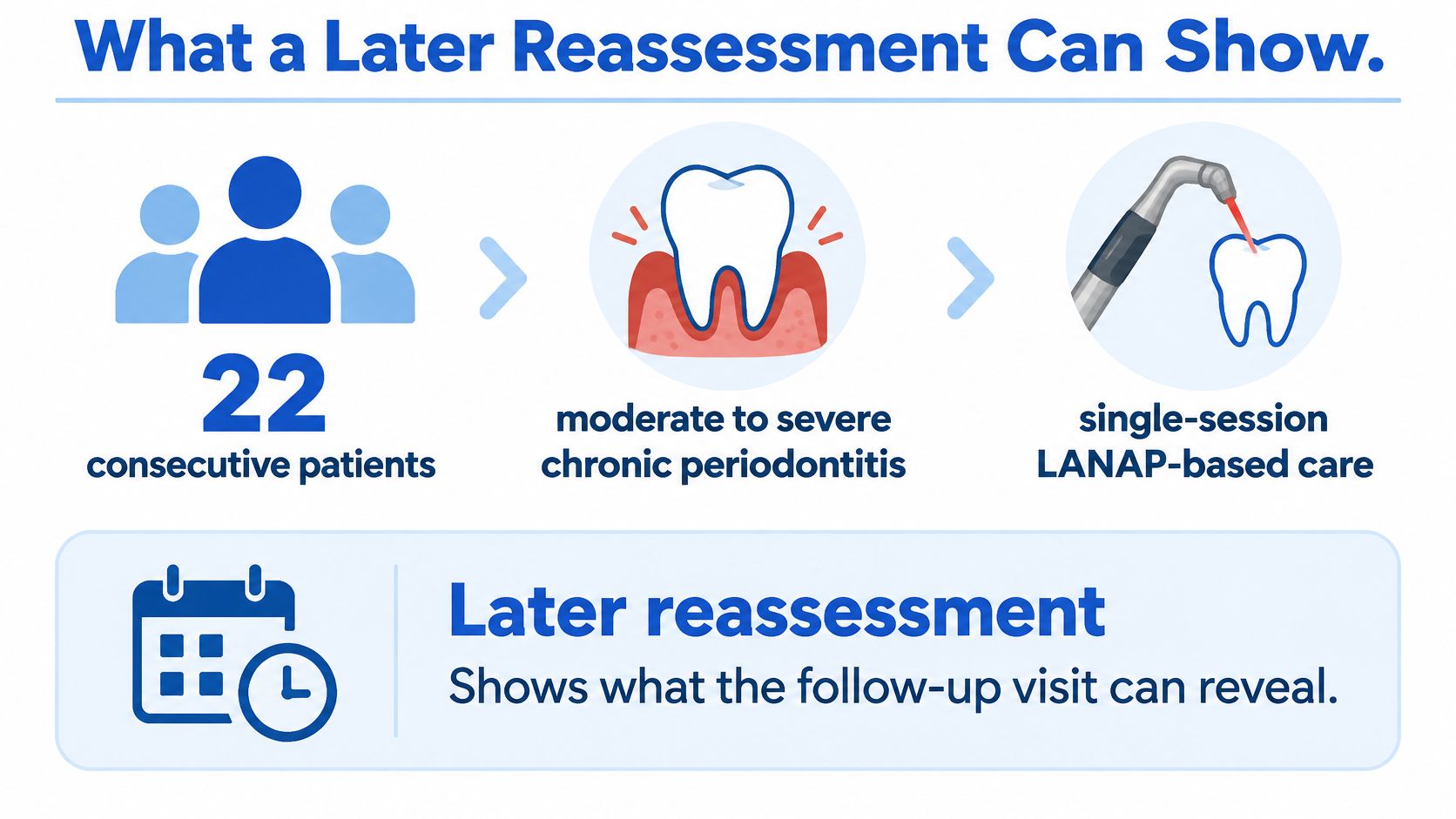
A retrospective case series followed 22 consecutive patients with moderate to severe chronic periodontitis after single-session LANAP-based active therapy, with starting pockets as deep as 11 mm; all completed reassessment at 12 to 18 months, when 93.5% of recorded probing depths were 3 mm or less, 40% of grade-2 furcation involvements had clinically closed, and mean recession was 0.1 mm.
This was a small retrospective series, not a warranty. The results don't establish that every deep pocket will become shallow or that every compromised tooth can be retained.
What those measurements mean
Probing depths describe measured spaces around teeth, not the percentage of patients cured. Shallower sites may be more manageable, but bleeding and plaque still matter.
A furcation is the area where a multirooted tooth's roots divide. Clinical closure in some affected sites is encouraging, but difficult molar anatomy can remain a maintenance challenge.
Mean recession describes average gum-margin change across the series. A small average doesn't mean every tooth had the same change or that LANAP treats every existing recession defect.
The guide to pocketing in teeth provides context for why measurements around individual teeth matter. The periodontist must interpret them alongside mobility, bone support, inflammation, and cleaning access.
Two possible paths after early comfort
Consider a patient who feels well soon after treatment and stops attending maintenance. Plaque and bleeding may return without enough pain to prompt an appointment, leaving the patient unaware that disease control has weakened.
Another patient keeps the prescribed maintenance visits and has residual problems identified during reassessment. The periodontist can then discuss targeted treatment, recession management, grafting, or replacement planning where a tooth cannot reasonably be maintained.
- Smoking and diabetes: These can alter the likelihood of stable healing.
- Anatomy and hygiene: Difficult access may require a more customized cleaning strategy.
- Original disease severity: Advanced damage can limit what treatment can accomplish.
Persistent mobility doesn't automatically require extraction, but it warrants a prognosis discussion. LANAP manages periodontal disease; it doesn't replace daily cleaning, professional care, or decisions about teeth with a hopeless outlook.
Call or Book When Healing Changes Course
Ordinary soreness should be distinguished from symptoms that worsen, interrupt medication, or suggest infection. Patients don't need to diagnose the problem before contacting the treating team.
Symptoms that need prompt attention
- Bleeding: Blood that won't slow, repeated bright bleeding, or bleeding that returns after settling.
- Increasing swelling: Swelling that continues to grow after the early postoperative period, particularly after day three.
- Worsening pain: Pain that rises after improvement or isn't eased by the recommended medicine.
- Possible infection: Fever, drainage, or a persistent bad taste accompanied by worsening symptoms.
- Tooth or bite changes: A tooth that becomes much looser or a bite that suddenly feels high.
- Medication problems: Rash, repeated vomiting, or nausea that prevents prescribed doses.
- Uncertainty: A symptom that doesn't match the written instructions.
Trouble breathing or significant difficulty swallowing requires emergency medical care, not waiting for an appointment. Rapidly spreading swelling or signs of a severe allergic reaction also require emergency attention.
Patients shouldn't start leftover antibiotics or change treatment on a guess. When recovery follows the expected course, the next steps remain the written diet and cleaning dates, tobacco avoidance, and scheduled reviews.
Individual results vary, and an article cannot diagnose a mouth or replace consultation with a periodontist. Adults across New Castle and Kent Counties, including Wilmington, Newark, Pike Creek, Hockessin, Bear, Middletown, Dover, and surrounding communities, can have expectations matched to their pocket depths, bone loss, and personal instruction sheet.
The board-certified team at Periodontal Associates of Delaware provides LANAP evaluation, individualized recovery guidance, and ongoing periodontal care. Patients considering treatment or concerned about healing can request an appointment at the nearest Wilmington, Newark, or Dover office to review symptoms, treatment options, and the next appropriate step.