Laser gum surgery may suit selected patients, but its value depends on the treatment protocol and the condition being treated. The word “laser” covers different approaches, and pocket depth, bone support, risk factors, and maintenance all shape the decision.
Popular advice can treat a laser as an automatic upgrade. A short laser add-on and a defined laser sequence are different protocols, and treatment should match the disease stage, including whether scaling and root planing is appropriate. Added pocket-depth differences are generally modest, so the patient's diagnosis and goals matter more than the device label. Comfort matters to people who dread surgery, but the decision should also account for long-term tooth support and continued maintenance.
Table of Contents
- Is Laser Gum Surgery Worth It? The Short Answer
- How LANAP Differs From Conventional Gum Surgery
- Pocket Reduction and Attachment Gain Results Compared
- Regeneration Evidence and How Long Results May Last
- Recovery, Discomfort and Procedure Risks Compared
- Cost, Maintenance and Long-Term Value
- Confirm Whether Laser Gum Surgery Fits Your Gum Condition
Is Laser Gum Surgery Worth It? The Short Answer
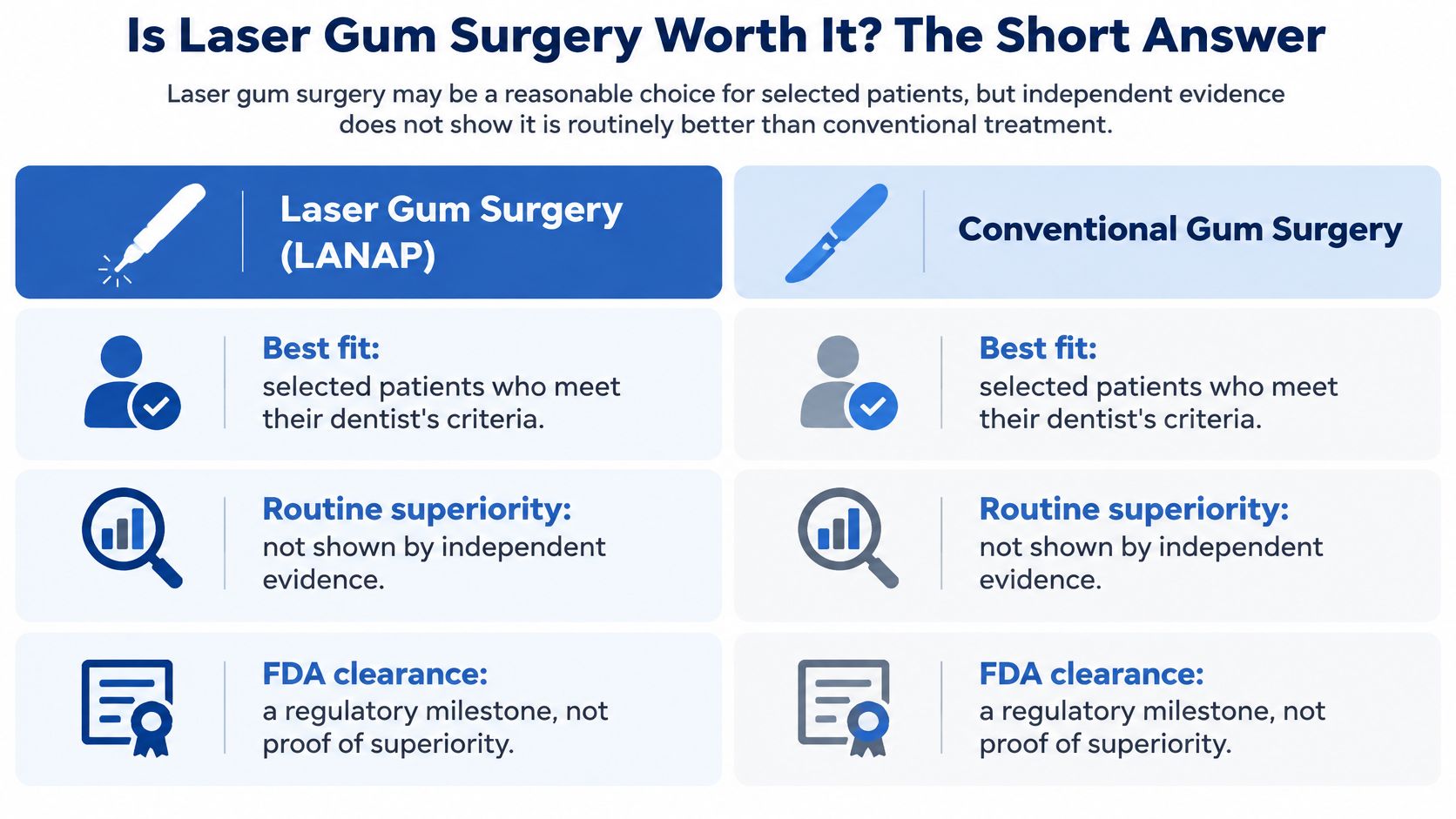
Worth depends on the treatment protocol, the condition of the gums and bone, and whether the patient can maintain the result. The word “laser” alone does not establish that a procedure is a better fit. Different devices and treatment goals are often grouped together, even though they do not represent one uniform approach.
The American Academy of Periodontology best-evidence consensus found insufficient evidence to conclude that laser therapy alone is superior or equivalent to conventional therapy for probing depth or clinical attachment level in moderate-to-severe chronic or aggressive periodontitis. For lasers added to periodontal surgery, most available evidence showed no additional clinical benefit beyond surgery alone. The practical comparison is therefore with established infection control, including scaling and root planing or surgery when indicated.
Gum treatment options at a glance
| Treatment | How it works | Best-fit situation | Strength of evidence |
|---|---|---|---|
| LANAP with PerioLase MVP-7 | Laser used in a minimally invasive protocol, typically without lifting a full gum flap | Selected pockets where a periodontist judges the approach suits the patient | Mixed; many studies are small or short-term |
| Scaling and root planing | Deep cleaning above and below the gumline without surgery | Early to moderate disease and first-line care | Strong base for infection control; long-term data well established |
| Open flap (osseous) surgery | Gum tissue is lifted to clean root surfaces and reshape bone | Deeper pockets and bone defects that need direct access | Long-established; comparable to laser in consensus reviews |
| Regenerative grafting | Graft materials and membranes support new bone and attachment | Defined bone defects with walls that can hold a graft | Strongest for contained defects treated with a defined protocol |
The decision turns on three features: diagnosis, pocket depth and anatomy, and the complete maintenance plan. A pocket's shape and the amount of supporting bone help determine whether access, cleaning, or regeneration is the main treatment need. Risk factors and the ability to keep up with maintenance also affect the likely value of a chosen protocol. LANAP with the FDA-cleared PerioLase MVP-7 is one option among these approaches, selected according to the patient's condition and treatment goals.
How LANAP Differs From Conventional Gum Surgery
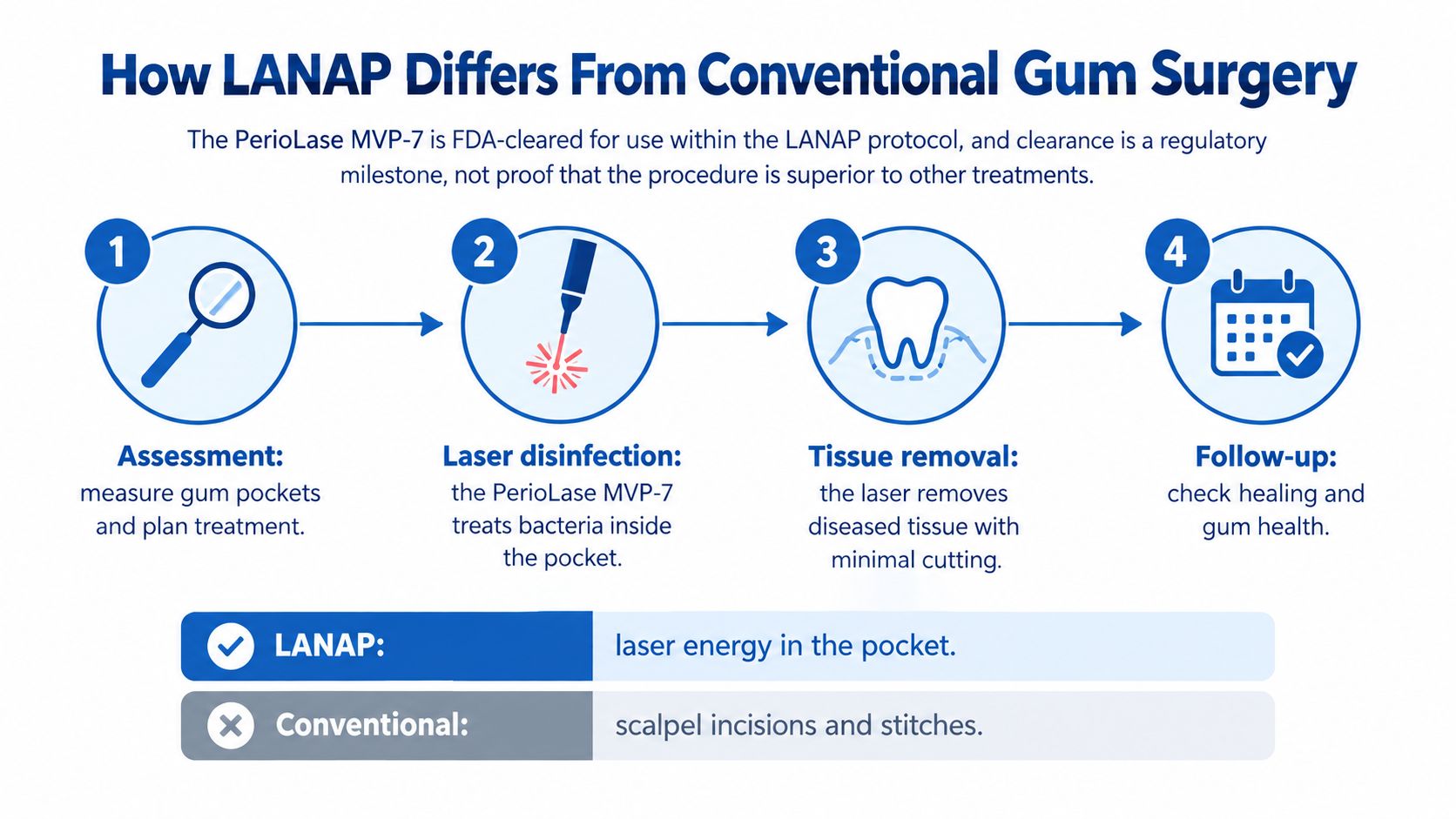
The PerioLase MVP-7 is FDA-cleared for use within the LANAP protocol, and clearance is a regulatory milestone, not proof the procedure beats other treatments.
Manufacturer milestones for the PerioLase and LANAP note that the PerioLase device was cleared by the U.S. FDA in 1999, received clearance for laser curettage and enamel-caries removal in 2001, and the LANAP protocol received FDA clearance in 2004 for cementum-mediated periodontal-ligament new attachment. Those dates don't show LANAP is superior to flap surgery, scaling and root planing, or regenerative procedures across all disease severities. Results still shift with study design, disease type, operator technique, maintenance, smoking, diabetes, oral hygiene, and follow-up length.
Two sequences, side by side
LANAP, described in general terms:
- Measure pocket depths and map the disease.
- Numb the area.
- Use the laser to treat the diseased pocket lining.
- Remove deposits from root surfaces.
- Confirm bleeding control and review aftercare.
- Return for follow-up and maintenance.
Conventional flap surgery:
- Numb the area.
- Lift the gum flap.
- Clean root surfaces and reshape bone if needed.
- Reposition and stitch the tissue.
- Remove sutures after about one to two weeks.
LANAP typically avoids lifting a full gum flap, which is why many patients ask about it. Flap surgery gives the periodontist direct sight of bone defects and root surfaces that a pocket approach can't fully show. Exact steps change with the protocol and the case. The periodontist selects the approach after reviewing imaging, including i-CAT 3D cone beam imaging.
Judge the proposal on pocket-depth reduction, attachment gain, bleeding control, tooth survival, side effects, maintenance, and out-of-pocket cost, not on a clearance date.
Pocket Reduction and Attachment Gain Results Compared
Laser results depend on the protocol and the condition being treated. Probing depth measures the space between gum and tooth; clinical attachment level measures how much supporting tissue remains attached. These outcomes help distinguish a small change in pocket measurements from a meaningful improvement for a particular tooth.
Reported pocket and attachment results
| Comparison | Probing depth change | Attachment level change | What it means |
|---|---|---|---|
| Laser alone vs mechanical treatment (review of controlled trials) | 0.14 mm weighted mean difference (95% CI -0.04 to 0.32; p=0.132) | 0.04 mm weighted mean difference (95% CI -0.35 to 0.42; p=0.850) | No statistically significant difference |
| Diode laser added to scaling and root planing, 3 to 6 months (review of controlled trials) | About 0.30 to 0.32 mm improvement | About 0.35 mm at 3 months; about 0.12 mm at 6 months | Small, short-term added benefit |
| Moderate-to-severe periodontitis, 28 randomized trials (Cochrane review of 28 randomized clinical trials) | Some laser approaches significant | Some laser approaches significant | Differences generally under 1 mm; certainty low to moderate |
| Laser added to periodontal surgery | No clear extra reduction in most evidence | No clear extra gain in most evidence | Most available evidence shows no added benefit beyond surgery alone |
The 0.14 mm figure is the estimated average difference in probing depth between laser alone and mechanical treatment. Its confidence interval crosses zero, and the reported result was not statistically significant, so it does not establish an advantage for laser. The 0.35 mm attachment change with diode laser was measured at three months; by six months, the reported change was about 0.12 mm. These are small average differences, not a prediction of what will happen at every site.
The Cochrane review found statistically significant gains with some laser approaches, but differences from scaling and root planing were generally less than 1 millimeter, with low-to-moderate certainty. Laser added to periodontal surgery also showed no clear extra reduction in pockets or gain in attachment in most of the available evidence.
What a fraction of a millimeter means
A fraction of a millimeter may have little noticeable effect on chewing or how a tooth feels. It can still matter at a specific site, particularly if a small measurement change affects bleeding or how easily the area can be cleaned. Across several teeth, modest changes may add up, but they do not make laser treatment a substitute for mechanical cleaning.
Time matters too. The diode-laser attachment result was larger at three months than at six months, so an early difference should not be treated as a lasting benefit. Smoking, diabetes control, daily plaque removal, and maintenance visits can influence the outcome alongside the treatment method. Whether a laser protocol is worthwhile therefore depends on the patient's pockets, remaining support, risk factors, and ongoing care, not on the word “laser” alone.
Regeneration Evidence and How Long Results May Last
The seven clinical investigations in a 2025 scoping review offer a limited test of whether periodontal lasers can regenerate tissue. The review found 15 total studies, but the clinical evidence comprised only three randomized controlled trials and four case reports. In a 2025 randomized trial of 45 patients, LANAP combined with low-level laser therapy produced better clinical and radiographic outcomes than scaling and root planing alone at 12 months, as described in the 2025 scoping review of laser use in periodontal regeneration. Small samples, incomplete reporting of randomization, unblinded operators and outcome assessors, and moderate-to-high risk of bias limit how confidently those results can be applied to other patients.
What FDA clearance covers
The March 2016 FDA 510(k) clearance for the PerioLase MVP-7 covers regeneration of new cementum, periodontal ligament, and alveolar bone on a previously diseased root surface when the device is used within the LANAP protocol. Clearance defines the device's permitted use; it does not establish that a particular patient will regenerate tissue or avoid conventional surgery. The likely value depends on the patient's pocket depths, bone defects, tooth stability, medical history, and ability to maintain home care.
What long-term evidence can show
Improved probing depth or a better bone outline on an X-ray has not been clearly linked to fewer lost teeth, fewer repeat procedures, or better daily life over five to ten years. Evidence is not yet sufficient to support lasers as monotherapy, and long-term randomized trials are still needed. The findings vary by protocol and study, so they do not establish a durable advantage for every patient.
i-CAT 3D cone beam imaging can help measure a bone defect's shape before a regenerative approach is considered. Ask for baseline pocket and bone measurements, a defined treatment endpoint, a maintenance plan, and a backup option if pockets remain deep. A laser protocol may suit some defects and patients, but it is not a guaranteed replacement for conventional surgery.
Recovery, Discomfort and Procedure Risks Compared
A laser does not guarantee an easier recovery, and an easier recovery does not establish better disease control. The relevant comparison is between specific procedures: discomfort, eating restrictions, bleeding, and the risks each carries. Patients should weigh comfort alongside how well the proposed treatment fits their gum condition.
Recovery and risk comparison by treatment
| Factor | LANAP (laser) | Flap surgery | Deep cleaning |
|---|---|---|---|
| Anesthesia | Local numbing typical | Local numbing typical | Numbing used when needed for comfort |
| Typical discomfort | Pain or discomfort can occur during recovery | Usually the most soreness of the three | Sensitivity for several days is common |
| Bleeding and swelling | Bleeding is possible, with added concern for bleeding disorders or anticoagulant use | Bleeding and swelling are expected for several days | Minor bleeding and tenderness |
| Sutures | Not always needed | Commonly placed and removed after about one to two weeks | Usually none |
| Return to normal eating | Soft foods may be needed during recovery | Soft foods for about a week or longer | Usually immediate |
| Main procedure-specific risk | Incorrect settings or handling can burn healthy tissue; eye protection is required | Gum recession, sensitivity, and delayed healing | Sensitivity or incomplete removal of deposits |
A peer-reviewed review of laser procedure risks reports that incorrect laser settings or handling can burn healthy oral tissues. Uncontrolled heat can injure teeth or bone, potentially contributing to sensitivity or structural damage. Recovery can also involve discomfort and postoperative bleeding, with bleeding a particular concern for people with bleeding disorders or those taking anticoagulant medication. Eye protection is required because laser exposure can injure the eyes.
Flap surgery carries a different set of problems
Lifting the gum can cause recession, longer-looking teeth, and root sensitivity. Stitches may tug, while plaque at the gum margin can slow healing. These trade-offs differ from laser heat injury, and the clinician's training and chosen protocol matter for either approach.
The guide to laser gum surgery healing time outlines day-by-day recovery expectations. Use those expectations to discuss eating, discomfort, and follow-up with the periodontist, then weigh them against the goal of controlling disease. The right choice depends on the individual's pockets, bone condition, risk factors, and ability to follow the treatment and maintenance plan. Comfort is one part of that decision, not a substitute for assessing whether the procedure is appropriate for the disease.
Cost, Maintenance and Long-Term Value
The procedure fee is only one part of what a patient pays. A systematic review of lasers used with scaling and root planing found that cost-effectiveness data were lacking, and that benefits alongside scaling and root planing were generally short-term, with differences no longer significant at follow-ups of six months or more. A higher fee needs a measurable benefit for that person, not a technology label.
What actually adds up
- Procedure fee: This covers the treatment visit, not the year of care around it.
- Visit count: Surgery or deep cleaning, follow-up checks, and imaging all belong on the list.
- Maintenance cleanings: These continue after laser care, flap surgery, or non-surgical therapy.
- Retreatment: Pockets that don't respond may need another procedure, and that second step can change the total substantially.
Insurance coverage varies by plan. A practice can't guarantee what any plan will pay. Financing questions are best answered at a consultation, not from a general article. Ask for a written estimate that puts the laser approach next to a conventional alternative. A fuller walk-through sits in this overview of laser gum treatment cost.
Three questions before booking:
- What the quoted fee includes: Imaging, the procedure, and early follow-up, or only the laser time.
- How many visits are planned in the first year: Treatment plus maintenance, written out.
- What the plan is if pockets persist: The next step, and whether that step is already priced.
If conventional cleaning can reach a similar longer-term result, the premium has to earn its place through comfort, anatomy, or a specific defect, not through the word laser.
Confirm Whether Laser Gum Surgery Fits Your Gum Condition
The right treatment follows the diagnosis, not the device on the tray. Pocket depth, bone shape, bleeding, tooth stability, medical risks, and whether home care will hold all change the answer.
When laser treatment may fit and when conventional care is often preferred
| Situation | Laser may be considered | Conventional treatment often preferred |
|---|---|---|
| Moderate pockets, good home care, responsive to cleaning | Possible, especially if comfort is a priority | Scaling and root planing first |
| Deep defects with bone loss needing access or grafting | Case-by-case decision | Open flap or regenerative surgery |
| Smoking or uncontrolled diabetes | Outcomes may be limited with either approach | Address risk factors first |
| Bleeding disorder or anticoagulant therapy | Requires careful medical review | Medical clearance and team coordination first |
| Unreliable plaque control | Maintenance and home care come first | Non-surgical therapy and coaching |
| Strong anxiety about traditional surgery | Worth discussing with the periodontist | Discuss sedation and comfort options |
Say someone in Middletown has 5 millimeter pockets, light bone loss, and steady brushing. Scaling and root planing is usually the first test of whether the sites will respond. Say someone in Dover has deep, irregular bone defects around several teeth. Direct access or a graft is often the clearer path, and a laser protocol is only one option on that list.
Gum recession and missing teeth
Gum recession needs its own look. The periodontist checks whether tissue grafting, conventional surgery, or laser treatment fits the defect, and how much gum is already there. A pocket protocol doesn't automatically cover an exposed root.
Missing teeth change the order of care. Gum and bone health come first. Implant planning may use i-CAT 3D cone beam imaging with X-Nav dynamic surgical navigation to guide placement. Laser gum treatment doesn't replace a planned tooth replacement, so both needs are assessed together. How pocket numbers guide that choice is covered in this discussion of pocketing in teeth.
What the exam should include
At Periodontal Associates of Delaware, a thorough visit includes a periodontal exam, i-CAT 3D cone beam imaging to assess bone, and a discussion of LANAP with the PerioLase MVP-7 alongside conventional options. Offices in Wilmington, Newark, and Dover see adults across New Castle and Kent Counties, including Pike Creek, Hockessin, Bear, Middletown, and nearby towns. Individual results vary, so readers should consult a periodontist before deciding.
Request an appointment at the nearest Wilmington, Newark, or Dover office through the online appointment page.
Periodontal Associates of Delaware provides board-certified periodontal care, including LANAP with the FDA-cleared PerioLase MVP-7 when it fits, and conventional treatment when that is the stronger match. If gum disease, recession, bone loss, or missing teeth are the concern, a measured exam is a better start than a technology headline. Visit Periodontal Associates of Delaware to request an appointment at the Wilmington, Newark, or Dover office closest to you.