Does osseous surgery rebuild lost bone or change how a pocket can be cleaned? It changes the bone's contour through a lifted gum flap, giving the clinician access to clean a deep pocket and, in some cases, making the area easier to keep clean afterward. It does not regrow bone that has already been lost.
A deep cleaning can leave pockets that still need a closer look. The decision to reshape bone depends on whether an uneven edge affects the gum's position and makes daily cleaning difficult. Pocket depth is one part of that assessment, not an automatic reason for surgery.
For adults across Wilmington, Newark, Pike Creek, Hockessin, Bear, Middletown, and Dover, “bone surgery” may bring to mind either exposing a tooth completely or building new bone. Osseous surgery is different: it may involve a small, planned change in bone contour to reduce a pocket. The trade-off can include a slightly longer-looking tooth and a root that is more sensitive to cold.
A periodontist reviews probing measurements and images with the patient before discussing whether surgery fits the situation. The goal is to weigh access for cleaning against changes in gum coverage and tooth sensitivity.
Table of Contents
- What Osseous Surgery Actually Does
- Pocket Depths That Guide the Decision
- What Pocket Reduction May Cost You
- Other Treatments Besides Bone Reshaping
- How the Visit Usually Proceeds
- Healing Week by Week After Surgery
- Request an Evaluation at the Nearest Office
What Osseous Surgery Actually Does
Could an uneven bone edge be keeping a deep pocket hard to clean? Consider a lower first molar after deep cleaning. If the pocket on its tongue side remains deep, an irregular ridge of bone between the teeth may keep the gum from settling close to the tooth. It is like a warped windowsill that prevents a window from closing flush, leaving a narrow ledge where biofilm can collect.
Osseous surgery changes the shape of the alveolar bone supporting teeth to help the gum lie closer and make remaining pockets easier to clean. The American Academy of Periodontology parameters on prognosis and treatment planning describe two approaches. Osteoplasty reshapes or thins bone that does not support the tooth, such as thick ledges. Ostectomy removes some supporting bone to correct craters or sharp edges left by disease.
The aim is a more even contour, better access to clean roots, and fewer pockets that remain difficult to maintain. A periodontist may consider the procedure when deep pockets persist after nonsurgical treatment and irregular bone contours remain around teeth that can still be maintained. The AAP parameters report that osseous surgery can reduce probing depths when initial pockets exceed 4 mm.
Reshaping is not regrowth
During surgery, the gum is lifted so the clinician can see the root, remove tartar and inflamed tissue, and adjust uneven bone. This resective approach may remove a small amount of bone to create a contour the gum can adapt to. Regenerative procedures instead aim to rebuild lost attachment and bone. The choice depends on the defect's shape, remaining pocket depth, tooth outlook, smile concerns, and the patient's ability to control plaque.
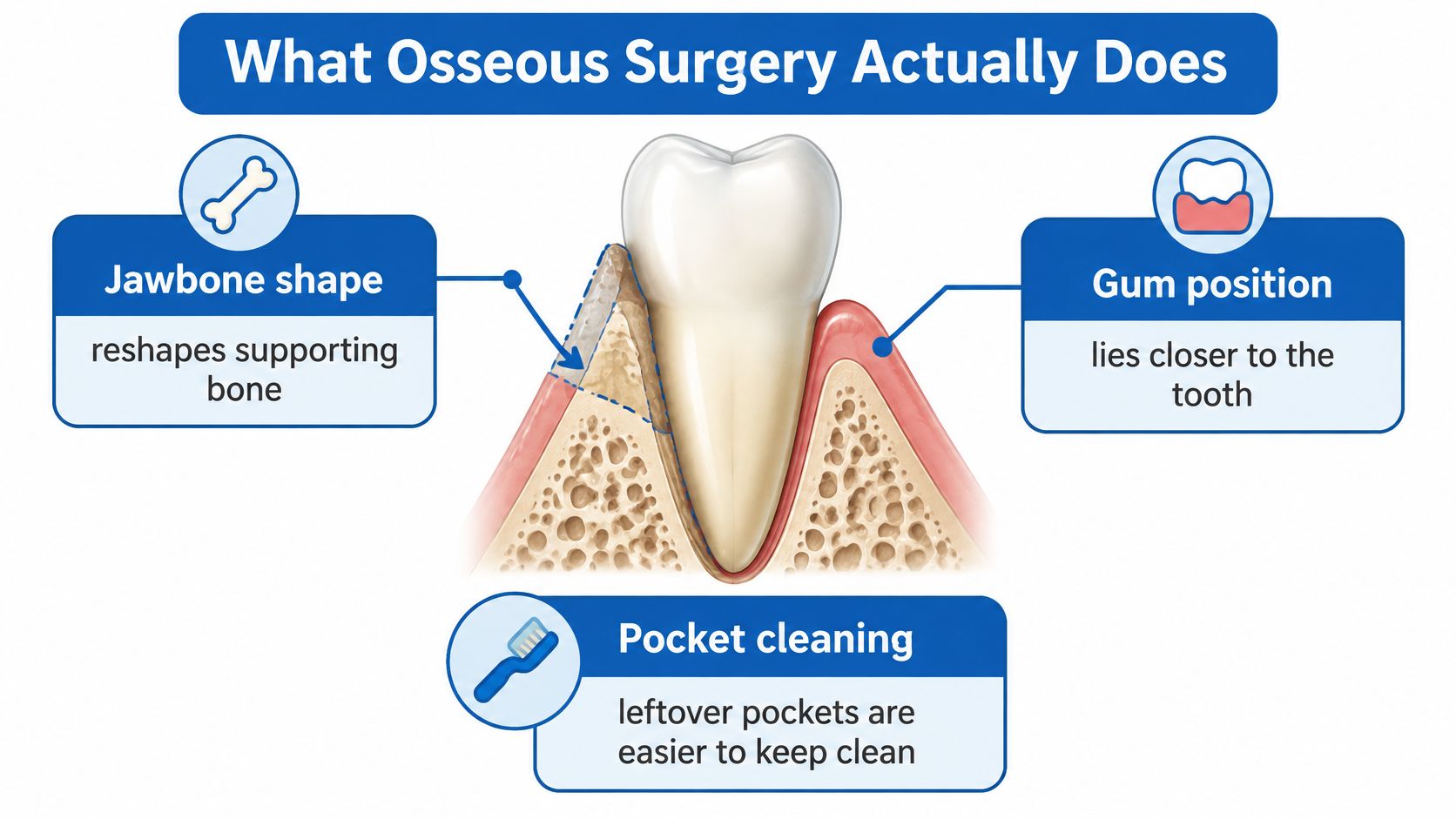
The procedure is a targeted change to the bone's shape, not a response to every pattern of bone loss. Its practical purpose is to make the area more accessible for cleaning. The trade-off is that removing supporting bone can affect the gum line and how long the tooth appears.
Pocket Depths That Guide the Decision
Pocket depth helps show how much access treatment may need to create, but it does not decide the treatment by itself. The figures below summarize published comparisons, with their sources linked in the relevant findings. They describe group averages, not an individual tooth's expected result.
| Starting pocket | Compared with | Probing-depth finding | Attachment finding |
|---|---|---|---|
| Deeper than 6 mm | Nonsurgical treatment at 12 months | About 0.6 mm more reduction with surgery | About 0.2 mm more gain with surgery |
| 4 to 6 mm | Nonsurgical treatment | About 0.4 mm more reduction with surgery | About 0.4 mm more gain with nonsurgical care |
| Greater than 4 mm | General osseous references | Substantial probing-depth reduction reported | Site by site, not one number |
| Around 7 mm | Scaling and root planing | Often the largest depth reduction | More gum recession than scaling alone is possible |
| About 5 to 6 mm | Modified Widman flap or root planing | Greater depth reduction with osseous surgery | Not the main reported advantage |
| 7 mm or more | Other surgical groups | Superior pocket-depth reduction | Broadly similar attachment results |
| Sites tracked to 12 months | Pocket threshold of 4 mm or less | About 98 percent weighted mean met that threshold | Not proof of tooth retention or regrowth |
What the millimeters actually compare
For pockets deeper than 6 mm, periodontal surgery produced approximately 0.6 mm more probing-depth reduction and 0.2 mm more clinical-attachment gain at 12 months than nonsurgical treatment, according to evidence summarized in StatPearls. For 4 to 6 mm pockets, surgery produced about 0.4 mm more pocket-depth reduction, while nonsurgical treatment produced about 0.4 mm more attachment gain.
The same summary reports substantial probing-depth reduction with osseous surgery for pockets greater than 4 mm. Pockets around 7 mm may show the largest reduction, with more gum recession possible than after scaling and root planing alone. A shallower pocket can make cleaning access easier, but removing or reshaping bone is a trade-off the clinician weighs against the site's condition.
A 4 mm threshold measures pockets, not tooth survival
The 2020 systematic review and meta-analysis reported an approximately 98 percent weighted mean of treated sites at 4 mm or less at 12 months for osseous resective approaches. That measurement describes pocket depth. It does not establish that a tooth will be retained or that lost bone has regrown. The review also reported greater depth reduction than with modified Widman flap surgery or root planing for pockets about 5 to 6 mm, and superior reduction with broadly similar attachment results for pockets 7 mm or more.
Measurements can vary by tooth, surface, swelling, and examiner. Charting and imaging help the periodontal team assess the site rather than relying on one probe reading. For background on how pockets in teeth are measured, see this guide. Depending on the defect and the patient's risks, an access flap, regeneration, laser therapy, or further nonsurgical treatment may be considered instead.
What Pocket Reduction May Cost You
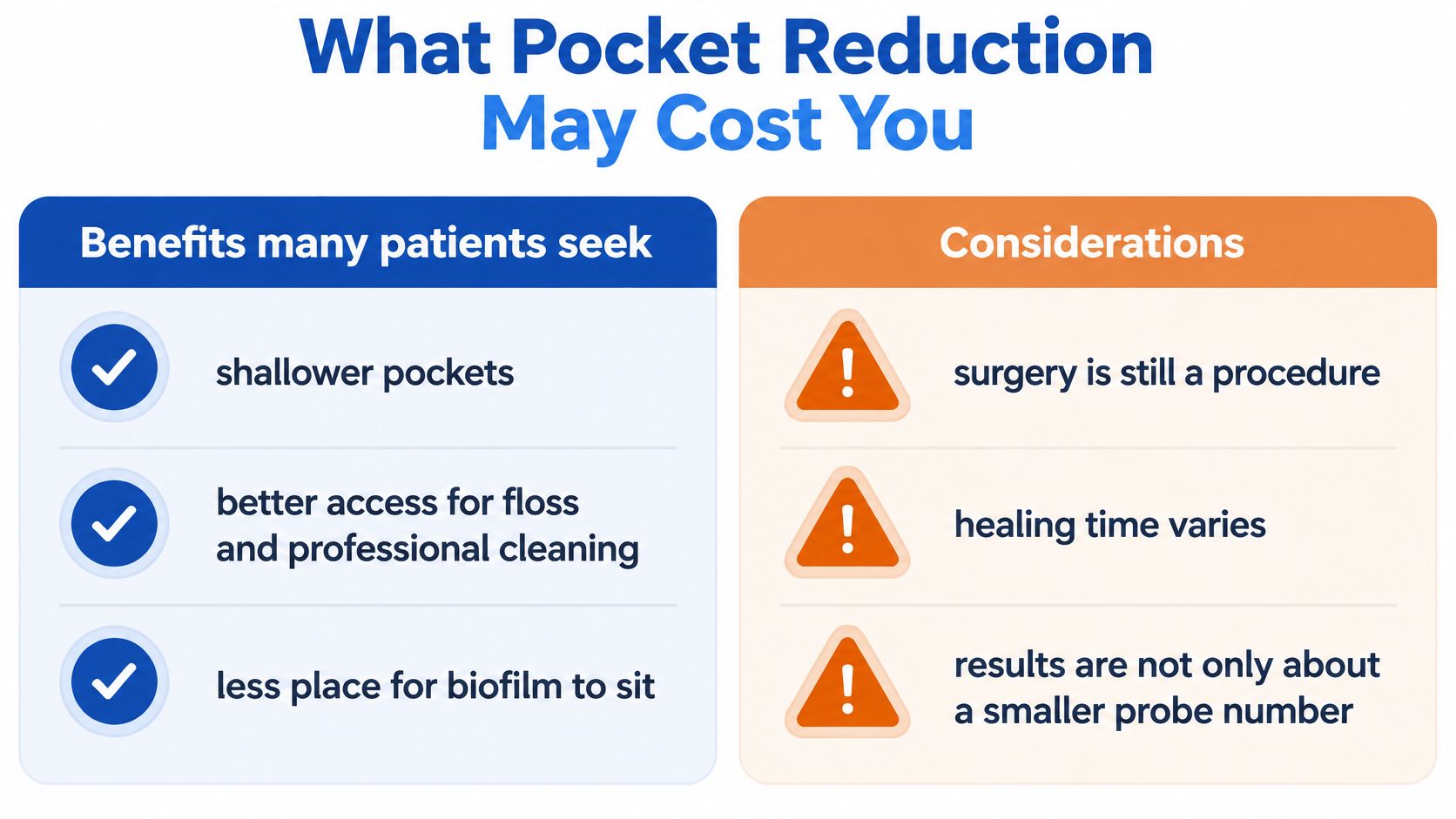
What can pocket reduction improve, and what may change along with it? The goal is a shallower pocket that a toothbrush, floss, and hygienist can reach more easily. When an uneven bone contour creates a sheltered space for biofilm, reshaping may make the area easier to clean. The procedure is about access and cleansability, not automatic bone regrowth.
That improvement can involve removing a small amount of supporting bone and lowering the gumline. A 2025 clinical comparison found similar 12-month pocket-depth improvement with a less-resective, fiber-preserving technique. In conventional osseous resective surgery, ostectomy averaged 1.0 ± 0.3 mm, compared with 0.4 ± 0.2 mm with the less-resective technique. The conventional approach also showed greater clinical attachment loss, 2.2 ± 1.0 mm versus 1.0 ± 0.6 mm, more radiographic bone resorption, 0.43 ± 0.08 mm versus 0.13 ± 0.09 mm, and more postoperative discomfort.
Questions worth asking before resection
These measurements describe trade-offs, not a reason to avoid surgery in every case. A pocket may become easier to maintain while the tooth looks longer or has less supporting tissue.
- Could the crown look longer? The gumline may sit lower where bone is reshaped.
- Could a front tooth be more noticeable? A high smile line, thin gums, already exposed roots, or a loose tooth can make tissue changes more important to discuss.
- Could another approach fit the defect? A fiber-preserving technique or regeneration may be considered when reducing tissue change is a priority.
A long-term periodontal summary describes a split-mouth study in which resective surgery reduced probing depths more than curettage in 4–6 mm pockets at five years, with outcomes comparable to modified Widman flap surgery. These findings show pocket-depth reduction, while attachment and tooth retention remain separate outcomes to consider.
Effects many patients notice
After surgery, temporary soreness, swelling, bleeding, and tenderness may occur. Root exposure can also make a site more sensitive to cold or touch. These effects vary, and the amount of gumline change depends on the site and the reshaping performed. Discussing the likely visible and functional trade-offs beforehand can help set realistic expectations.
Other Treatments Besides Bone Reshaping
Could a different treatment clean the pockets without reshaping bone? The answer depends on the pocket and the shape of the bone beneath the gum. Osseous surgery mainly improves access and creates a contour that is easier to clean. Regenerative treatment instead aims to rebuild attachment and bone. A 2025 review of surgical and nonsurgical periodontal therapy describes the choice as depending on defect anatomy, tooth outlook, inflammation control, esthetic risk, and whether the remaining bone can support regeneration.
| Approach | Main goal | Often considered when | Main trade-off |
|---|---|---|---|
| Scaling and root planing | Calm infection and clean roots | First treatment and moderate pockets the patient can maintain | Deep or uneven defects may remain |
| Access flap | See and clean roots with limited bone change | Residual depth needs access but architecture can be preserved | May reduce pockets less than resection |
| Osseous reshaping | Create a shallower, cleanable bone contour | Irregular bone persists after nonsurgical care on a tooth that can be kept | May remove a small amount of bone and leave the tooth looking longer or more sensitive |
| Regeneration | Rebuild attachment | A contained deep intrabony defect can support grafts or enamel-matrix products | Not suited to every crater or area of wide bone loss |
| LANAP with PerioLase MVP-7 | Treat periodontal disease with a laser protocol | The disease pattern fits a minimally invasive laser plan | Not a match for every tooth or defect |
| Extraction and implant plan | Replace a tooth unlikely to be kept | Mobility or prognosis makes keeping the tooth unlikely | Requires bone, healing time, and a separate restorative plan |
Scaling and root planing is usually the starting treatment. It may be enough when pockets are moderate and home care can reach the areas. If deep pockets remain, an access flap lets the clinician see and clean root surfaces while making limited bone changes. For pockets of at least 6 mm, access-flap surgery is more effective than nonsurgical treatment for reducing pocket depth, according to the 2025 review of surgical and nonsurgical periodontal therapy. However, long-term evidence has not shown a clear advantage of resective flap surgery over access surgery for stabilizing attachment or retaining teeth. For deep intrabony defects that can hold the material, guidance often favors guided tissue regeneration or enamel-matrix derivatives.
LANAP with the FDA-cleared PerioLase MVP-7 may be considered when the defect and tooth outlook fit a laser approach better than resection. A closer look at whether laser gum surgery is worth it can help frame that discussion, though laser treatment is not a default choice. Clinicians at the Wilmington, Newark, and Dover offices match treatment to the defect's shape, esthetic risk, and whether plaque can be kept off the site. No option fits every case.
How the Visit Usually Proceeds
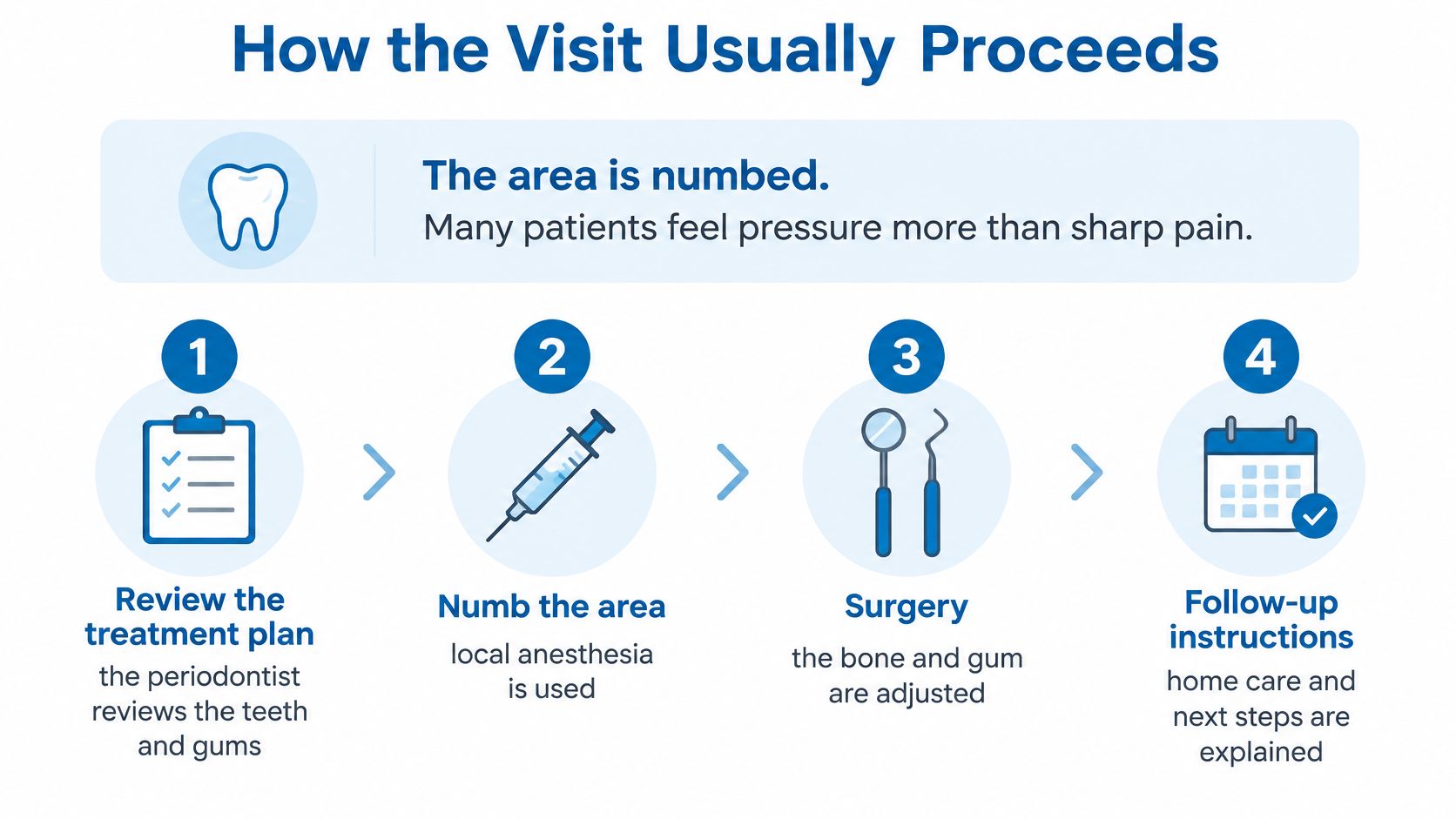
The area is numbed before any bone is touched. Many patients feel pressure more than sharp pain. That isn't a promise of a pain-free visit. Soreness afterward is expected, and the plan should say so before the day of surgery.
What happens, and what it tends to feel like
- The chart comes first. The periodontist reviews pocket depths and X-rays and confirms which teeth still need surgery after scaling. Patients usually feel nothing at this step beyond the probe they already know.
- The site is numbed. Local anesthetic blocks sharp sensation. Sedation may be discussed when anxiety is high. Pressure can still register.
- A small incision lifts the gum. The flap is reflected so roots and bone are visible. With the anesthetic working, this is pressure and movement, not a cutting feeling that can be localized.
- Roots are cleaned under direct view. Tartar and inflamed tissue come off surfaces a scaler couldn't fully see. Patients often hear instruments more than they feel them.
- Bone is adjusted in two limited ways. Osteoplasty thins non-supporting ledges. Limited ostectomy evens craters so the bone slopes in a way the gum can follow. Root reshaping, or odontoplasty, is considered only when tooth shape itself traps plaque.
- The flap goes back, often slightly lower. Stitches close it where the new bone edge sits. A longer crown outline may be visible right away.
- Home care is written down. A dressing may cover the site. Instructions cover bleeding, cleaning, medicines, and which side to chew on.
One area is often treated at a time so the other side can still chew. The practical goal is a pocket the patient and the hygienist can maintain, not a cure and not a guarantee the tooth will never need more care.
Healing Week by Week After Surgery
Healing doesn't follow one calendar. The stages below are common patterns, not a promised schedule.
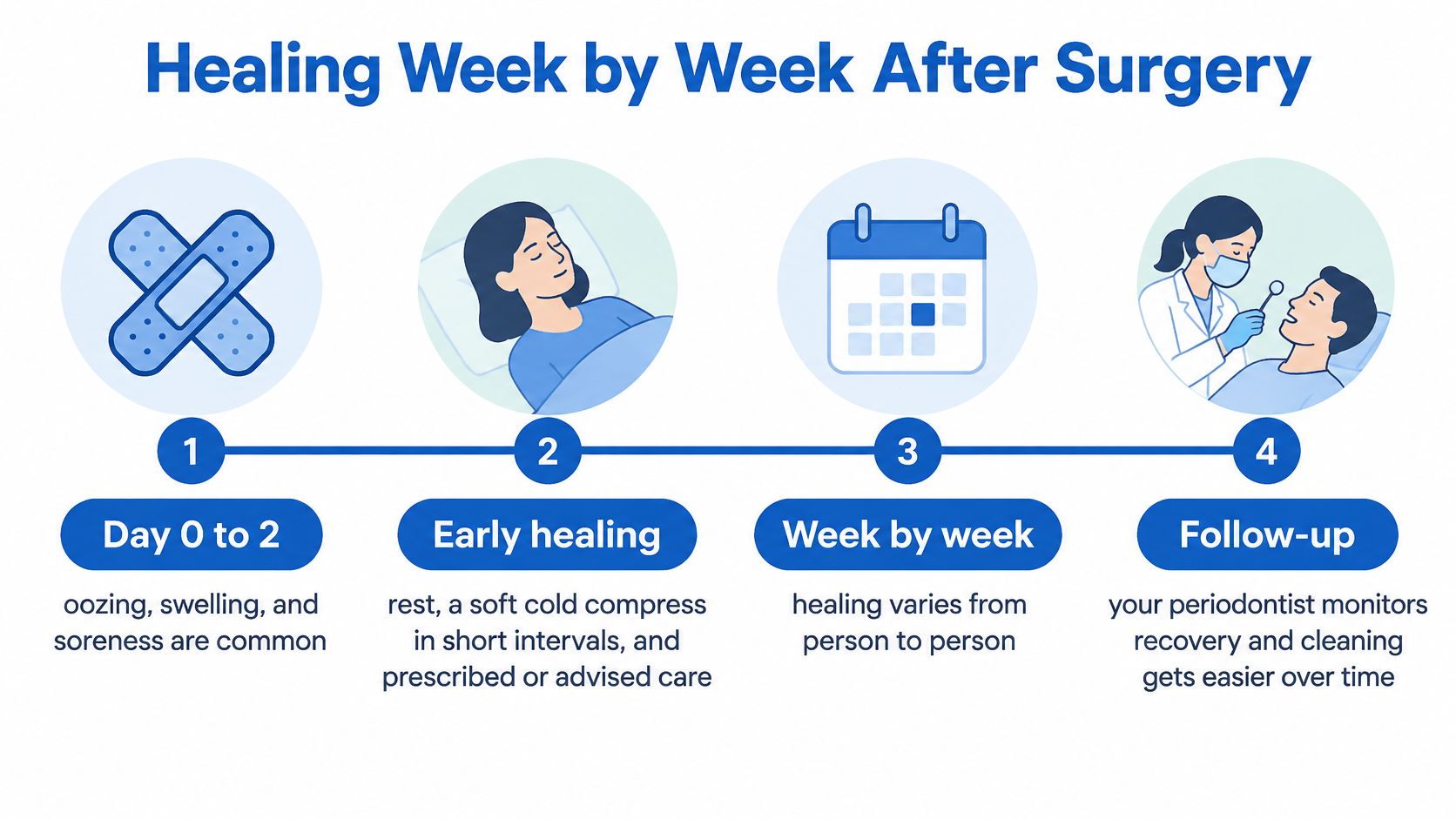
Day 0 to 2
Oozing, swelling, and soreness are common. Rest, a soft cold compress in short intervals, and the pain relief discussed before surgery may help. Many patients manage with those medicines. A little blood on gauze isn't the same as bleeding that won't slow.
Days 3 to 7
Swelling often peaks, then eases. Soft foods stay on the other side. Straws, smoking, and vigorous rinsing can pull at the clot and the stitches. Clean the rest of the mouth as instructed, and leave the surgical site alone until the clinician says otherwise. Details on gum surgery stitches matter here, because non-dissolving stitches are often removed around 7 to 14 days.
Weeks 2 to 4
The gum firms, but the site can still be tender. Cold sensitivity may show up as the gum sits lower on the root. Brushing returns gradually with a soft brush only when the area is ready. Early foods are usually yogurt, eggs, pasta, and lukewarm soup. Crunchy, spicy, and seedy foods wait.
Weeks 4 to 12 and after
Probing is usually delayed until tissues are stable. Maintenance cleanings matter more than the surgery day itself. The new contour stays healthy only with daily plaque control and periodontal maintenance, often every three months. A longer-looking tooth can be permanent even when the pocket is shallower. Individual results vary.
When to call
Call the office for bleeding that won't slow, swelling that worsens after several days, fever, a stitch or dressing problem, or pain that medicines don't ease. Ordinary soreness that fades is different from pain that climbs.
Request an Evaluation at the Nearest Office
A consultation can help you weigh appearance, tissue preservation, and the purpose of treatment. Ask:
- Which sites still need treatment after scaling? Reviewing the current pocket chart helps separate sites that need care from those that have improved.
- Could another approach preserve more tissue? Ask whether regeneration or LANAP fits the defect and your treatment goals.
- How might a changed gumline affect my smile? Discuss how the result could look, particularly around visible teeth.
Only a periodontist who has examined your gums and reviewed your images can recommend a plan. Costs and insurance coverage are confirmed individually.
Periodontal Associates of Delaware is a board-certified periodontal practice with offices in Wilmington, Newark, and Dover. An evaluation may include i-CAT 3D cone beam imaging. If a tooth cannot be kept and implant treatment is appropriate, planning may use X-Nav dynamic surgical navigation. Bring recent X-rays or a referral when available.
The practice offers periodontal evaluation, nonsurgical care, osseous surgery when bone contour makes cleaning difficult, LANAP when appropriate, and implant care when a tooth cannot be kept. To discuss your concerns, contact Periodontal Associates of Delaware.