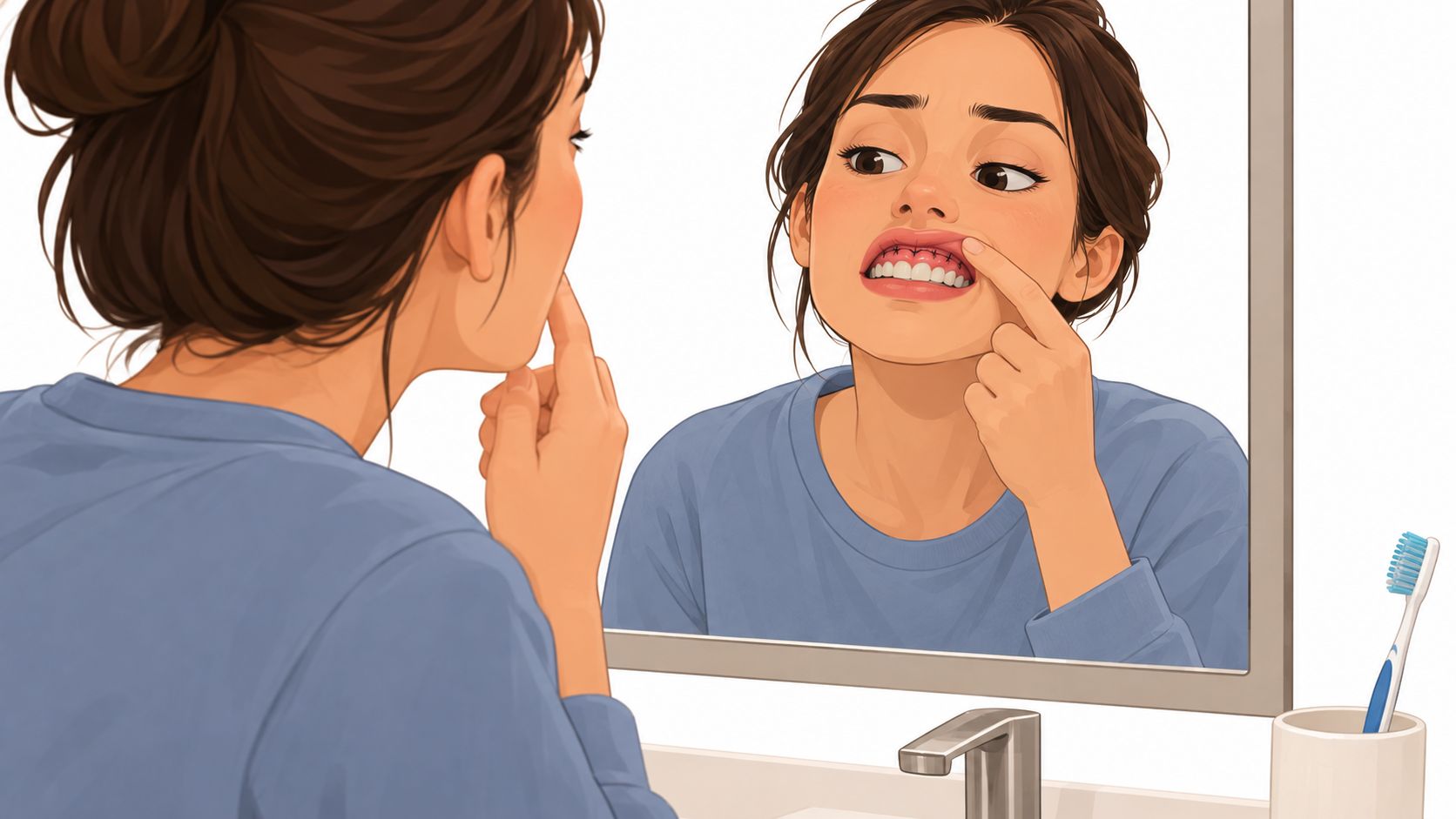
The drive home is usually quiet. The numbness fades, a little soreness settles in, and curiosity wins. A patient leans toward the bathroom mirror, lifts a lip just enough, and sees something unfamiliar where smooth gum used to be. Tiny knots. Short threads. Sometimes a pale dressing over the area. Gum surgery stitches can look more dramatic than they feel, and that first look raises the same questions for many people. What are those threads doing, how long will they stay, and what happens if one loosens?
Table of Contents
- Looking in the Mirror After Gum Surgery
- Resorbable Versus Non-Resorbable Sutures
- Common Suture Materials Used in Periodontal Care
- When Stitches Come Out and What Changes the Timeline
- Caring for Stitches Day by Day After Gum Surgery
- Why Stitches Sometimes Cause Inflammation and What That Means
- Warning Signs That Mean Call the Periodontist
Looking in the Mirror After Gum Surgery
That first mirror check often happens within hours of a flap procedure or gum graft. The gumline may look uneven, slightly puffy, or held together with visible thread. A knot might sit near a tooth, or a loop might cross over the gum like a small hammock. None of that, by itself, shows how well surgery went. The stitches are easy to see because the mouth is easy to inspect.
What the Thread Is Actually Doing
Stitches do not heal tissue on their own. They hold a gum flap or graft in the exact position the periodontist chose while the body begins attaching it. Think of them as a temporary scaffold. The biology underneath, including blood supply, early tissue attachment, and new cell growth, does the repair work.
Different stitch patterns appear for different jobs. A 2025 scoping review of suturing methods used with gingival grafts analyzed 63 studies covering interrupted, sling, mattress, cross, continuous, and periosteal sutures, and it found no single technique clearly superior across all graft procedures. That variety explains why one person's gum graft may show a sling around a tooth while another person's flap shows several small separate knots. The pattern follows the shape of the tissue and the need to keep it still.
Why Appearance Varies So Much
Swelling changes how tight a stitch looks. A thread that sat flat on surgery day may feel more prominent once swelling eases, or it may start to feel loose as early healing progresses. A small tail of material may also poke toward the cheek or tongue, which makes it hard to ignore even when the site is healing normally.
A loose feeling does not mean the tissue underneath has finished healing, and a missing stitch does not automatically mean the procedure has failed.
For anxious patients across Wilmington, Newark, Dover, and surrounding Delaware communities, the calmer interpretation is usually the right starting point. The thread is a temporary positioning tool, not a scorecard. What matters is the type of stitch placed, how long support is needed, and whether the site stays protected during the vulnerable early phase.
Resorbable Versus Non-Resorbable Sutures
The most useful question after surgery is simple. Is the stitch meant to disappear, or is it meant to be removed? That answer shapes almost every expectation during the first two weeks, from whether small fragments are normal to whether a follow-up visit includes stitch removal.
Resorbable sutures are designed to lose strength and break down in the tissue over time. They're a bit like a sugar-based thread in concept, built to soften and vanish rather than stay put. Non-resorbable sutures behave more like fine fishing line. They remain mechanically stable until a clinician cuts and lifts them out.
Two Different Waiting Games
Harvard School of Dental Medicine notes in its post-procedure dental care instructions that many oral surgery stitches dissolve on their own and may fall out within about one week, while some types can remain for up to two weeks. That's why a resorbable stitch may loosen, feel stringy, or release in small pieces without any action from the patient. It isn't unraveling because something went wrong. It's doing what the material was designed to do.
A non-resorbable stitch follows a different logic. It holds tissue with steady strength and then comes out at a planned visit once the periodontist confirms the flap or graft has enough early stability. Removal is usually quick. The clinician assesses healing first, then cuts the thread close to the tissue so the exposed portion isn't dragged through the wound.
| Feature | Resorbable sutures | Non-resorbable sutures |
|---|---|---|
| What happens over time | Loses strength and breaks down in tissue | Stays stable until removed |
| Removal visit | Usually not needed for the stitch itself | Needed, after the clinician checks healing |
| What patients may notice | Softening, loosening, or small fragments | A thread that stays firm and visible |
| Common periodontal role | Many flap closures needing temporary support | Cases needing controlled, longer stabilization |
| Patient action | Leave fragments alone and report concerns | Never cut or pull the thread at home |
Neither category is automatically better. A periodontist may prefer resorbable material when support is needed only briefly and a removal step adds little value. Non-resorbable material may suit a delicate graft or a flap where precise positioning needs to be checked before support is taken away. Once a patient knows which type is present, the waiting makes more sense. One path means watching for gradual breakdown. The other means waiting for an appointment.
Common Suture Materials Used in Periodontal Care
Material names sound technical, but each one answers a practical question. How long should the stitch hold? How does tissue tend to react to it? Will it dissolve, or will someone need to remove it? Those trade-offs explain why periodontists don't rely on one universal thread for every mouth.
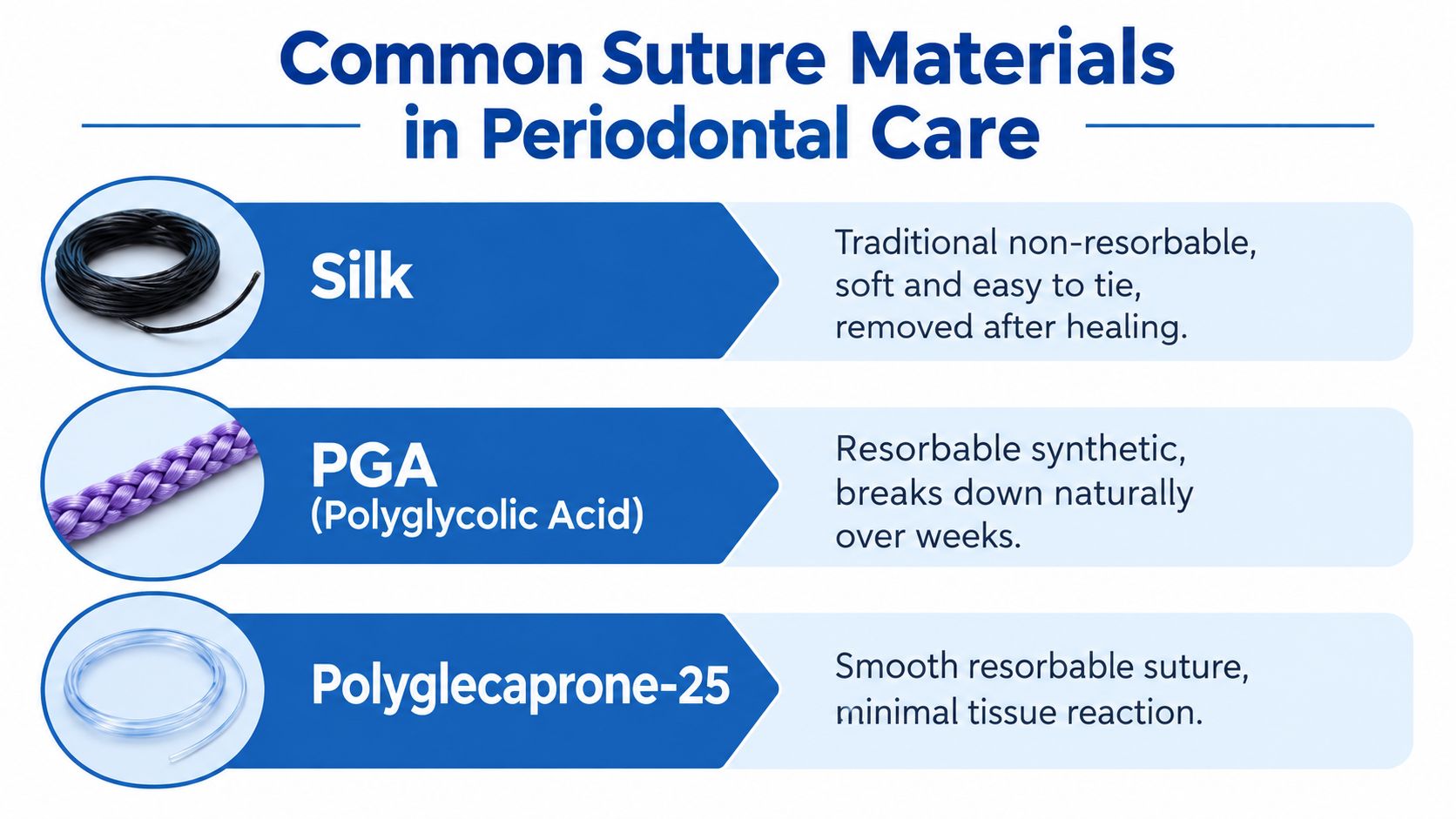
Silk is a traditional non-resorbable material that's soft and easy to tie, so it has a long history in oral surgery. Its drawback is tissue response. A review of suture tissue reactions in oral surgery reported that 6 studies found silk produced a more intense inflammatory response and delayed wound healing compared with materials including expanded polytetrafluoroethylene, polyglecaprone-25, polyglycolic acid, and nylon. That doesn't mean every silk stitch causes a problem. It means material choice can influence early healing conditions.
Synthetics, Gut, and How Long Support Lasts
Polyglycolic acid, or PGA, is a resorbable synthetic often chosen when support needs to last beyond the first few days. A review of dental suturing for soft tissue management reports that PGA retains useful tensile strength for approximately 14 days and typically resorbs over about 21 to 28 days. The same review contrasts that pace with surgical gut, which may dissolve within roughly 24 to 48 hours, and silk, which generally requires removal after about one week.
Polyglecaprone-25 is a smooth resorbable synthetic that tends to be discussed favorably for tissue response. In the tissue reaction review cited above, 2 studies specifically reported favorable healing effects for polyglecaprone-25 compared with silk, as described in that same review. Nylon and expanded polytetrafluoroethylene, or ePTFE, are non-resorbable options that may be selected when stable support and planned removal fit the procedure.
- Short support need: Faster-resorbing materials may suit tissue that gains early stability quickly.
- Graft stabilization: Longer-lasting support may help keep a graft closely adapted to its recipient bed.
- Planned reassessment: Non-resorbable thread lets the clinician decide at follow-up whether support can end.
The right material depends on tissue thickness, wound tension, plaque exposure, and how long mechanical help is needed. It's a deliberate match between thread and task, not a default choice pulled from a drawer.
When Stitches Come Out and What Changes the Timeline
Most patients want one date circled on a calendar. Periodontal healing rarely works that neatly. A stitch placed after a routine flap procedure follows a different schedule than one protecting a gum graft, and resorbable material follows its own internal clock.
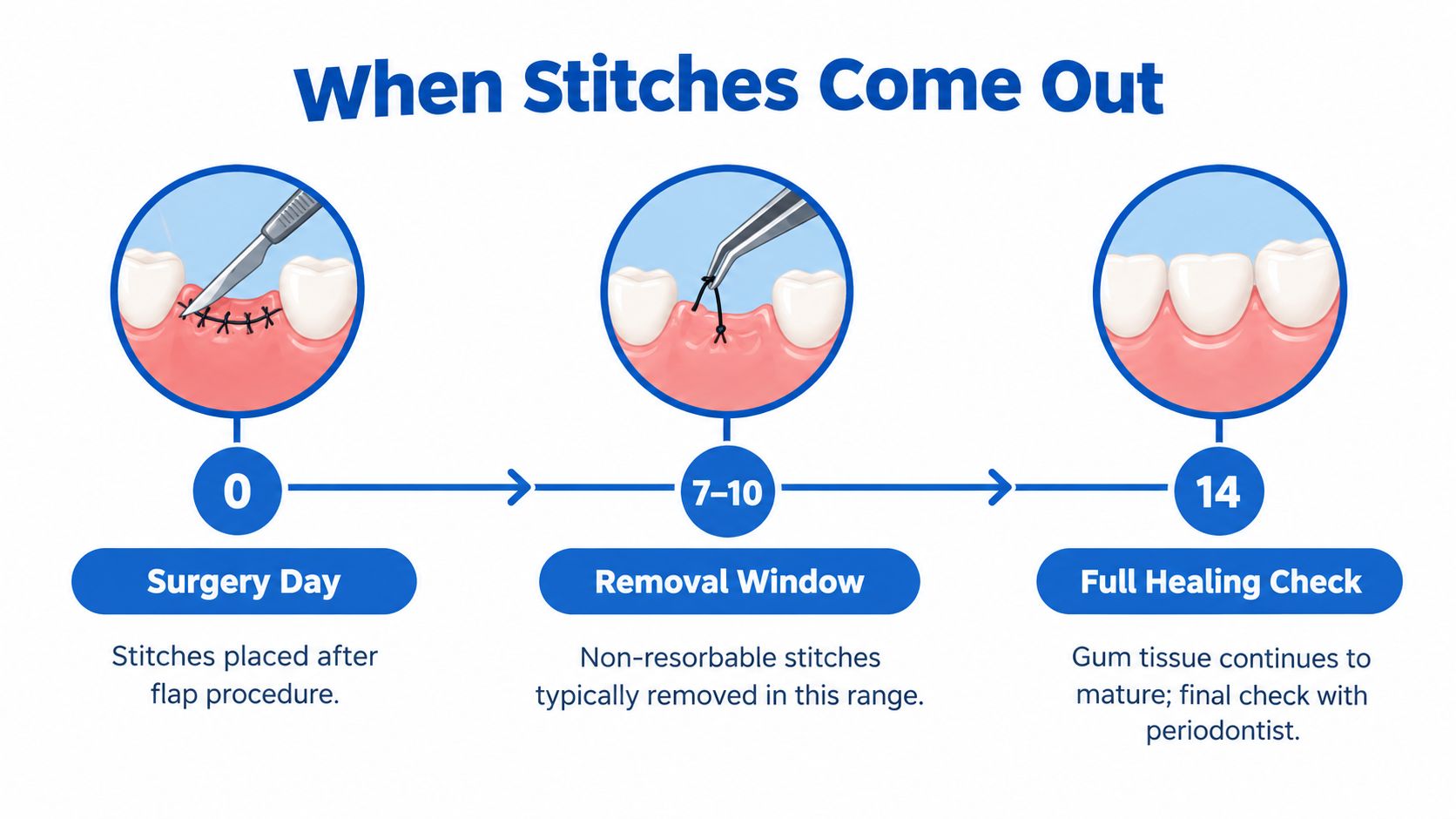
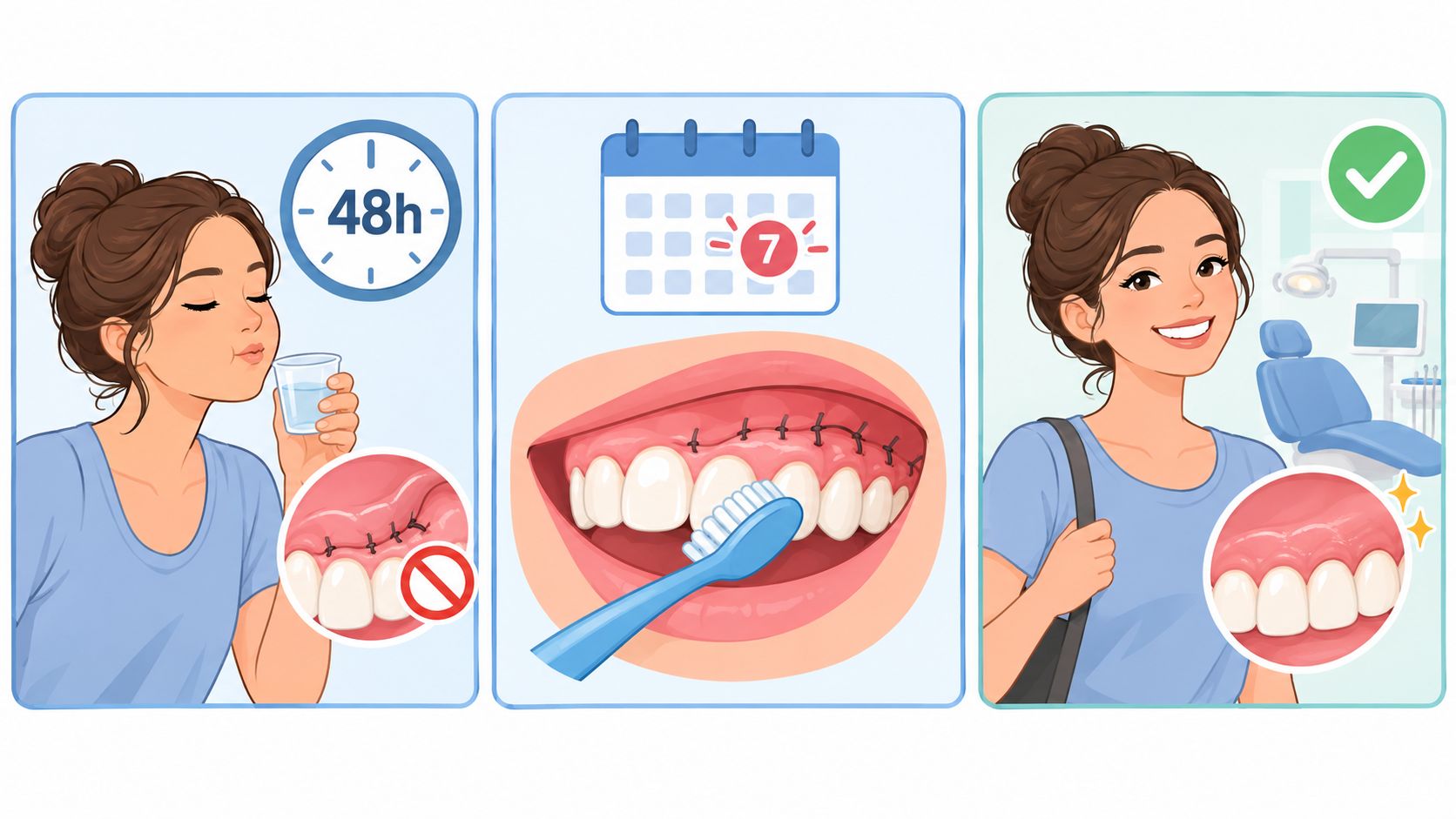
For many flap procedures, non-resorbable stitches come out around 7 to 10 days. A periodontal surgery review on suture removal timing cautions against treating that window as a fixed rule, because removing stitches too early can cause wound margin separation while leaving problematic stitches too long can impair flap blood circulation and provoke inflammation. The same review notes that flaps repositioned over their original location may need removal later than 7 to 10 days, and that recession coverage or grafting cases often shift removal to approximately 10 to 14 days.
Why One Mouth Runs Ahead of Another
Several factors move the date:
- Procedure type: A graft that must stay immobile against its blood supply often needs longer protection than a repositioned flap, and regenerative care described in information about periodontal bone grafts may involve closure that protects material placed beneath the gum.
- Tissue quality: Thin, fragile tissue may need gentler handling and a more cautious removal decision.
- Smoking and medical conditions: Smoking, diabetes, and blood supply can all slow early healing.
- Plaque control: Debris collecting around a stitch gives the clinician more to assess at follow-up.
- Treatment approach: Laser-assisted care such as LANAP with the FDA-cleared PerioLase MVP-7 follows a different protocol than traditional flap surgery, so stitch expectations differ by case.
At the removal visit, the periodontist checks flap stability, tissue adhesion, inflammation, and whether any stitch has loosened. A stitch that looks ready to a patient in the mirror may still be doing useful work underneath. Waiting for that assessment protects primary closure, which is the close edge-to-edge healing that stitches are meant to support.
Caring for Stitches Day by Day After Gum Surgery
Good stitch care is mostly about restraint. The first two days set the tone, the first week tests patience, and the period after removal still calls for gentleness even though the thread is gone. Patients receiving care at Periodontal Associates of Delaware in Wilmington, Newark, or Dover get instructions suited to the specific procedure, and those instructions take priority over general guidance.
The First 48 Hours
Harvard's periodontal postoperative instructions advise patients to protect the site during the first 24 to 48 hours, avoid brushing in or near surgical sites until the follow-up visit, and begin a prescribed antiseptic mouthwash the morning after surgery, used twice daily. Other teeth still get cleaned normally. The surgical area gets left alone.
Cheek stretching deserves special mention because it's so tempting. Pulling the cheek wide for a better mirror view can tug directly on sutures. Brief, gentle looks are safer than repeated retraction. If a periodontal dressing covers the site, small pieces breaking away aren't necessarily an emergency, but picking at the dressing is still a poor idea.
Practical rule: Protecting gum surgery stitches usually means doing less at the site, not more.
The First Week and Beyond Removal
As days pass, small sensations become common talking points. A thread may catch on soft food. A resorbable stitch may feel loose or leave a tiny fragment on the tongue. Mild tenderness around a knot can come and go. These experiences often reflect normal material breakdown and tissue change rather than a complication.
Regenerative procedures add another reason for patience, since closure may protect a membrane or graft material, as explained in an overview of guided tissue regeneration. Forceful rinsing, probing with a finger, or brushing directly across the margin can move tissue before it has attached. After non-resorbable stitches come out, the gum still isn't finished healing. It has reached the point where thread support is no longer the limiting factor, so gentle cleaning resumes only as the periodontist directs.
Why Stitches Sometimes Cause Inflammation and What That Means
There's an uncomfortable question many patients think but don't ask. If the gum looks red right around a stitch, is the stitch itself part of the problem? Sometimes, yes, and that honest answer helps explain why technique and follow-up matter so much.
Any suture is a foreign material sitting in healing tissue. Common materials including silk, nylon, polyglycolic acid derivatives, catgut, and ePTFE can support bacterial adherence and produce some degree of tissue reaction. A braided or exposed thread can also retain plaque, and plaque near a fresh wound edge invites local inflammation. Tension adds a second concern. A knot tied too tightly can compromise microcirculation, while a loose stitch may catch during chewing and irritate the margin.
The Trade-Off Behind Every Stitch
Removing stitches from the equation sounds appealing until the alternative is examined closely. A systematic review identified 4 randomized controlled trials published from 1987 through 2014 involving 101 patients, each comparing fibrin sealant with conventional sutures, and 2 studies reported faster or better early bleeding control with sealant while the overall evidence base stayed small, as summarized in a systematic review of fibrin sealants versus sutures in periodontal surgery. Sealants are an interesting alternative, not a proven replacement for every case.
Newer evidence points in a similar direction. A 2025 systematic review comparing tissue adhesives with conventional sutures found pooled wound healing proportions of approximately 88% for adhesives versus 86% for sutures, with no statistically significant overall difference and substantial study heterogeneity. Adhesive closure isn't automatically better. Case selection, hygiene, tension control, and follow-up appear to carry much of the weight.
So why did a particular periodontist choose stitches, and those stitches in particular? The answer may involve graft protection, bleeding control, tissue thickness, the need to reduce tension, or the simple fact that a flap must stay precisely positioned while attachment forms. Mild redness immediately around a thread can be part of that bargain. Spreading redness, increasing pain, or a stitch that feels increasingly tight or debris-coated deserves a call, because the balance between stabilization and irritation sometimes needs professional adjustment.
Warning Signs That Mean Call the Periodontist
Normal healing and a developing problem can feel similar on day one. They usually separate over the following days. Normal healing trends in one direction, with soreness and swelling gradually easing. A problem tends to reverse course or escalate.
Signs That Deserve a Same-Day Call
- Bleeding that does not slow: Slight oozing early on is common, but persistent bleeding needs professional guidance.
- Swelling that keeps worsening: Swelling that rapidly increases rather than gradually settling should be reported.
- Fever or pus: Either sign can point toward infection and shouldn't be watched at home for days.
- Severe or escalating pain: Pain that intensifies after initial improvement deserves assessment.
- Visible wound separation: Gum edges pulling apart, sometimes called dehiscence, can compromise closure. Concerns about graft healing connect closely with information on gum graft failure rates and risk factors, though only an in-person exam can judge a specific graft.
By contrast, mild soreness, slight early oozing, a stitch loosening on schedule, or a small dissolving fragment usually falls within expected healing. The mistake to avoid is self-treatment. Cutting a poking thread with household scissors or pulling a loose loop can drag bacteria through tissue or separate a margin that wasn't ready. A quick call costs very little. A torn flap can cost weeks.
When a symptom is getting worse instead of better, the trend matters more than any single moment in the mirror.
Individual results vary, and no article can judge a specific surgical site. Readers should consult a periodontist for personalized advice, especially before changing rinses, resuming brushing at the site, or touching any stitch that feels wrong.
Periodontal Associates of Delaware provides board-certified periodontal care across Wilmington, Newark, and Dover, including LANAP laser gum surgery with the PerioLase MVP-7, gum grafting, and implant planning with i-CAT 3D cone beam imaging and X-Nav dynamic surgical navigation. Anyone with questions about gum surgery stitches, healing timelines, or whether a stitch needs attention can learn more through Periodontal Associates of Delaware and request an appointment at the nearest Wilmington, Newark, or Dover office.