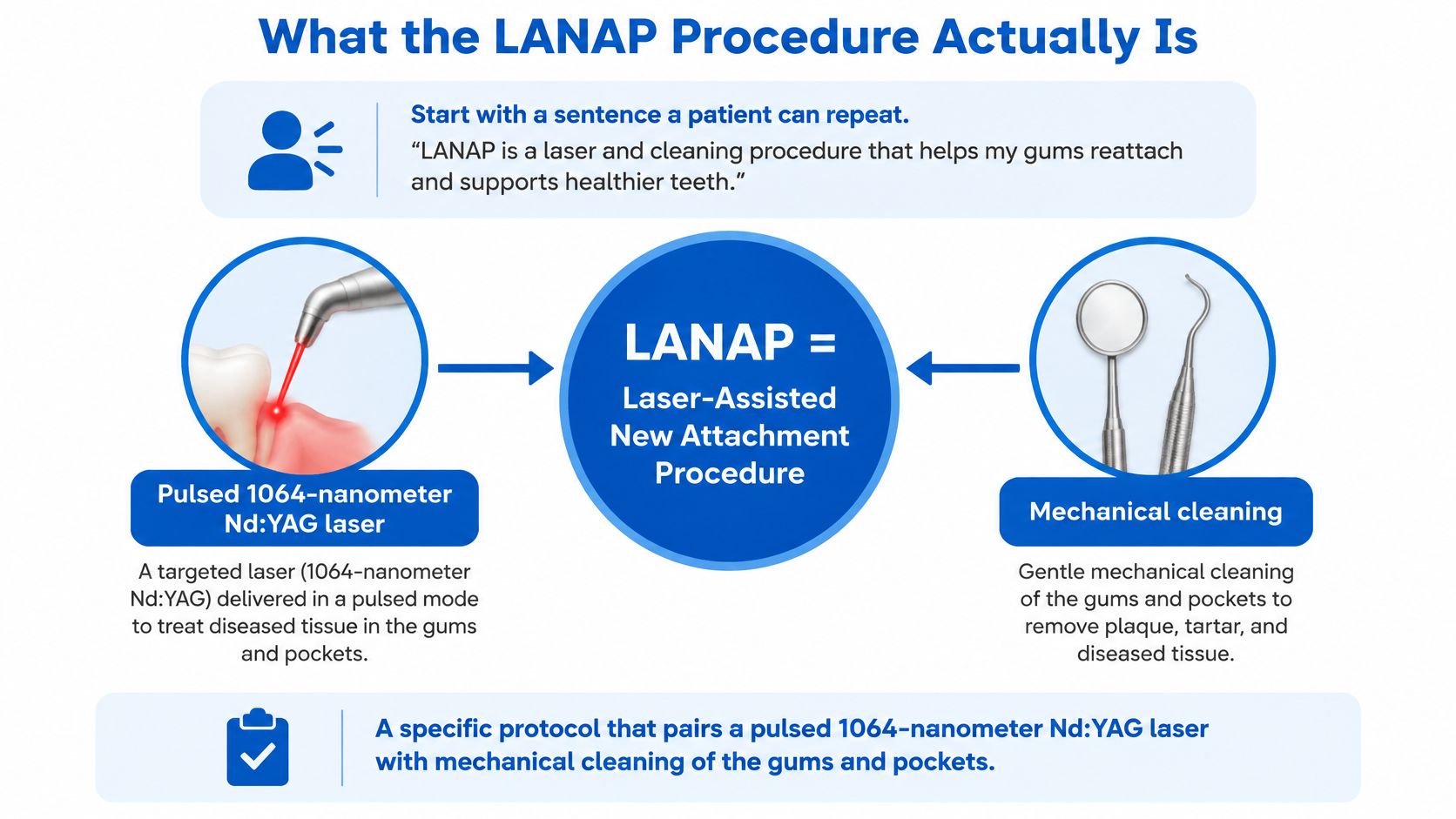
LANAP, the Laser-Assisted New Attachment Procedure, pairs a pulsed 1064 nm Nd:YAG laser with mechanical cleaning of diseased gum pockets, and FDA clearance describes a specific protocol, not a guaranteed result for every patient.
If a laser can support healing, why might a tooth still need deep cleaning or conventional gum surgery? The answer depends on what's beneath the gumline: hardened deposits, the shape of the remaining bone, and whether the tooth has enough support to keep.
For adults anxious about periodontal treatment, that distinction matters. LANAP is an option for managing periodontitis, not a cure or a substitute for an individualized diagnosis.
Table of Contents
- What the LANAP Procedure Actually Is
- How a LANAP Visit Treats the Pocket
- What Studies Say About New Attachment
- Which Gum Treatment Fits Your Situation
- Limits, Recovery, and Healing Checks
- Request a Periodontal Visit in Delaware
What the LANAP Procedure Actually Is
LANAP combines targeted laser treatment with thorough cleaning around tooth roots. It isn't a nickname for every procedure performed with a dental laser.
Periodontitis damages the structures that hold teeth in place. As the attachment breaks down, spaces called periodontal pockets develop between the gums and roots. Treatment aims to control inflammation, clean contaminated root surfaces, and establish conditions that support healing.
What new attachment means
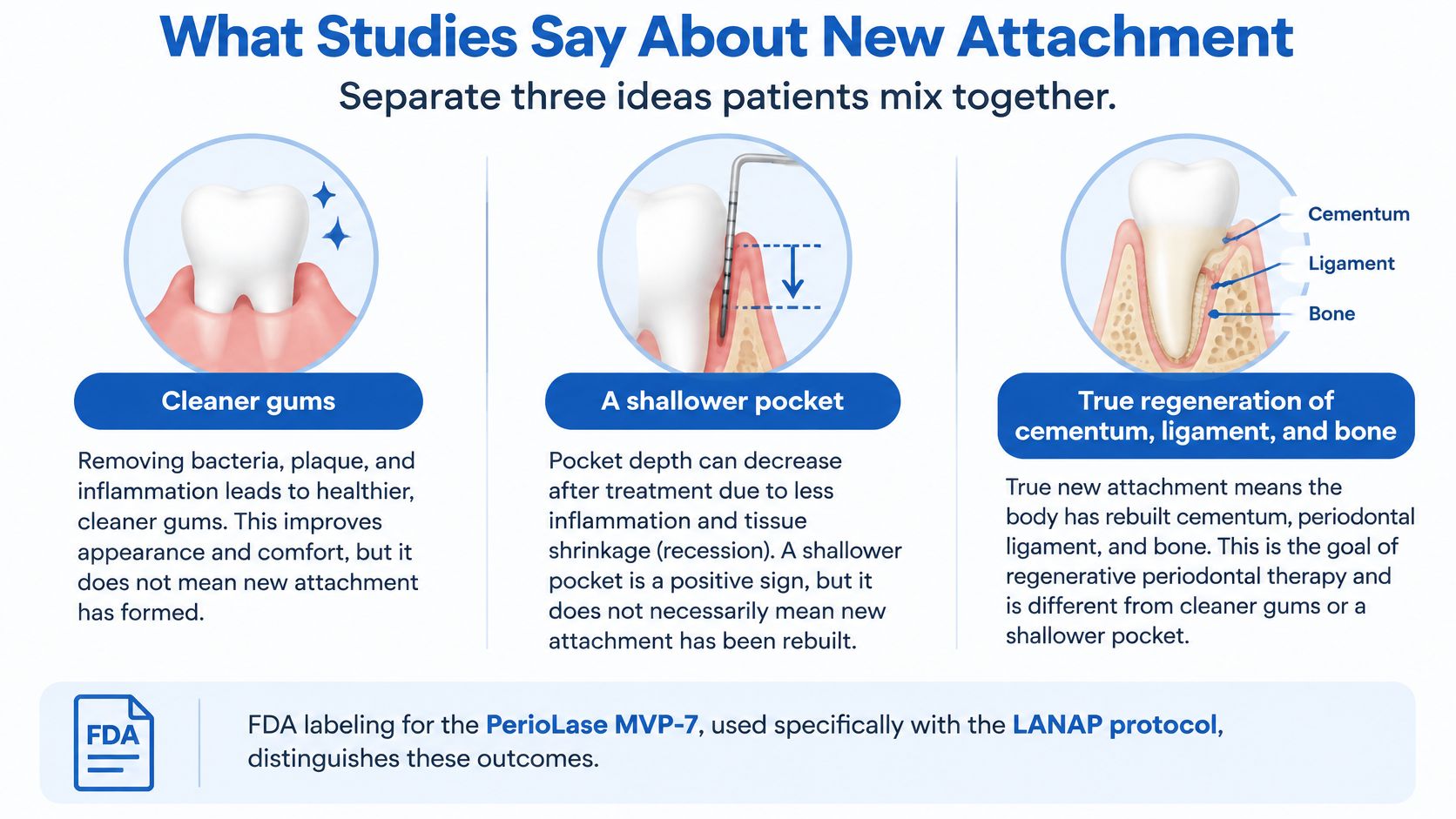
A tooth's supporting system includes cementum, the covering on its root; the periodontal ligament, connective fibers that attach the root to bone; and alveolar bone, the bone surrounding the tooth. New attachment refers to rebuilding a functional connection involving those structures.
That differs from healing through a long junctional epithelium, a lining of cells that forms a seal along the root. Such repair can help control disease, but it isn't the same as rebuilding the original attachment apparatus.
The Dentistry Today explanation of LANAP's development and clearance traces the protocol to clinicians Robert Gregg II and Del McCarthy, who began developing it around 1989, and identifies FDA clearance milestones on July 26, 2004, for cementum-mediated new attachment without a long junctional epithelium, and March 15, 2016, for labeling describing new cementum, periodontal ligament, and alveolar bone with the LANAP protocol.
The same account describes the human microscopic tissue evidence behind the attachment indication. The National Institutes of Health also describes LANAP as the only laser procedure with human histologic evidence cited in support of that specific attachment claim. That's a narrower statement than saying every laser treatment grows bone.
LANAP at a Glance
| Item | What it means |
|---|---|
| Full name | Laser-Assisted New Attachment Procedure |
| Laser | Free-running, variable-pulsed Nd:YAG at 1064 nanometers |
| Named device | PerioLase MVP-7, identified in the FDA device record as 510(k) K151763 |
| 2004 clearance | July 26, 2004, cementum-mediated new attachment without a long junctional epithelium |
| 2016 labeling | March 15, 2016, new cementum, periodontal ligament, and alveolar bone when the LANAP protocol is used |
| What it is not | Not every dental laser, and not a guarantee that every pocket regenerates |
The distinctions in the table prevent a common misunderstanding: a device, a wavelength, and a complete treatment protocol aren't interchangeable. A clinician's use of a laser doesn't automatically mean the clinician performed LANAP.
The treatment aims to remove diseased pocket lining while preserving conditions for clot formation and healing around the root. Individual results vary, and a periodontist must match the method to the specific defect rather than choose it by equipment alone.
How a LANAP Visit Treats the Pocket
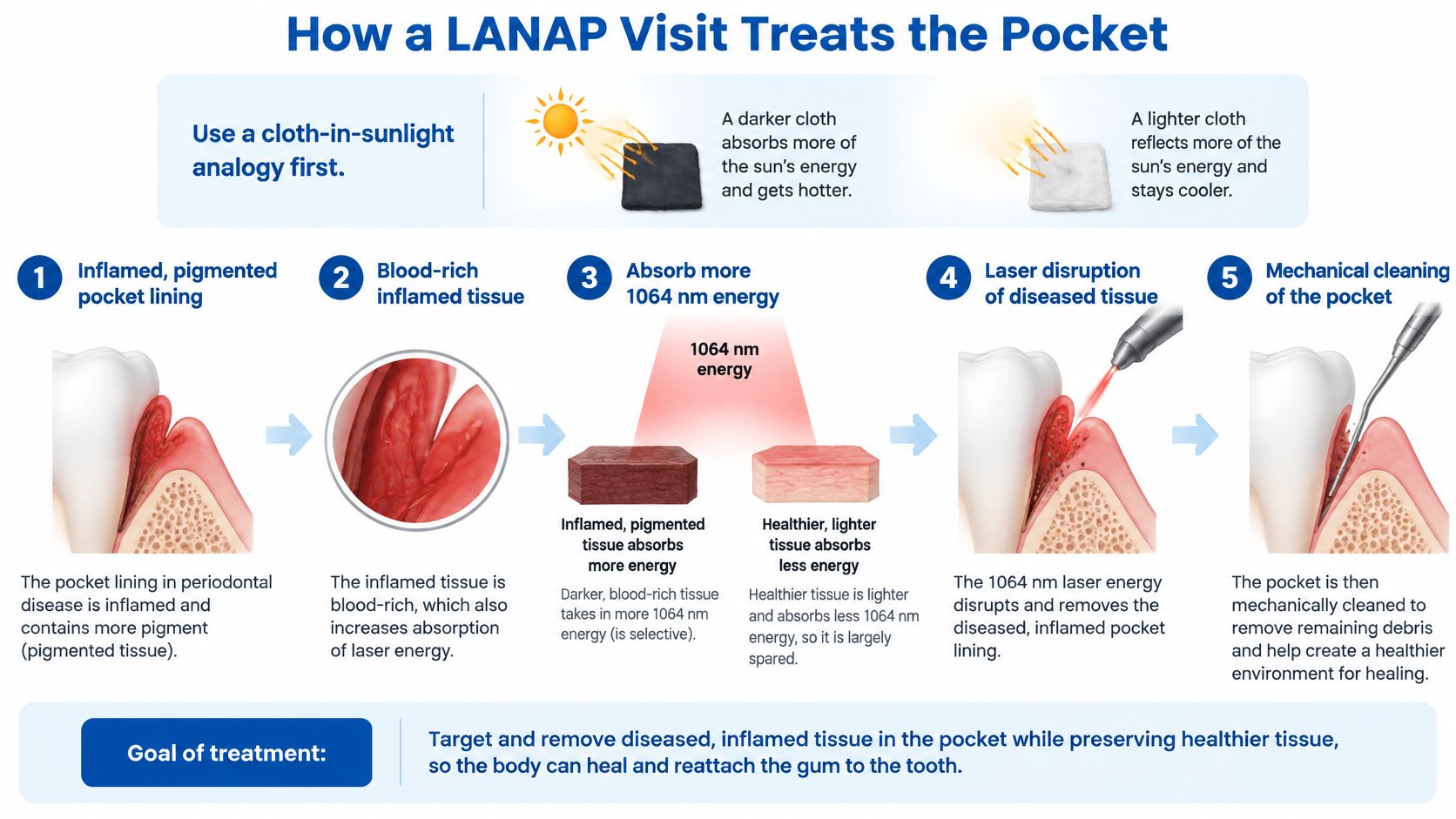
Dark cloth absorbs sunlight differently from light cloth. A similar principle helps explain laser selectivity: inflamed, pigmented pocket lining and blood-rich tissue absorb laser energy differently from healthier, less-pigmented tissue.
That analogy has a limit. Healthy tissue isn't immune to heat, so controlled technique matters. The clinician uses the laser to disrupt diseased tissue while limiting unwanted thermal injury.
The treatment sequence
Measure and plan. The periodontist records pocket depths, checks tooth mobility, and reviews the bone-loss pattern. These findings show where treatment is needed and establish a baseline for later comparisons. The explanation of pocketing around teeth helps clarify why measurements matter even when gums don't hurt.
Treat the diseased lining. A laser fiber enters the pocket to target inflamed lining and pigmented bacterial deposits. This pass addresses tissue inside the pocket rather than opening a surgical flap.
Clean the root mechanically. Ultrasonic tips and hand instruments remove calculus, the hardened deposits also called tartar. Laser treatment doesn't eliminate the need for this hands-on cleaning.
Support a stable clot. A subsequent laser pass helps establish a fibrin clot around the treated root. The clot provides an early framework for healing.
Evaluate biting forces. Heavy contacts on vulnerable teeth may need adjustment. Reducing excessive force can help protect the healing site from repeated movement.
Set the home-care plan. The patient receives instructions for eating, cleaning, and follow-up before leaving. Protecting the treated area is part of treatment, not an optional extra.
What laboratory findings can explain
A laboratory study of Nd:YAG-treated root specimens used 80 mJ per pulse, 4 W, and 50 Hz with scaling and root planing and reported mean fibroblast counts of 48.28, compared with 22.24 after scaling and root planing alone. Fibroblasts are cells involved in connective-tissue healing.
That was an in-vitro result, meaning it came from laboratory specimens, not a demonstration that patients experienced equivalent regeneration. It offers a possible explanation for healing behavior, not a prediction for an individual tooth.
A systematic review of adjunctive Nd:YAG treatment described settings around 75–100 mJ per pulse and 60–120 seconds of irradiation, but also found substantial variation among study results. Those ranges aren't a treatment recipe; settings belong to a trained clinician working within the appropriate protocol.
LANAP itself uses no scalpels or sutures. That can make treatment less intimidating for many patients, although comfort needs and recovery still require individual planning.
What Studies Say About New Attachment
Three outcomes often get lumped together in laser discussions: cleaner gums, shallower pockets, and true regeneration. Less bleeding points to reduced inflammation, and a smaller probing measurement points to a shallower pocket. Regeneration sets a higher bar, because it requires new cementum, ligament, and bone to form on a root surface that was previously diseased.
The PerioLase regeneration-labeling explanation describes regeneration of that attachment apparatus on a previously diseased root when the device is used specifically with LANAP. The labeling leaves open how much regeneration any particular patient will achieve.
Key Studies on LANAP and Laser-Assisted Therapy
| Study or source | Design and size | Reported finding |
|---|---|---|
| 2022 split-mouth randomized controlled trial | 15 people with chronic periodontitis | Both electrosurgical treatment and LANAP improved clinical measures; LANAP quadrants showed greater reductions at 6, 9, and 12 months in the published trial account. |
| Split-mouth diode laser study | Small within-person comparison | Diode laser plus scaling improved probing depth and attachment more than scaling alone at early and later follow-up visits; the study tested a diode laser, a different device from the Nd:YAG laser used in LANAP. |
| 2018 AAP best-evidence consensus | Evidence summary | Appropriately applied adjunctive laser therapy may add less than 1 mm in probing-depth reduction and attachment improvement; laser alone wasn't established as superior or equivalent, as summarized in the LANAP evidence overview. |
| 2018 systematic review and meta-analysis | Pooled comparison | Could not conclude that LANAP outperforms conventional periodontal treatment. |
| 2025 scoping review | Small group of clinical investigations, some randomized | Small samples and moderate-to-high risk of bias limit confidence in the findings. |
The split-mouth design compares treatments within the same person. In the LANAP trial, clinicians treated different mouth quadrants with different methods and tracked plaque, inflammation, probing depth, attachment, and radiographic bone levels. This works like holding the patient constant so the two methods compete on more equal footing, although a small trial still can't represent every pattern of disease.
The diode-laser study shows why device identity matters. Each laser protocol needs its own evidence: a diode result describes what that diode system did, and LANAP's claims rest on trials that followed the Nd:YAG protocol itself.
A favorable study result supports a treatment discussion. It doesn't establish that the same treatment is best for every tooth.
Why interpretation matters
Published reviews describe LANAP as minimally invasive while noting that evidence remains thin for some periodontal laser applications. Encouraging findings and uncertainty can sit in the same paper.
Clinical attachment measurements and radiographs let clinicians assess healing from outside the tissue. Confirming that new attachment formed requires microscopic examination, which routine follow-up visits don't include. A shallower pocket can reflect several healing changes, including reduced swelling or a shift in the gum margin, so a better number works like a fading bruise: it shows improvement without revealing how the deeper tissue repaired.
In the studies above, improvement meant specific measured changes: lower plaque and inflammation scores, shallower probing depths, and gains in clinical attachment. How far those gains go, and how long they last, depends on disease severity, smoking, diabetes, oral hygiene, root anatomy, and ongoing maintenance. Several risk factors stacking together widens the range of outcomes from one mouth to the next.
Which Gum Treatment Fits Your Situation
LANAP is a case-selection treatment used alongside mechanical cleaning, not a universal replacement for scaling and root planing or flap surgery. The useful question isn't which method sounds most advanced. It's which method gives the periodontist adequate access and the tooth a reasonable chance of remaining functional.
A review of periodontal laser evidence explains why claims of universal superiority aren't justified. Treatment selection still requires a diagnosis, an assessment of the remaining support, and a realistic maintenance plan.
When Each Periodontal Option May Fit
| Situation | Often considered first | Why this may fit |
|---|---|---|
| Gingivitis or shallow pockets | Scaling and root planing plus home care, with treatment depth matched to the diagnosis | Inflammation can often be controlled without pocket surgery; gingivitis alone generally doesn't require root planing. |
| Moderate or deep pockets and a desire to avoid a flap | LANAP with thorough root cleaning | A protocol option when the root is reachable and the tooth is worth keeping. |
| Severe bone defects, furcations, or unreachable calculus | Traditional osseous or regenerative flap surgery | Direct access when pocket instruments cannot adequately clean or reshape the site. |
| Smoking, uncontrolled diabetes, or poor plaque control | Disease control and maintenance before surgery | These factors can limit healing after any periodontal procedure. |
| Tooth that cannot be predictably saved | Extraction and site preservation | Replacement, sometimes with an implant, may serve better than repeated pocket treatment. |
Access and anatomy can decide the method
Gingivitis affects the gums without the attachment loss that defines periodontitis. Professional cleaning and effective daily plaque removal may be sufficient. Root planing is directed at diseased root surfaces when the diagnosis calls for it, not because gums bleed.
For deeper disease, a periodontist considers whether instruments can reach and clean the root through the pocket. A relatively accessible root on a tooth with useful remaining support may present a different opportunity than a molar with extensive damage between its roots.
That space between roots is called a furcation. Its shape can make cleaning difficult, both professionally and at home. Conventional surgery may provide the visibility needed to manage deposits and defects that a closed-pocket approach can't adequately address.
The explanation of osseous surgery describes why direct access remains useful. Regenerative flap procedures may also be appropriate for selected bone defects; regeneration isn't a goal limited to laser treatment.
Practical rule: The least intimidating procedure isn't always the procedure most likely to provide adequate disease control.
Saving a tooth requires a realistic prognosis
Avoiding a scalpel is a reasonable concern, especially for an anxious patient. Comfort still needs to be weighed against pocket depth, mobility, bone-loss pattern, and the ability to maintain the site afterward.
For example, a moderately loose tooth with treatable inflammation may deserve an effort to preserve it. A severely compromised tooth that cannot be cleaned or maintained may require a different discussion, including extraction and site preservation.
LANAP also shouldn't be confused with treatment for every form of gum recession. Exposed roots may require a separate soft-tissue assessment rather than pocket treatment. Individual results vary, and the diagnosis should determine the plan.
Limits, Recovery, and Healing Checks
The laser cannot reliably remove every calculus deposit, and improper use can cause thermal injury. Mechanical root cleaning stays part of treatment for that reason. A comfortable early recovery does not prove that every root is clean or that the disease is permanently controlled.
A clinical evidence review discussing LANAP outcomes describes a 12-month comparison with sustained improvements but some increase in plaque and bleeding between six weeks and one year, along with a 2023 clinical study reporting average reductions in pocket depth, visible plaque, and bleeding. Findings like these do not establish regeneration or tooth retention for every patient.
Protecting the early healing site
The initial clot works like a scab, shielding the area while new attachment begins. Disturbing it can interfere with healing even when the site feels fine. Because LANAP avoids scalpel incisions and sutures, recovery generally involves less pain, less bleeding, and a faster return to routine than traditional gum surgery. How quickly a particular patient heals still depends on the extent of treatment, local tissue conditions, and general health.
The written postoperative plan should identify exactly where cleaning is allowed and when normal techniques can resume.
- Choose soft foods. Eggs, yogurt, mashed vegetables, and other foods that require little chewing can reduce stress on treated sites. Hard, crunchy, or sticky foods may disturb healing tissue.
- Brush only as directed. Untreated areas still need cleaning, but treated gum margins may require temporary changes in technique. Brushing harder does not speed early healing.
- Delay flossing at treated sites until cleared. Floss, interdental brushes, and water-flossing devices can disrupt the healing area if introduced too soon.
- Use medications as instructed. Pain-control and rinse recommendations should account for medical conditions, allergies, and other medications. Patients should not independently stop prescribed blood thinners.
- Keep follow-up appointments. A site that looks acceptable in a mirror may still need professional assessment.
The guide to what to expect after LANAP surgery provides additional recovery context. The treating periodontist's site-specific instructions take priority over general advice.
What healing checks can establish
An early visit focuses on comfort, tissue appearance, and whether the patient can follow the home-care plan. Persistent or worsening pain, increasing swelling, or bleeding that does not settle warrants contact with the treating practice rather than waiting for a routine review.
Later assessments evaluate the response over months. The periodontist compares appropriately timed pocket measurements, bleeding findings, and mobility with the starting condition, and radiographs taken at planned intervals help track bone changes. Probing too early can disturb healing, so the clinician determines when measurements are appropriate.
As inflammation settles, recession or root sensitivity may become more noticeable. A gum margin that sits lower should be read alongside attachment measurements and symptoms rather than treated as failure on its own.
Laser treatment does not replace daily plaque control or periodontal maintenance.
When the plan needs to change
Very mobile teeth, difficult root anatomy, and uncontrolled infection can make regeneration less predictable. Smoking, uncontrolled diabetes, and missed maintenance visits can further weaken the outlook, regardless of the procedure selected.
If bleeding returns or a pocket deepens, the clinician looks for a cause first. Remaining deposits, hard-to-clean anatomy, inadequate plaque control, and excessive biting forces each call for a different response. The next step might be more frequent professional cleaning, changes in home care, further localized treatment, or conventional surgery for improved access. The right correction matches the cause the clinician finds.
The goal is durable disease control and preservation of useful teeth when feasible, not a promise that every treated site will rebuild lost support.
Request a Periodontal Visit in Delaware
Choosing between LANAP, scaling and root planing, or conventional surgery depends on what the periodontist finds in your mouth, not on which option sounds most appealing. A consultation sorts that out, and booking one commits you to nothing beyond an evaluation.
Periodontal Associates of Delaware is a board-certified, LANAP-certified periodontal practice with offices in Wilmington, Newark, and Dover, Delaware. A referral isn't needed to schedule an appointment.
Preparing for the consultation
Bring an updated medication list and be ready to discuss diabetes, tobacco use, previous gum treatment, and current symptoms such as bleeding or loose teeth. Earlier dental imaging, if you have it, helps the clinician see how the condition has changed over time.
A short list of questions keeps the visit focused:
- Treatment choice. What findings make LANAP, nonsurgical care, or flap surgery appropriate for the affected teeth?
- Tooth prognosis. Which teeth have a reasonable outlook, and which need a separate discussion?
- Comfort and recovery. What measures and home-care changes fit the planned treatment?
- Ongoing care. How will the periodontist assess healing and coordinate maintenance?
The practice performs LANAP with the FDA-cleared PerioLase MVP-7, part of the only FDA-cleared laser protocol for periodontal regeneration. If implant planning becomes part of care, i-CAT 3D cone beam imaging and X-Nav dynamic surgical navigation support precise placement.
Office staff can address expected costs and insurance questions directly. A periodontist should evaluate the condition before you choose a treatment, because the diagnosis, not the technology, determines which option fits.
Periodontal Associates of Delaware offers periodontal evaluation and treatment options, including LANAP when the diagnosis supports it. Adults concerned about bleeding gums, bone loss, or gum surgery can request an appointment at the nearest Wilmington, Newark, or Dover office to discuss an individualized plan.