Most sinus lift healing time falls between 3 and 12 months, depending on whether the implant is placed during the same surgery or after the graft matures. In many delayed cases, 4 to 6 months is a common window before implant placement, but readiness still depends on what the bone and sinus look like, not just the calendar.
That's why a patient can feel fine long before the graft is ready for the next step. The swelling drops, eating gets easier, and normal life starts to feel close again, yet the deeper work beneath the gums is still going on.
Table of Contents
- What the Typical Sinus Lift Healing Timeline Looks Like
- Healing After Sinus Augmentation - Phases and Milestones
- What Research Shows About Sinus Lift Recovery Intervals
- Simultaneous Versus Delayed Implant Placement After Sinus Lift
- Factors That Influence Your Individual Healing Time
- How Periodontists Determine When You Are Ready for Implants
What the Typical Sinus Lift Healing Timeline Looks Like
A patient sitting in the chair after a sinus lift usually wants one direct answer, how long until the implant goes in. The honest answer is that the body works on two timelines at once, early soft-tissue recovery and slower bone maturation. Those timelines often overlap, which is why patients can feel confused when they're told they're “healing well” but still can't move ahead right away.
For the first several days, the body is closing the incision, calming swelling, and protecting the graft. That stage can feel very different from the later stage, when new bone is forming around the graft material. Those later changes happen underneath the gums, long after the soreness has faded.
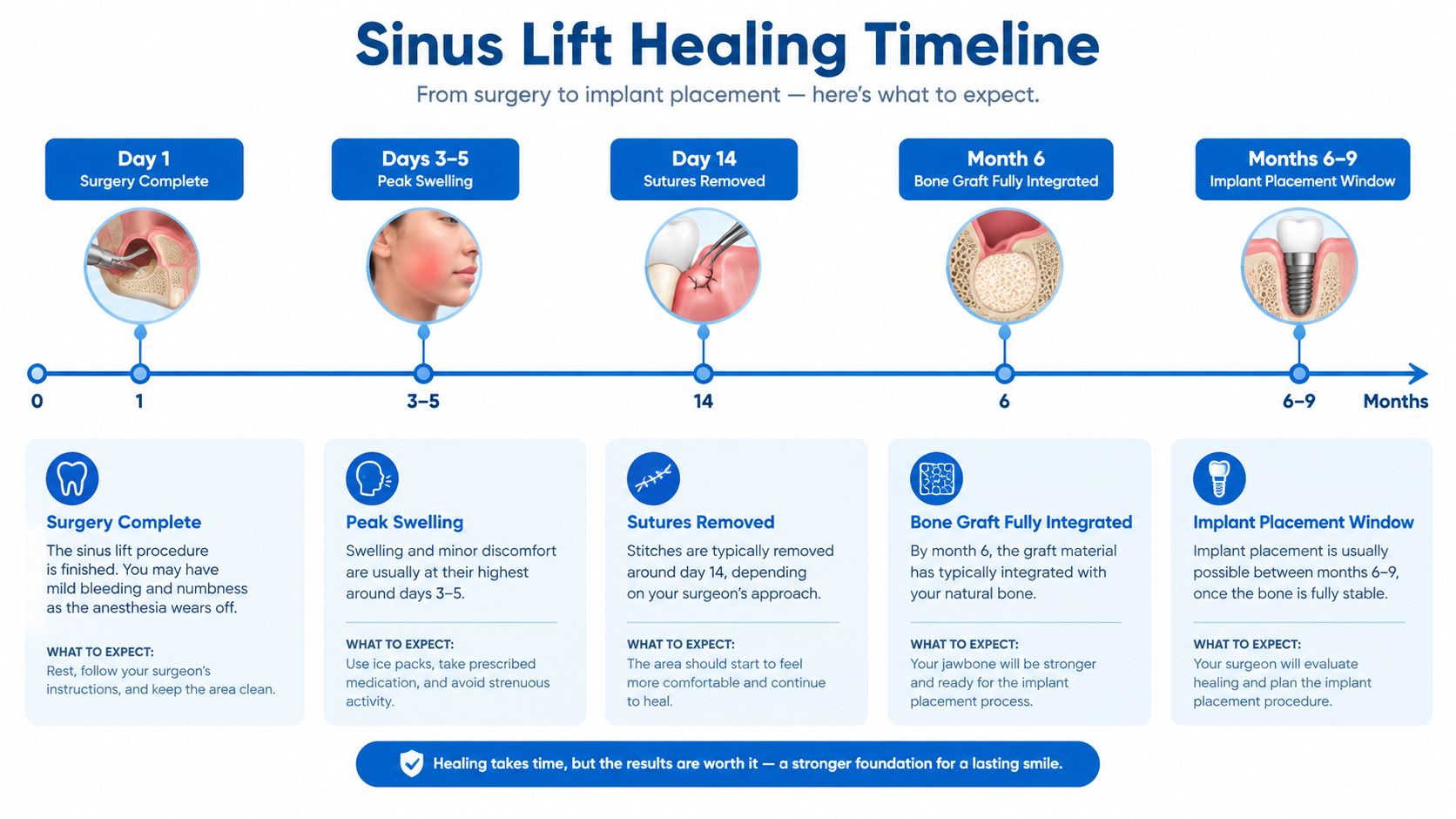
A useful way to think about it is like renovating the frame of a house. The visible work might look almost finished early on, but the structural changes keep happening after the walls look normal. The same thing happens after sinus augmentation, because comfort returns earlier than biological readiness.
The first week feels different from the first few months
The first week is usually about symptoms, not maturity. Swelling, pressure, and tenderness may improve first, while the graft is still settling in underneath. That's one reason a patient may feel ready to chew normally but still not be ready for an implant.
Practical rule: feeling better is not the same as being ready for the next surgery.
The internal healing story continues for months, and that's where many patients get tripped up. A site can look calm on the outside while still needing more time to build stable bone inside. Periodontal teams use that gap between comfort and maturity to plan follow-up care with care rather than speed.
For patients across Wilmington, Newark, Dover, and nearby Delaware communities, the important question is not just “How long has it been?” It's “What has healed, and what still needs time?” That mindset keeps expectations realistic and makes the recovery process easier to tolerate.
For a more detailed patient guide, see the practice resource on sinus lift surgery recovery.
Healing After Sinus Augmentation - Phases and Milestones
Healing after sinus augmentation is easier to understand when it's broken into phases. The body doesn't switch from “not healed” to “healed” on one date, it moves through a series of biologic steps. Each step has a different job, and each one matters for later implant placement.
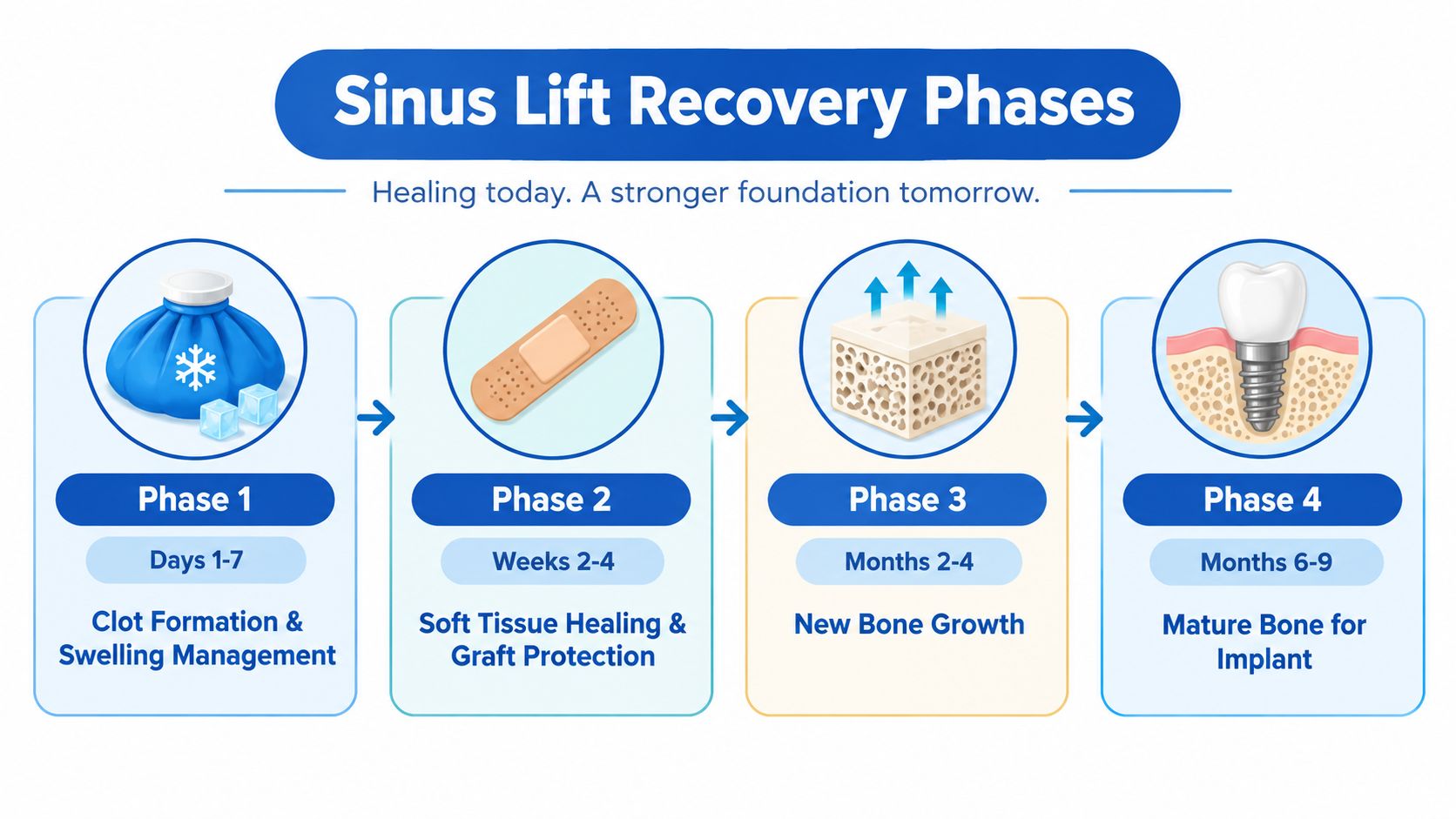
Early recovery is about protection
During the first stretch, the body focuses on clot stability, swelling control, and protecting the graft from pressure. That's why post-op instructions are so specific about avoiding anything that could disturb the surgical site. The tissue can close before the deeper graft has finished integrating, so the outside may look calmer than the inside is.
Weeks two through four are often about soft tissue closure and settling down. Soreness usually drops, the gums become less reactive, and daily comfort improves. That's encouraging, but it still doesn't mean the graft has turned into implant-ready bone.
Bone formation keeps going long after discomfort fades
The middle months are where patients often become impatient. Pain is better, meals are easier, and the mouth feels more normal, so it's natural to assume the site must be ready. In reality, the graft may still be reorganizing and strengthening under the surface.
The mouth can feel recovered before the bone is recovered.
That's why clinicians look for maturity, not just comfort. Bone needs time to form, connect, and gain the kind of quality that can support an implant. A patient who understands that distinction usually finds the waiting period much less frustrating.
For patients who are also managing gum disease or tooth loss, a staged approach can feel slow, but it's usually safer. The goal is not to finish the process fast. The goal is to place the implant when the foundation is ready for it.
For background on bone and tissue rebuilding, see periodontal bone graft information.
What Research Shows About Sinus Lift Recovery Intervals
Clinical research shows a range, not a single deadline. In a systematic review of maxillary sinus floor augmentation, delayed implant protocols used graft-healing intervals from 3 to 18 months, while immediate or simultaneous implant protocols used healing periods from 45 days to 6 months. A separate review of delayed implant placement found intervals of 3 to 12 months and concluded that at least 3 to 4 months generally appears necessary before a second surgical step can reliably place implants in grafted sites with adequate stability. Wiley review on sinus floor augmentation and implant timing
| Clinical Evidence on Sinus Lift Healing Intervals | Healing Interval | Key Finding |
|---|---|---|
| Systematic review of maxillary sinus floor augmentation | 3 to 18 months for delayed protocols, 45 days to 6 months for immediate or simultaneous protocols | Healing time varies with implant timing and site conditions |
| Review of delayed implant placement | 3 to 12 months | At least 3 to 4 months may be needed before a second surgery |
| Human histologic study after sinus augmentation | 6 ± 1 months | Ongoing regeneration can still be present at this point |
| Human comparison of 4 vs 8 months | 4 months and 8 months | 8 months showed more newly formed bone and less residual graft |
| Six-month histomorphometric study across biomaterials | 6 months | New-bone percentages varied widely by graft material |
Why the numbers seem to disagree
They don't really disagree, they describe different situations. A small, stable site with favorable anatomy may be ready sooner, while a larger augmentation or slower-remodeling graft may need more time. That's why a single healing number can be misleading if it gets treated like a universal rule.
Human histologic studies show the same pattern. One study found that biopsies collected 6 ± 1 months after sinus augmentation still showed ongoing regeneration, with graft particles in the apical area remaining relatively loose and surrounded by fibrous tissue. Another study found 28.22% ± 6.29% newly formed bone at 8 months compared with 20.02% ± 5.97% at 4 months, with a reported p-value below 0.001. The same comparison found residual graft substitute of 31.65% ± 8.70% at 8 months versus 39.12% ± 8.15% at 4 months, showing more replacement of graft material over time. Human histology study on sinus augmentation healing
A six-month histomorphometric investigation also found new-bone percentages ranging from 16.1% to 32.1% across six biomaterials, which is a good reminder that graft choice matters. The practical takeaway is simple, 4 months may be enough in selected cases, but 6 to 8 months can give better maturation. Final timing still has to match the site, not the stopwatch. Allograft and biomaterial healing data
Simultaneous Versus Delayed Implant Placement After Sinus Lift
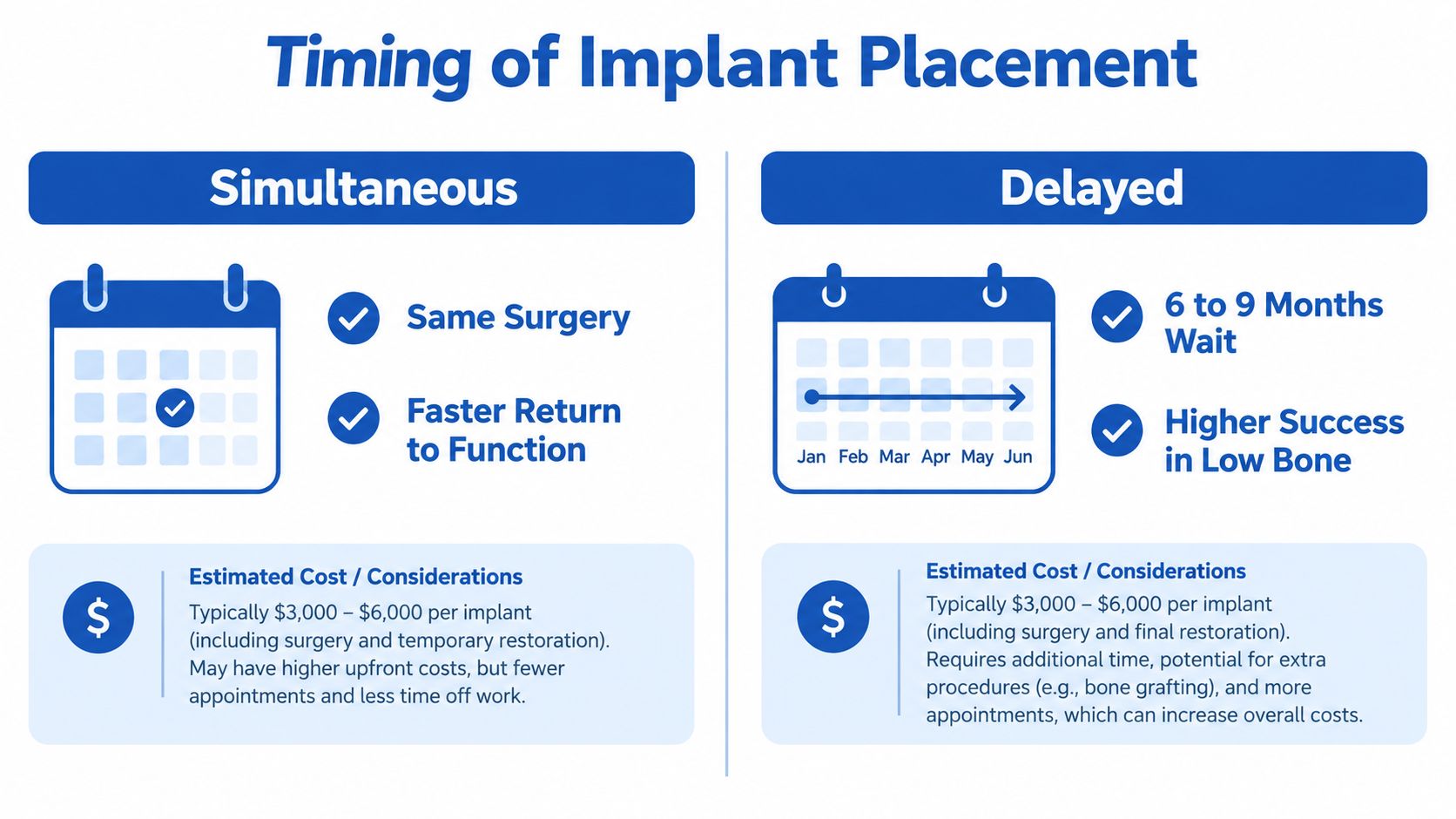
There are two broad ways to sequence treatment. In simultaneous placement, the implant goes in during the same surgery as the sinus lift, but that only works when there's enough remaining bone and the implant can achieve primary stability. In delayed placement, the graft is allowed to mature first, then the implant is placed later.
What simultaneous placement offers
Simultaneous placement can shorten the overall treatment sequence because it combines two steps. That said, it doesn't eliminate healing, it just changes how the healing is staged. The implant still needs time to integrate, and the graft still needs to mature around it.
That approach tends to be considered when the bone base is sufficient enough to hold the implant securely during surgery. If the site can't give that level of stability, a periodontist may choose to wait instead. The decision is based on anatomy, not convenience.
What delayed placement changes
Delayed placement adds time, but it can give the graft a stronger biologic start. That extra time may be useful in sites with limited native bone, more complex sinus anatomy, or slower-remodeling graft material. For many patients, this is the more cautious route.
Clinical reality: slower isn't always worse, sometimes it's the safer path to a stronger foundation.
A delayed plan can feel frustrating because it asks for patience. Still, it often gives the surgical team a clearer picture of the site before implant placement. That matters in the upper back jaw, where bone quality can vary a lot from one person to the next.
For Delaware patients weighing treatment in Wilmington, Newark, or Dover, the right timing is the one that fits the bone and the implant plan. A rushed sequence can create more problems than it solves, while a carefully staged plan can support better long-term function.
Factors That Influence Your Individual Healing Time
A sinus lift does not heal on a fixed schedule. Recovery depends on how much native bone remains, the shape of the sinus, the graft material used, the surgical approach, overall health, smoking, infection, and whether the implant could be held stable during surgery. One patient may feel comfortable early and still need more time for the graft to mature beneath the surface.
Why two similar surgeries can heal differently
Two sites can look similar on paper and still heal at different speeds. One may begin with more native bone, which gives the graft better support from the start. Another may have a wider or more complex sinus space, which changes both the surgical plan and the healing environment.
Graft material matters too. Some materials remodel faster than others, so the bone may look and behave differently from case to case. General health can also slow repair, and smoking can make healing less predictable. Infection, inflammation, and poor postoperative compliance can all interfere with progress.
Sinus health changes the story too
Preexisting sinus disease, airway obstruction, and membrane perforation can affect recovery. A clinical review of sinus-lift-related rhinosinusitis found that acute or chronic sinusitis was more common in patients with preexisting sinus disease, sinonasal obstruction, or membrane perforation, and it suggested that preoperative otolaryngology evaluation may help higher-risk patients. Clinical review of sinus-lift-related rhinosinusitis
Symptoms alone never tell the full story. A patient may have only mild soreness and still need close follow-up, while another may feel fairly normal even though the graft is still consolidating. Healing is individualized, and the safest timeline comes from matching the biology to the treatment plan.
How Periodontists Determine When You Are Ready for Implants
Readiness for implants means the site has enough bone volume, enough stability, and enough biological maturity to support the next step. Periodontists do not decide that from the calendar alone. They pair a clinical exam with imaging, because the outside of the mouth cannot show what the graft is doing deep inside the bone.
A normal-looking scan can be misleading. The graft may look settled while the internal bone structure is still organizing, like concrete that has set on the surface but is still hardening inside. That is why periodontists read the images carefully and look for more than just a familiar outline.
What the follow-up visit is really checking
The visit is not only about whether swelling has faded. It is about whether the graft has consolidated, whether the ridge still looks stable, and whether the site can accept an implant safely. Clinical judgment and three-dimensional imaging matter most here.
A 2025 study found that grafted volume looked stable at six months, yet the trabecular structure was still immature. Another 2025 case series reported continued graft integration and maturation through 12 months. The point is simple. A scan can show progress without proving full readiness. 2025 study on graft stability and trabecular immaturity
Periodontal Associates of Delaware uses advanced planning tools, including guided tissue regeneration resources, and may also use i-CAT 3D cone beam imaging and X-Nav dynamic surgical navigation when implant planning is appropriate. Used together, these tools help the team map the site more precisely once healing has progressed enough.
The best clearance date is the one confirmed by exam and imaging, not the one circled on a calendar.
Patients should ask direct questions at follow-up. Has the graft matured enough? Is the bone volume stable? Does the scan suggest that more healing is still needed? Those answers are more useful than a generic timeline, especially for adults across New Castle and Kent Counties who want a plan that fits their own mouth, not someone else's average.
Individual results vary, and a periodontist needs to confirm the safest sequence for each patient.