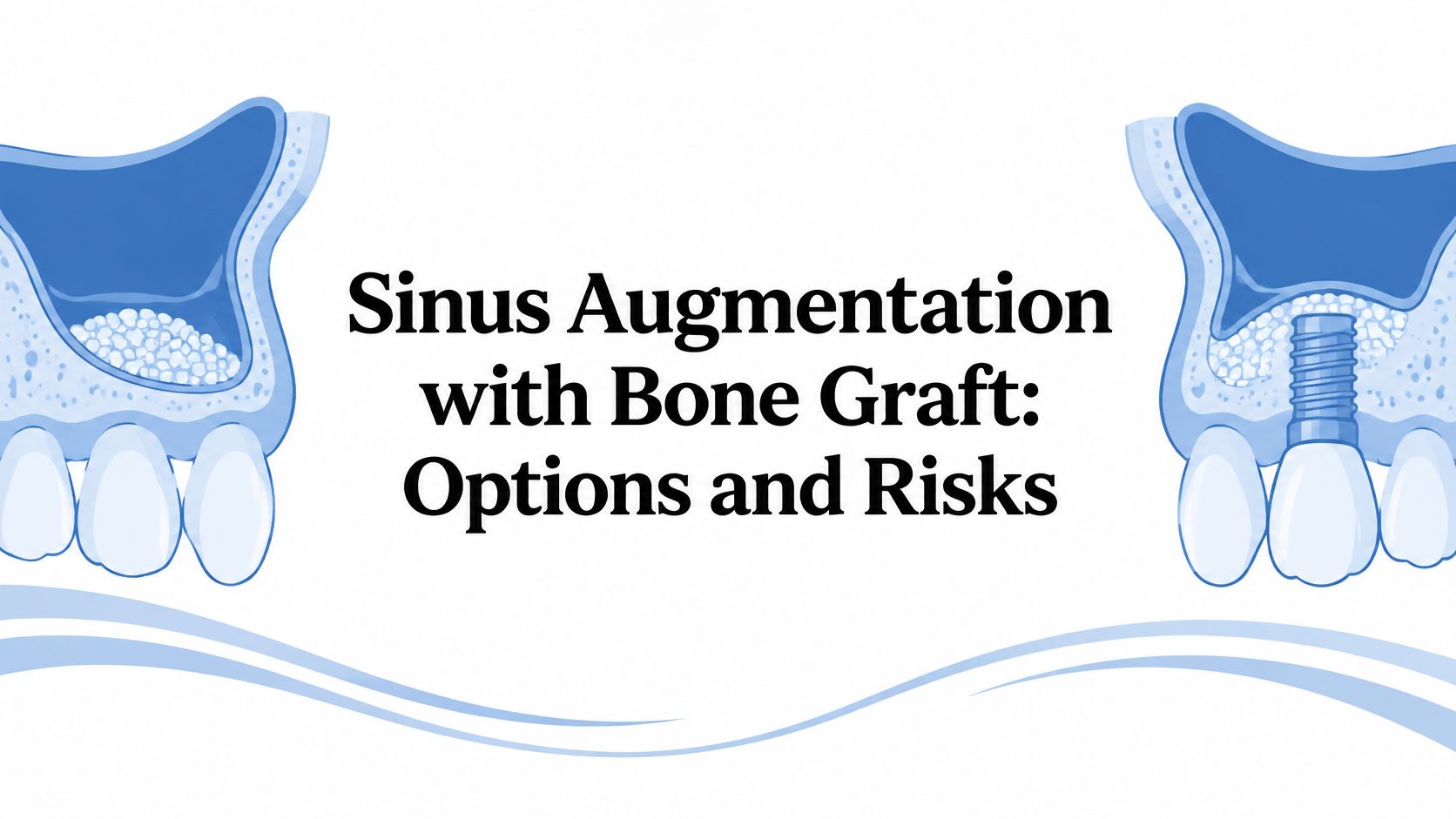
An adult preparing to replace a missing upper molar may expect a conversation about implants, then hear that a bone graft and sinus lift may be needed first. That can sound like an unexpected complication, especially for someone already nervous about gum surgery. Sinus augmentation with bone graft is a way to build an implant foundation when the bone beneath the sinus is too limited, but the decision should follow a careful review of the site, not a one-size-fits-all rule.
For adults across New Castle and Kent Counties, including Pike Creek, Hockessin, Bear, Middletown, and surrounding communities, understanding the choices can make that conversation less intimidating. The important questions concern the available bone, the graft material, the surgical approach, and what happens if the original plan needs to change.
Table of Contents
- What a Sinus Lift Does and When Bone Height Calls for One
- Lateral Window or Crestal Approach Explained
- Bone Graft Materials and How They Compare
- How the Sinus Lift Procedure Unfolds Step by Step
- Healing Timeline and When Implants Can Be Placed
- Membrane Tears, Complications and What They Mean
- Get a 3D Sinus Evaluation Before Choosing a Graft
What a Sinus Lift Does and When Bone Height Calls for One
A shelf that's too thin to support a heavy book needs reinforcement. The same basic idea helps explain a sinus lift, also called sinus augmentation: the periodontist adds bone beneath the maxillary sinus, the air-filled space above the upper back teeth, to create a foundation for an implant.
Rather than filling the sinus itself, the surgeon gently raises its lining and places graft material beneath it. Adults who have lost upper back teeth may need this procedure because the supporting bone can thin and the sinus can extend downward into the available space.
Residual Bone Height and What It Generally Means
The following bands are discussion guides, not treatment cutoffs. A systematic review of sinus-floor elevation identifies approximately 4 to 6 mm of remaining height as a range in which augmentation is commonly considered; the surrounding bands help frame an individualized discussion.
| Residual Bone Height | What It Generally Means | Common Next Question |
|---|---|---|
| Under about 4 mm | Often too little bone for a standard implant to stay stable | Whether grafting or another implant option fits the site |
| About 4 to 6 mm | Sinus elevation is commonly considered | Which surgical approach fits and whether the implant can go in at the same visit |
| Over about 6 mm | A standard implant may be possible in some cases | Ridge width, sinus anatomy, and bite forces still need review |
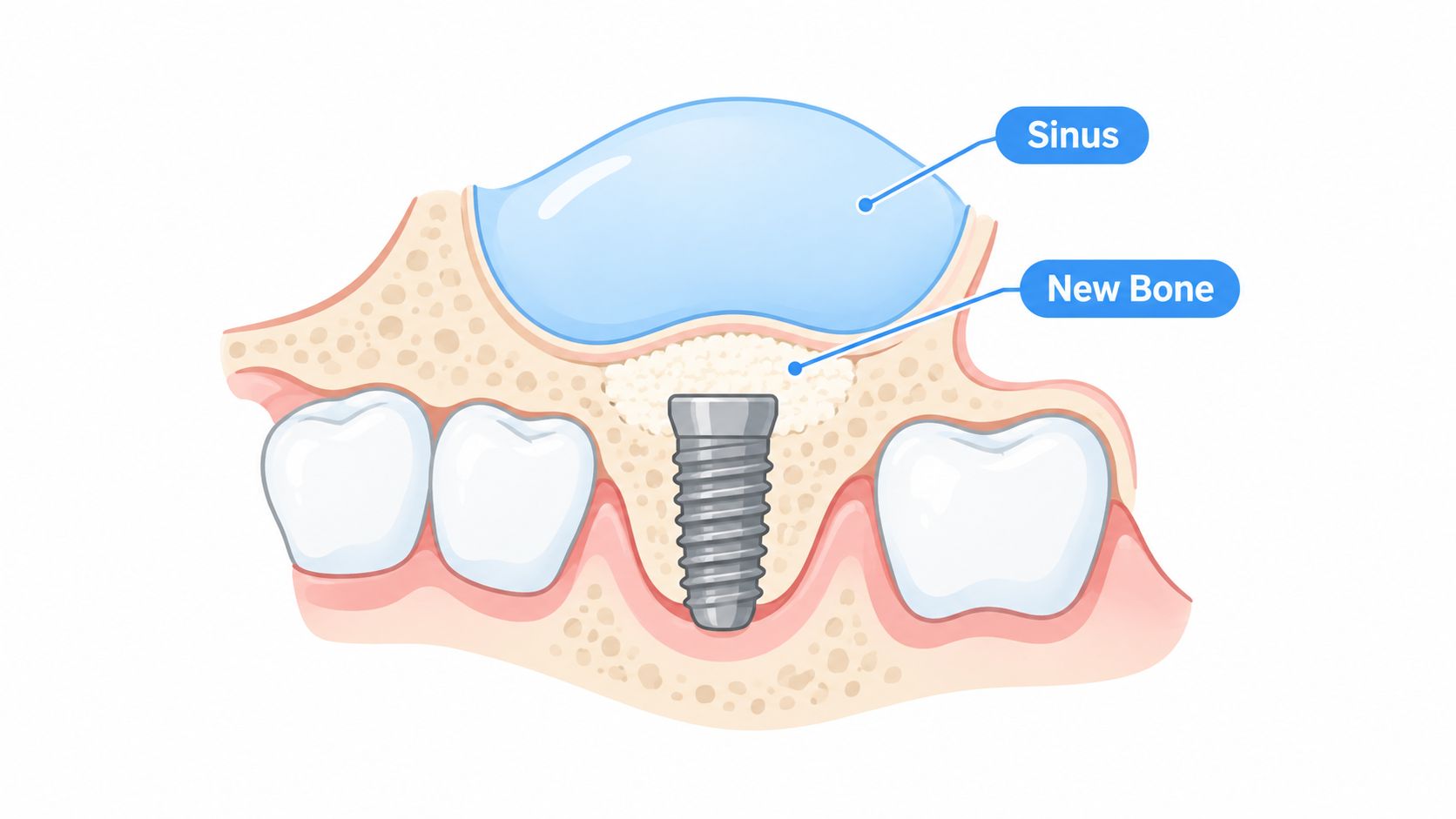
Height alone doesn't decide whether grafting is necessary. A tall but narrow ridge may present a different challenge than a wider ridge with less height. Infection, smoking, medical history, bite forces, and the planned implant position also matter.
Practical starting point: Patients can ask the periodontist to show the bone measurements on the three-dimensional scan and explain which finding limits implant placement.
The scan discussion should include alternatives. A recommendation for augmentation should explain why the added foundation is useful for that particular site, rather than treating a measurement as an automatic instruction to operate.
Lateral Window or Crestal Approach Explained
Reaching the space beneath the sinus lining is a little like reaching an attic. A lateral-window approach resembles making a window in the side of a house, while a crestal approach resembles using a hatch from below. These are access routes, not competing grades of treatment.
Through a lateral window, the periodontist can lift the lining over a larger area. Through a crestal opening, the surgeon works through the planned implant site, generally using a smaller opening. The amount and location of the needed augmentation help determine which route offers appropriate access.
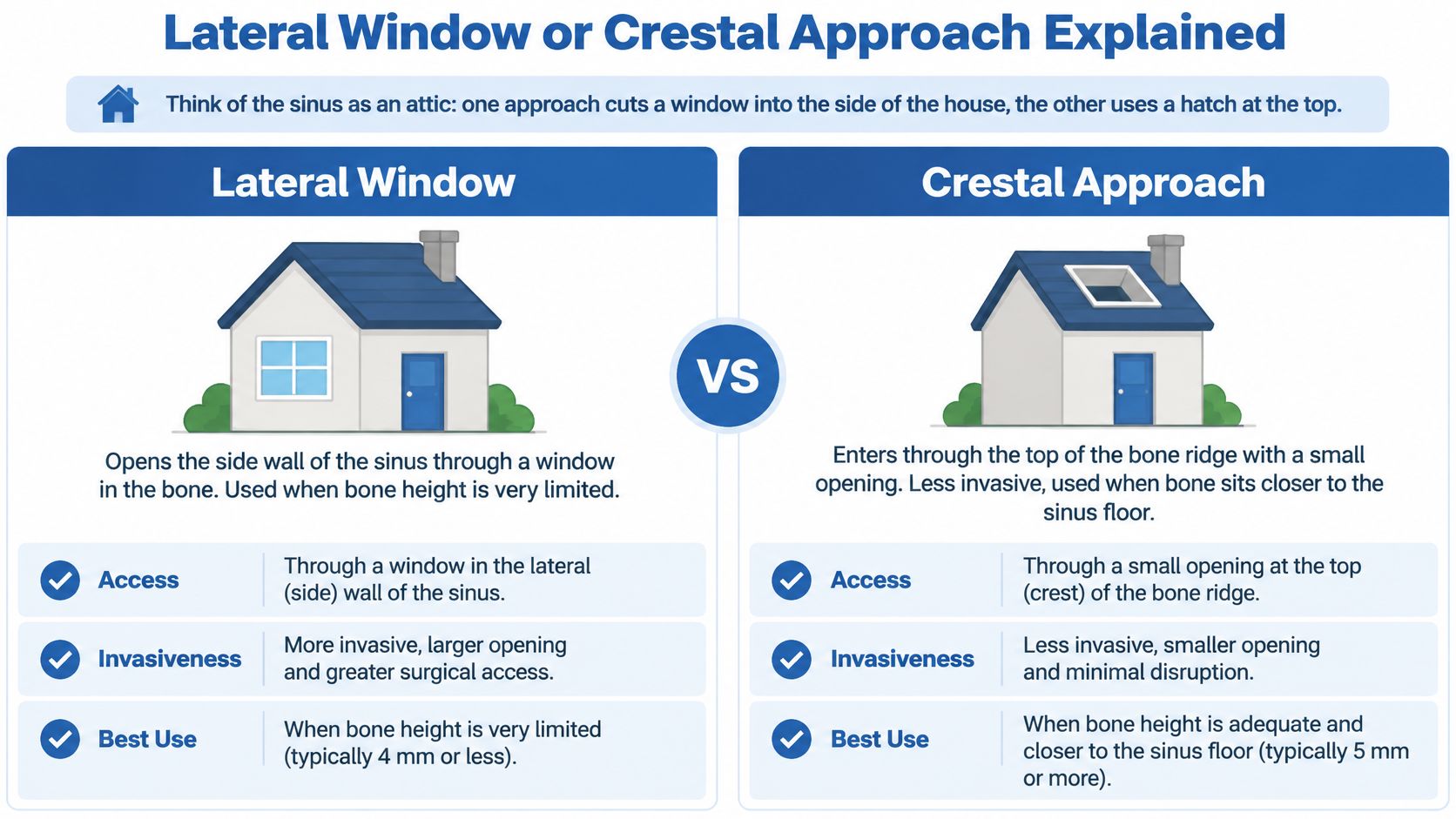
Lateral Window and Crestal Approach Compared
The measurements and complication comparison below describe the specific treatment comparison in the Cochrane review of sinus augmentation approaches, not universal rules. That evidence also reports pooled implant survival of 97.7% at 3 to 6 years, although the studies differed and smoking may negatively affect prognosis.
| Factor | Lateral Window | Crestal |
|---|---|---|
| Access point | Window cut in the side of the upper jaw | Opening made through the implant site |
| Area of sinus lining lifted | Larger area | Smaller area |
| Bone height often suited | Cases needing more vertical gain | About 3 to 6 mm of residual bone in the cited review |
| Implant length in the cited review | At least 10 mm | About 8 mm |
| Complication pattern in the cited review | Possibly more complications | Possibly fewer complications |
The comparison doesn't mean that a smaller opening is always the safer choice. A surgeon needs enough access to carry out the planned lift and manage the lining appropriately. Choosing a limited approach for a site that needs broader access may not serve the patient's needs.
What Changes the Recommendation
The periodontist also evaluates sinus septa, which are internal bony partitions, along with membrane findings, ridge width, tooth position, and infection. These features can affect access even when neighboring implant sites have similar bone height.
For example, a site needing localized elevation presents a different task from a broader area needing substantial vertical rebuilding. The clinician should explain which anatomical finding favors the proposed route, rather than describing either technique as universally superior.
The treatment sequence also matters. Some sites permit implant placement during augmentation; others need a separate healing stage. Those choices should be explained before surgery, including the circumstances that could lead the surgeon to modify the plan.
The survival figure above describes a group of treated patients. It isn't a guarantee for an individual, and it doesn't establish that every approach or implant length performs equally in every jaw.
Bone Graft Materials and How They Compare
No single graft material is proven best for every sinus lift. The useful question isn't which material is most natural or most expensive. It's which material can support the planned reconstruction while fitting the patient's health, anatomy, and preferences.
Graft material can be understood as building material placed within a protected space. Different materials behave differently as the body forms bone and remodels the graft, so faster replacement isn't automatically a better result.
Graft Material Types and Reported Findings
The survival findings below come from a review of implants placed in grafted maxillary sinuses. Separately, a review addressing graft selection and clinical findings reports the volume and allograft complication findings shown below, including volume reductions of 7.30% ± 15.49% for xenograft and 41.71% ± 12.63% for autogenous bone at six months.
| Material | Source | Reported Findings | Points to Discuss |
|---|---|---|---|
| Autogenous bone | The patient's own bone, usually taken from a nearby site | 93.0% implant survival in lateral-window studies; about 41.71% volume reduction at six months | Requires a second surgical site |
| Allograft | Processed donor human bone | 19.6% complications in a 2025 clinical review of demineralized freeze-dried allograft | Donor screening and processing method |
| Xenograft | Processed animal bone mineral, usually bovine | About 7.30% volume reduction at six months | Often used when the implant goes in at the same visit |
| Alloplast | Lab-made synthetic material | No material-specific outcome figure established in this comparison | Which product is used and why |
| Combination graft | The patient's own bone mixed with a substitute | 96.5% implant survival across 833 implants | Often favored when implant placement is delayed |
Autogenous bone requires harvesting, so patients must weigh the additional surgical site. Allograft and xenograft raise different questions about tissue origin and processing, while synthetic materials may suit particular personal preferences. Combination grafts allow the clinician to use more than one material within the same plan.
Bone Replacement and Space Maintenance Aren't the Same
A graft has to do more than disappear and be replaced. It must also help preserve the space intended for the implant foundation. The reported volume findings illustrate why rapid remodeling doesn't necessarily mean better retention of the reconstructed shape.
A material that changes more slowly may still serve a useful purpose if the treatment requires sustained space maintenance.
The allograft complication rate in the table was numerically higher than comparison groups, but the difference wasn't statistically significant. That finding shouldn't be turned into a blanket conclusion that all donor-derived grafts are less safe.
Likewise, survival percentages and volume measurements come from different study designs and aren't directly comparable. The broader guide to periodontal bone grafts provides context, but selection still depends on residual bone, sinus anatomy, timing, medical history, ethical preferences, and clinician experience.
How the Sinus Lift Procedure Unfolds Step by Step
Anxiety often increases when the sequence of treatment is unclear. A preoperative discussion should explain the expected steps, available comfort options, and how the patient can signal discomfort during surgery.
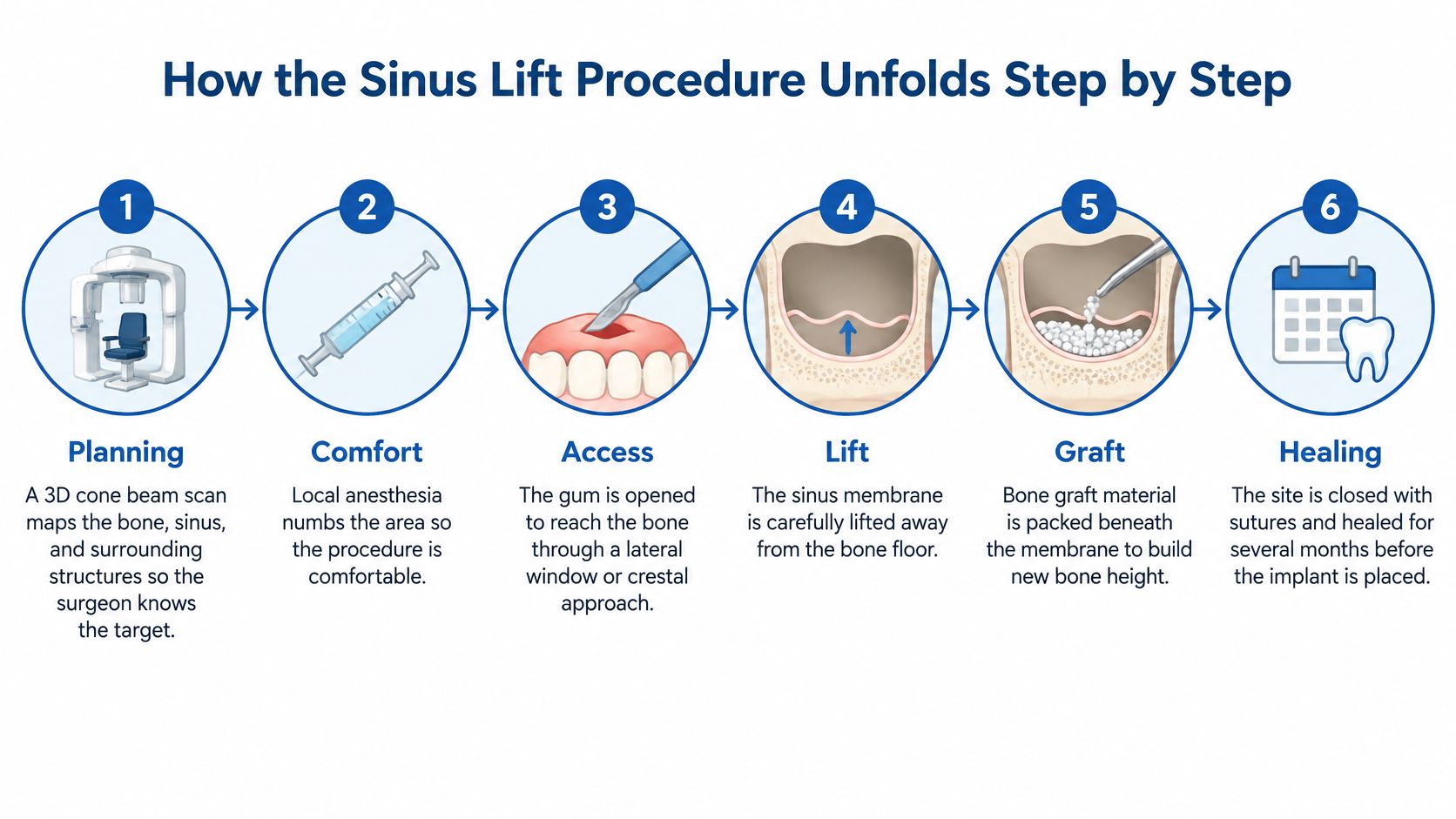
The illustration summarizes the process. Its healing sequence represents a staged pathway; the actual implant timing depends on the treatment plan.
Planning, Comfort, and Access
Planning establishes the target. A three-dimensional cone beam scan maps the bone, sinus, and surrounding structures. The surgeon uses that information to identify the intended graft space and anticipate access challenges.
Comfort is addressed before treatment begins. Local anesthesia is used, and appropriate sedation options can be discussed beforehand. The patient and team should agree on a signal for discomfort or a needed pause, without assuming treatment will be pain-free.
The gum tissue is opened. The surgeon lifts the tissue to expose the underlying bone. This creates access while allowing the tissue to be repositioned over the surgical site afterward.
The planned entry is made. The surgeon creates either a lateral window or a crestal opening. The chosen route provides access to the area that needs augmentation.
The sinus lining is lifted. The lining is carefully separated from the underlying bone. This creates the protected space where the graft will be placed.
Containment, Closure, and Follow-Up
The membrane is checked. The surgeon assesses whether the lining remains intact and whether the graft can be contained. A manageable tear may be repaired before treatment continues; a less controllable finding may change the sequence.
The graft material is placed. The chosen material fills the planned space beneath the raised lining. A barrier membrane may also be used to help protect or contain the grafted area.
The tissue is closed. The gum is repositioned and stitched. Closure protects the surgical site during early healing.
Implant timing is confirmed. Depending on the plan and the stability available during surgery, the implant may be placed at that appointment or later. The decision must reflect the actual site, not just the preferred schedule.
Aftercare instructions are reviewed. The team explains nasal precautions, including avoiding forceful nose blowing, along with smoking restrictions and reasons to call. Written instructions help patients distinguish expected recovery from symptoms that need review.
A patient doesn't need to memorize the surgical details. Understanding the purpose of each stage can make it easier to ask focused questions and participate in planning.
The sequence can change if surgery reveals something unexpected. A change may protect the graft or allow a local condition to heal before treatment resumes. Before the procedure, the periodontist should explain those possibilities and how the patient will receive an update if the original plan changes.
Healing Timeline and When Implants Can Be Placed
The most pressing question is often how long treatment will take before the implant can go in. The answer depends on whether the site can support an implant immediately or needs graft maturation first. Healing also occurs in phases, and feeling better doesn't necessarily mean the bone is ready.
Typical Healing Phases After a Sinus Lift
These are broad planning phases rather than promised deadlines. The periodontist sets the schedule according to the procedure, examinations, and imaging findings.
| Phase | Typical Timing | What Usually Happens |
|---|---|---|
| Early recovery | First few weeks | Swelling, soreness, and sinus pressure often ease; follow-up check |
| Graft maturing | Several months, set by imaging | New bone forms and the graft integrates with existing bone |
| Staged implant placement | After the graft has matured | Implant placed once the site is ready |
| Simultaneous placement | Same visit as the graft | Possible when enough native bone supports the implant |
| Final restoration | After implant healing | Crown or bridge attached |
Early soreness, swelling, or cheek pressure can feel different from the deeper bone-healing process. A follow-up examination, and imaging when indicated, help the clinician assess progress that isn't visible from the outside.
Why Immediate Placement Isn't Always Better
Simultaneous placement requires enough existing, or native, bone to hold the implant securely at surgery. The new graft doesn't substitute for that initial mechanical support. When support is inadequate, staged treatment allows the grafted site to mature before implant placement.
A systematic review of sinus augmentation outcomes covered 39 studies, 2,046 patients, and 6,913 implants, reporting 91.49% overall implant survival over 12 to 75 months; survival was 92.17% with simultaneous placement and 92.93% with delayed placement. The similar group results support considering either sequence when the clinical conditions fit.
Those figures don't establish that timing is interchangeable for every patient. Patients selected for simultaneous treatment may have different starting anatomy from those who need staging. A staged recommendation isn't, by itself, a sign that treatment is going poorly.
Healing checkpoint: Comfort is useful feedback, but the periodontist must assess the foundation before advancing treatment.
The explanation of a sinus lift and implant at the same time can help patients prepare for that timing discussion. The final schedule should follow imaging and healing progress rather than a fixed calendar.
A patient's planning conversation should also distinguish implant placement from completion of the tooth replacement. The crown or bridge follows implant healing, so the full treatment sequence includes more than the graft alone.
Membrane Tears, Complications and What They Mean
A membrane tear doesn't automatically mean the sinus lift has failed. The Schneiderian membrane is the thin lining inside the sinus. Its condition matters because the surgeon needs to maintain a suitable, contained space for the graft.
A review of maxillary sinus-floor augmentation complications reported a mean perforation incidence of 3.8%, ranging from 0% to 21.4%, specifically for osteotome-mediated elevation with simultaneous implant placement. Those figures shouldn't be treated as a universal risk estimate for every sinus-lift technique.
A Tear Creates a Decision Point
The surgeon considers the tear's size and location, contamination, membrane stability, and the ability to contain the graft. A consensus discussion of sinus augmentation management describes repair with a resorbable collagen membrane for perforations up to approximately 10 mm when reliable containment is possible; larger tears may require staging or stopping.
- Repair and continue: A manageable tear may be covered or repaired when the surgeon can reliably isolate the grafted space.
- Modify the procedure: The surgeon may change the planned sequence if proceeding as originally intended would compromise containment.
- Stop and allow healing: A larger or difficult-to-control tear, or an unhealthy sinus, may make postponement the more appropriate choice.
The measurement isn't a stand-alone permission to continue. A smaller tear in an unfavorable position can present a different problem from an accessible tear with stable surrounding tissue.
Other Symptoms Deserve Attention
Other reported complications vary in severity and may overlap with ordinary postoperative symptoms. Patients shouldn't try to diagnose the cause at home.
- Postoperative infection: Increasing pain, swelling, fever, or drainage may signal a problem requiring assessment.
- Bleeding or nosebleed: Blood may come from the surgical site or nose; persistent or concerning bleeding warrants contact with the treating team.
- Nasal blockage: A blocked or congested sensation should be reported if persistent or worsening.
- Hematoma: Collected blood may cause bruising or localized swelling.
- Positional vertigo: A spinning sensation with changes in head position needs clinical advice.
- Graft migration or loss: Displacement may compromise the grafted site and requires professional evaluation rather than self-assessment.
Problems involving graft containment and sinus health are discussed in the evidence review of sinus-floor augmentation. Early reporting gives the clinician an opportunity to assess symptoms and decide whether treatment is needed.
Worsening pain, swelling, fever, drainage, or persistent sinus symptoms should be reported promptly. Patients shouldn't assume that steadily worsening symptoms are just part of healing.
A tear may change the treatment timeline and associated fees. Before surgery, patients can ask how the practice handles repairs, postponed grafting, additional visits, and any revised cost estimate.
Get a 3D Sinus Evaluation Before Choosing a Graft
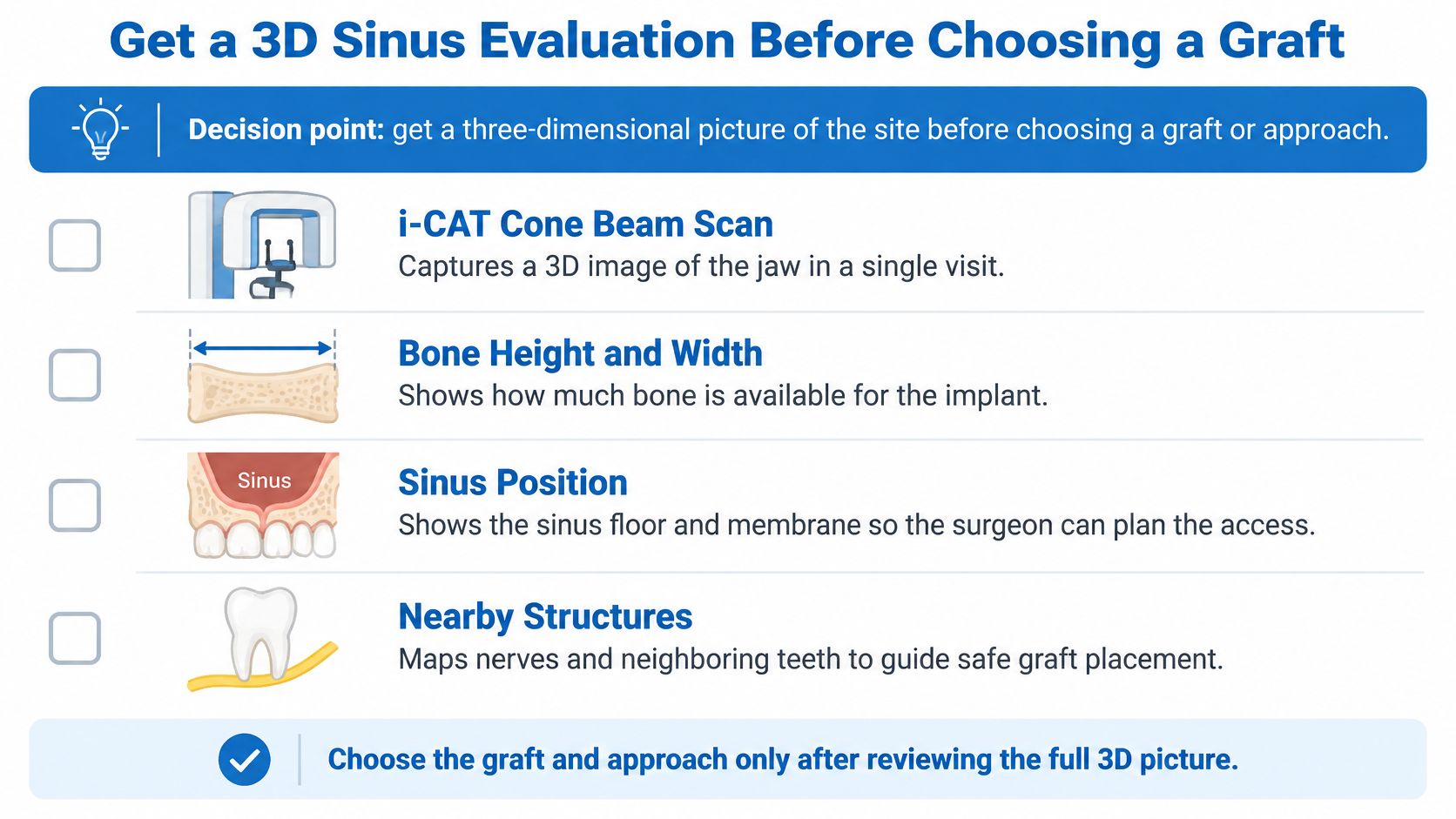
The decision should begin with the anatomy, not a preferred graft product. A three-dimensional evaluation helps the periodontist understand what needs rebuilding and whether the sinus presents findings that should change treatment.
i-CAT 3D cone beam imaging shows bone height and width, the sinus floor, internal partitions, and lining findings. X-Nav dynamic surgical navigation supports implant placement by relating the surgical position to the planned position during treatment. Neither technology eliminates surgical risk.
Preparation for the Consultation
An evidence review of grafted maxillary sinus augmentation supports planning around the full anatomy and implant position rather than a single height threshold. The related guide to dental implant space requirements helps explain why the planned tooth position matters alongside the bone measurements.
Patients can bring a focused checklist:
- Approach: Which surgical route fits the bone and sinus findings?
- Material: Which graft is recommended, and what purpose does it serve?
- Sequence: Is implant placement planned at the same visit or after graft healing?
- Contingency: How would a membrane tear change treatment?
- Recovery: What healing phases and follow-up visits should be anticipated?
- Preparation: What instructions apply to smoking, medications, and existing sinus symptoms?
Active gum disease also belongs in the planning discussion. Available periodontal treatments include LANAP laser gum surgery using the FDA-cleared PerioLase MVP-7, but gum disease treatment and sinus augmentation address different needs. The periodontist should explain how any needed periodontal care fits the implant plan.
Costs depend on the approach, graft type, imaging, and whether treatment is staged. Insurance coverage varies, and the office can review the anticipated plan and fees before surgery without promising coverage or a fixed outcome.
Individual results vary. An examination and consultation with a periodontist are necessary to determine which options are appropriate.
Periodontal Associates of Delaware is a board-certified periodontal practice offering sinus augmentation and implant planning with i-CAT imaging and X-Nav navigation across its Wilmington, Newark, and Dover offices. Adults considering a sinus lift can request an appointment at the nearest Wilmington, Newark, or Dover office to review their scan, graft options, and expected treatment sequence.