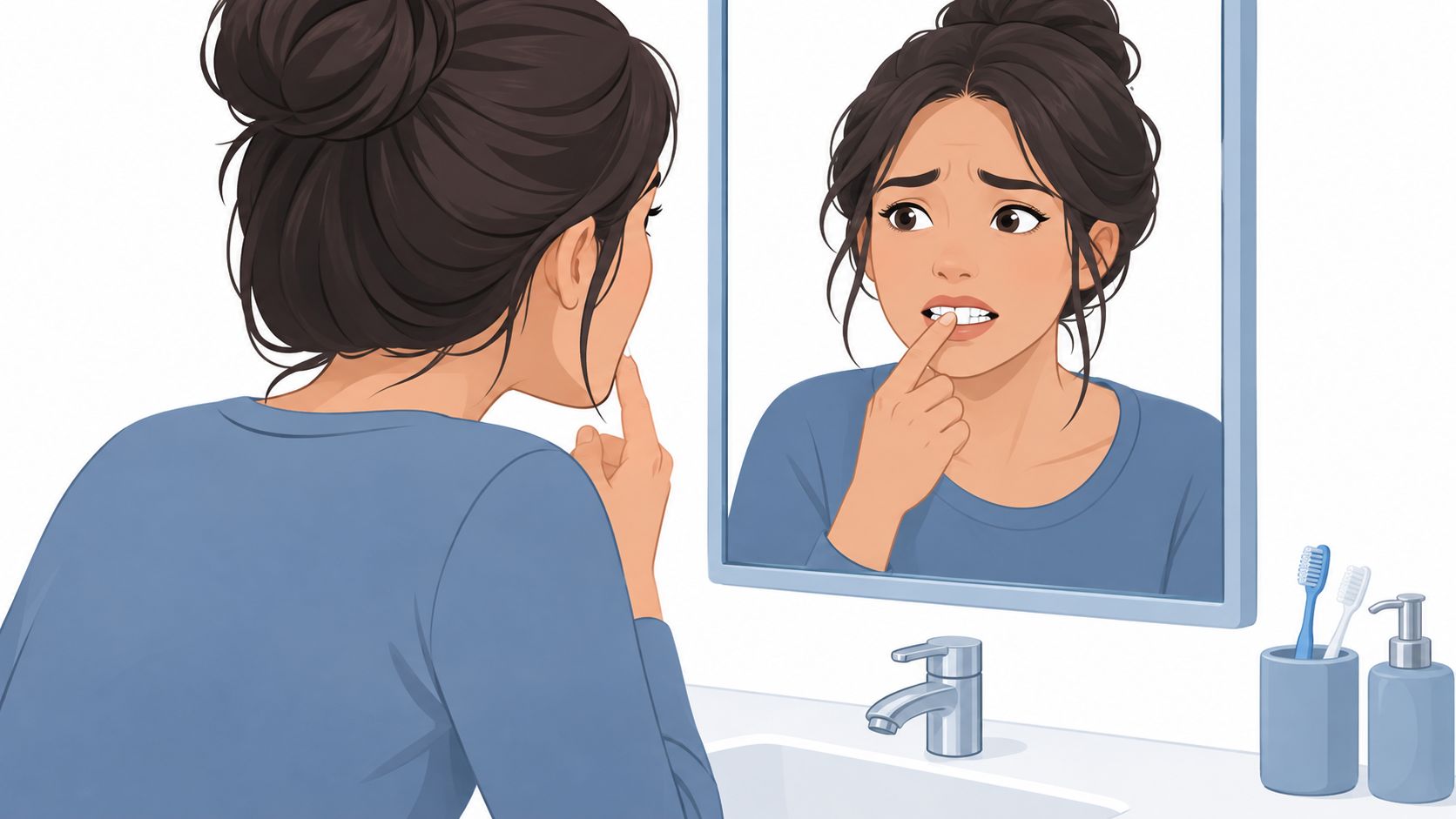
A front tooth shifts slightly when a person bites into an apple. The movement is small, but the reaction is immediate: the person checks the tooth in the mirror, presses it with a finger, and starts wondering whether extraction is next. That fear is understandable, but a mobile adult tooth is not automatically a lost tooth.
The mobility of teeth is a clinical finding, not a diagnosis by itself. It can reflect periodontal inflammation, reduced bone support, altered biting forces, root shape, trauma, or several factors working together. A periodontist needs to identify the cause, measure the supporting tissues, and observe how the tooth responds to treatment before recommending that it be retained or replaced.
Table of Contents
- When a Tooth Feels Loose - What It Really Means
- How Periodontists Grade Tooth Mobility
- Why Teeth Become Mobile Beyond Gum Disease
- Treatment Options for Mobile Teeth
- Prognosis - Can Mobile Teeth Be Saved Long-Term
- What to Record Before Your Periodontal Evaluation
- Taking the Next Step Toward Tooth Stability
When a Tooth Feels Loose - What It Really Means
A patient may notice movement while brushing, flossing, eating, or touching the tooth with the tongue. Sometimes the tooth feels different because the bite has changed. In other cases, inflammation around the tooth has made the periodontal ligament more compliant, so the tooth moves more than it should under pressure.
A periodontist doesn't decide the future of that tooth from movement alone. The examination also considers pocket depth, clinical attachment loss, inflammation, radiographic bone support, root anatomy, furcation involvement, restorability, and occlusal forces. A tooth with mild movement and controllable inflammation may have a very different outlook from a tooth with the same grade of movement, a root fracture, and advanced structural loss.
The setting matters, too. A 2023 cross-sectional study at a tertiary-care dental center found clinically detectable mobility in 65 of 163 patients, or 39.88%, and recorded 271 mobile teeth among those patients. Most of those teeth, 234 of 271, or 86.35%, were classified as Grade 1. Because the participants attended an advanced-care center, those findings aren't a measure of mobility in the general population, but they show why early mobility deserves careful assessment rather than panic. The study's clinical findings are available here.
Practical rule: The first question isn't “Should this tooth be pulled?” It's “Why is this tooth moving, and can the cause be controlled?”
Periodontal Associates of Delaware evaluates mobility tooth by tooth and follows a staged approach. Disease control comes first when inflammation is present. Bite forces, hygiene access, and restorability then help determine whether the tooth should receive continued periodontal care, regenerative treatment, temporary stabilization, or replacement. Some mobile teeth can remain useful for many years when their causes are addressed, although individual results vary.
How Periodontists Grade Tooth Mobility
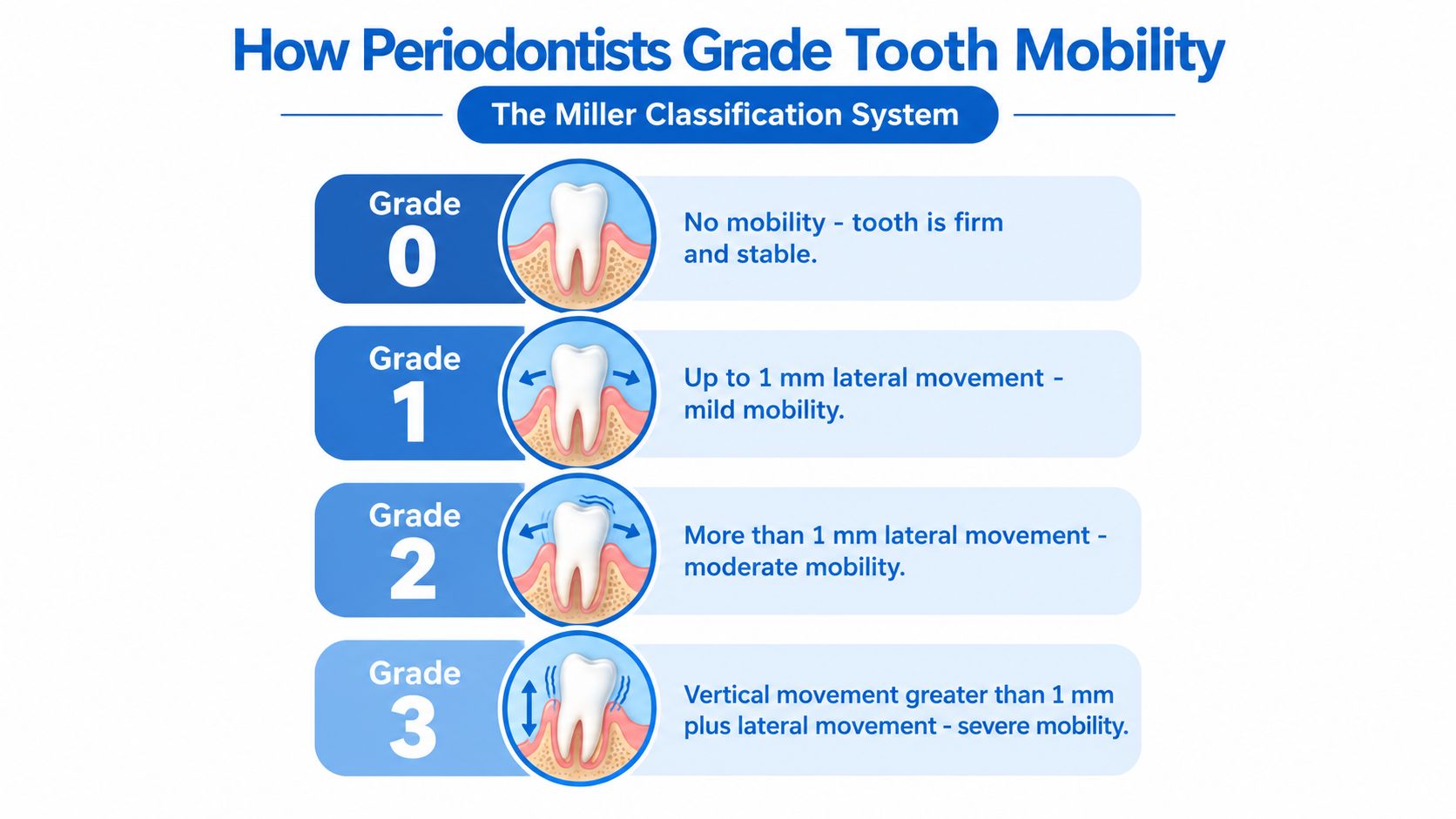
When a tooth feels loose, the next step is not to guess whether it is doomed. A periodontist starts by grading how much it moves, in a consistent way, so the finding can be tracked over time. The most widely used reference is the Miller mobility classification. The historical classification and clinical context are described in this periodontal therapy study
The four Miller grades
- Grade 0: No movement beyond normal physiologic motion.
- Grade 1: Horizontal movement up to 1 millimeter.
- Grade 2: Horizontal movement greater than 1 millimeter.
- Grade 3: Horizontal movement plus vertical movement, also called axial depressibility.
That scale helps translate a patient's experience into a clinical record. In plain terms, Grade 1 often feels slightly different to the patient or the clinician. Grade 3 usually feels obvious. The grade describes the amount and direction of movement. It does not identify the cause by itself.
Normal teeth are not welded into bone. They sit in a periodontal ligament, which works like a tiny shock absorber between the root and surrounding bone. Because of that ligament, a healthy tooth can show a very small amount of movement. Physiologic movement is commonly described as about 0.2 millimeters horizontally and 0.02 millimeters axially. Movement beyond that range can reflect inflammation, reduced support, unusual biting forces, or several factors acting together.
| Grade | Mobility Description | Clinical Significance |
|---|---|---|
| Grade 0 | No abnormal movement beyond physiologic motion | The tooth is clinically firm |
| Grade 1 | Horizontal movement up to 1 millimeter | Mild mobility that may relate to inflammation, loading, or early support changes |
| Grade 2 | Horizontal movement exceeding 1 millimeter | More noticeable movement requiring evaluation of periodontal support and function |
| Grade 3 | Horizontal and vertical movement | Severe mobility that may indicate substantial support loss or another serious problem |
Why the grade isn't the whole prognosis
A mobility grade is a starting point, not a verdict. Two teeth can share the same grade and have very different outlooks depending on pocket depth, attachment loss, inflammation, bite forces, root shape, and whether the problem improves after treatment.
This is why repeated measurements matter. A periodontist compares mobility with probing depths, attachment levels, bleeding, radiographic bone support, and bite contacts before and after initial therapy. A tooth that becomes firmer after inflammation is controlled is telling a different story from one that stays mobile or worsens.
That prognosis-based approach is often reassuring. Mobility severity is not the same as inevitable tooth loss, and treatment aims first to stabilize the causes of movement rather than just immobilize the tooth.
Why Teeth Become Mobile Beyond Gum Disease
Periodontal disease is a major cause of adult tooth mobility, but it isn't the only explanation. A tooth stays stable through the combined support of the periodontal ligament, alveolar bone, root shape, surrounding inflammation, and the forces placed on it during chewing and clenching.
That combination explains why one tooth may move while its neighbors remain firm. A front tooth may receive a different load from a molar. A tooth with a shorter or differently shaped root may resist side-to-side forces less effectively. Previous tooth loss can also redistribute chewing pressure to the remaining teeth.
Local factors and body-wide risk
A large retrospective study of 15,881 adults with periodontitis reported clinically significant mobility in 70.4% of patients and 26.9% of evaluated teeth. Grade 1 was most common, and incisors represented 56.3% of mobile teeth. The strongest independent predictors included advancing age, previous tooth loss, and hypertension. The study's abstract and findings are available through the University of Minnesota.
Those findings don't mean hypertension alone causes a particular tooth to loosen. They show why medical history belongs in periodontal risk assessment. Blood-pressure management should remain coordinated with the patient's medical team, while the periodontist evaluates the local dental causes.
Common contributors
- Periodontal inflammation: Infection can damage the periodontal ligament and the alveolar bone that supports the root.
- Excessive bite forces: Clenching, grinding, or a contact that strikes too heavily can increase movement, especially when support is already reduced.
- Trauma: A fall, impact, or sports injury can stretch or damage the periodontal ligament.
- Root and bone anatomy: Root length, root shape, bone level, probing depth, and furcation involvement affect resistance to movement.
- Treatment history: Previous extractions can alter how remaining teeth carry chewing forces.
A 2024 study of young patients with advanced, rapidly progressing periodontitis found that premolar mobility was influenced by root length, bone resorption, and probing depth. Bone-level crown-root ratio was an effective predictor when root dimensions and bone loss varied. The study details why mobility should be interpreted biomechanically.
Patients who grind or clench may also benefit from reviewing how grinding teeth can contribute to receding gums, particularly when a change in bite occurs alongside mobility.
Treatment Options for Mobile Teeth
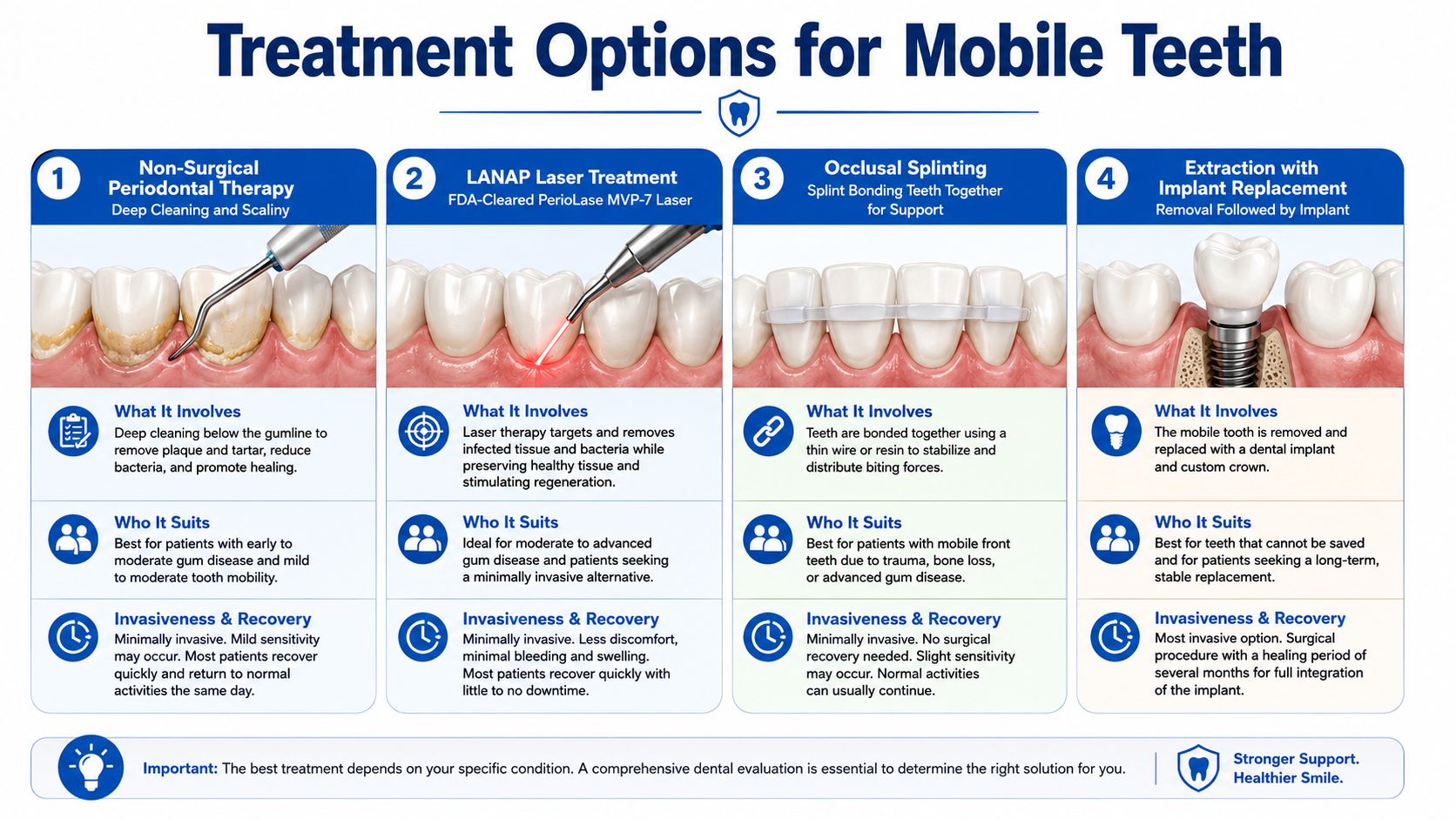
Treatment should match the cause and the tooth's ability to remain clean, functional, and restorable. A splint may reduce movement, but it can't remove periodontal infection or rebuild lost bone by itself.
Treating inflammation first
Non-surgical periodontal therapy may include careful periodontal instrumentation, scaling and root planing, and a maintenance plan that controls bacterial deposits. When inflammation decreases, mobility may decrease as the periodontal ligament becomes less inflamed and the tissues become more stable.
In a clinical study of 93 patients and 2,421 teeth with moderate-to-severe periodontitis, mobility decreased significantly after periodontal treatment. Mobility temporarily increased after pocket-reduction surgery, while the same pattern wasn't reported after curettage, modified Widman flap therapy, or scaling and root planing. Acute postoperative inflammation and tissue disruption can explain why movement sometimes rises before longer-term healing. The clinical review discusses treatment-related mobility changes.
Periodontal Associates of Delaware provides non-surgical periodontal care and LANAP laser gum treatment using the FDA-cleared PerioLase MVP-7 when clinically appropriate. The practice coordinates treatment planning with general dentists across Wilmington, Newark, and Dover.
Comparing possible pathways
| Approach | Best For | Expected Outcome |
|---|---|---|
| Non-surgical periodontal therapy | Teeth with inflammation, pockets, and treatable periodontal infection | May reduce inflammation and mobility while slowing further support loss |
| LANAP laser treatment | Selected periodontal cases requiring targeted laser-assisted treatment | May support disease control and tissue stability; results depend on the individual condition |
| Occlusal splinting | Selected mobile teeth where movement affects comfort or function during treatment | May improve comfort and reduce movement, but doesn't regenerate bone |
| Extraction with implant planning | Teeth that aren't maintainable, restorable, or functionally stable | Removes the compromised tooth and may allow later implant-supported replacement when conditions permit |
Splinting connects a mobile tooth to neighboring teeth so the group can function with less movement. A randomized trial involving 38 patients with advanced periodontitis and a mobile upper posterior tooth found that an elastic occlusal splint produced greater improvement in masticatory efficiency and a larger reduction in mobility during treatment. However, a separate three-year study found no statistically significant added benefit from splinting over periodontal treatment alone, particularly for Grade 0 or Grade 1 teeth. The randomized trial and its clinical context are reported here.
For patients considering laser care, this overview of laser gum treatment explains why treatment planning must focus on disease control rather than the appearance of a temporarily steadier tooth. If a tooth cannot be maintained, extraction site preservation and implant planning may be considered with i-CAT 3D cone beam imaging and, when appropriate, X-Nav dynamic surgical navigation.
Prognosis - Can Mobile Teeth Be Saved Long-Term
“Can this tooth be saved?” is usually more useful than “How loose is it?” The mobility grade matters, but the answer depends on what caused the movement, how much support remains, whether infection can be controlled, and whether the tooth can be maintained over time.
A 2024 systematic review reported tooth-loss rates of 5.85% for teeth without mobility, 11.8% for Grade 1 mobility, and 40.3% for Grade 2 mobility. Mobile teeth were nearly three times more likely to be extracted or lost than teeth without mobility, with a reported hazard ratio of 2.85 and a 95% confidence interval of 1.88 to 4.32. The systematic review presents these mobility-related outcomes.
Those figures describe groups, not an individual patient. The same review concluded that mobility isn't automatically a reason for extraction and that some mobile teeth can remain functional for more than 20 years when causes such as periodontal inflammation, plaque-related breakdown, traumatic occlusion, or other local factors are addressed.
The support around the root matters
A separate systematic review covering 20 studies and 15,422 patients, with a mean follow-up of 12 years, reported a higher risk of tooth loss for mobile teeth, with a risk estimate of 3.71 and a 95% confidence interval of 1.65 to 8.38. It also identified deeper pockets, greater bone loss, molar location, furcation involvement, smoking, diabetes, older age, and poor maintenance compliance as relevant risk markers. The meta-analysis explains why prognosis requires multiple factors.
Bone loss doesn't produce one automatic outcome. A recent review estimated that multi-rooted, vital teeth in patients without diabetes and with approximately 40% bone loss had an 80% to 89% probability of survival over an average follow-up of 11.8 years. For comparable teeth in patients with diabetes, the estimated survival probability was 50% to 59%. Even teeth with more than 60% initial bone loss were retained in approximately two-thirds of cases over 20 years in the cited evidence. The review emphasizes individualized prognosis.
These are population estimates, not promises. Remaining bone, inflammation, probing depth, root anatomy, furcation status, endodontic condition, restorability, smoking, diabetes control, bite forces, and maintenance all influence the decision. Guided tissue regeneration may be considered in selected defects, but a specialist must determine whether the anatomy and disease pattern support that approach. More information about guided tissue regeneration is available here.
What to Record Before Your Periodontal Evaluation
A short symptom record can help a periodontist understand how the tooth behaves outside the examination room. Patients in Wilmington, Newark, Dover, and nearby communities can bring the following information to the appointment:
- Location: Note which tooth moves and whether nearby teeth feel different.
- Function: Record pain on biting, difficulty chewing, or a feeling that the bite has changed.
- Inflammation: Note bleeding, swelling, tenderness, drainage, or persistent bad taste.
- Recent events: Include trauma, a new filling or crown, orthodontic changes, or a recent cleaning.
- Loading habits: Mention grinding, clenching, nail biting, or repeatedly testing the tooth with the tongue.
- Timing: Record whether movement feels worse in the morning, later in the day, or after meals.
During an evaluation, the periodontist may measure mobility, probing depths, attachment loss, bleeding, inflammation, bite contacts, and restorability. Radiographs help assess bone levels, while i-CAT 3D cone beam imaging can provide three-dimensional information when bone anatomy or implant planning requires it. If an implant is being considered, X-Nav dynamic surgical navigation may assist with planning and placement.
Patients shouldn't try to repeatedly wiggle the tooth before the visit. That can irritate the area and doesn't provide a reliable home measurement. Individual results vary, so a board-certified periodontist should interpret the findings and explain the available options.
Taking the Next Step Toward Tooth Stability
The central lesson is simple: mobility is measurable, but it isn't self-explanatory. A tooth's grade helps describe the problem, while probing measurements, bone levels, inflammation, root anatomy, bite forces, medical history, and restorability help explain its likely course.
Persistent or increasing movement after initial therapy deserves reassessment. A periodontist may look for residual deep pockets, progressive attachment loss, furcation involvement, traumatic occlusion, root fracture, an endodontic-periodontal lesion, or inadequate plaque control. Splinting can sometimes improve comfort, but stabilizing the disease is more important than mechanically immobilizing the tooth.
Periodontal Associates of Delaware offers periodontal evaluations, non-surgical therapy, LANAP treatment with the FDA-cleared PerioLase MVP-7, regenerative procedures when appropriate, and implant planning supported by i-CAT 3D imaging and X-Nav dynamic navigation. The practice serves adults across New Castle and Kent Counties through offices in Wilmington, Newark, and Dover, with financing options available. Individual results vary, and this educational information doesn't replace an examination by a periodontist.
Patients who notice new or worsening mobility should request an appointment rather than waiting for the tooth to become more unstable. A timely evaluation can clarify whether the next step is disease control, bite management, temporary stabilization, regenerative care, continued maintenance, or tooth replacement.
Periodontal Associates of Delaware evaluates mobile teeth by examining the supporting tissues, bite, bone levels, and overall periodontal health, with LANAP, regenerative care, and implant planning available when appropriate. Adults in New Castle and Kent Counties can visit Periodontal Associates of Delaware to request an appointment at the nearest Wilmington, Newark, or Dover office through the appointment request page.