Grinding teeth alone is not proven to directly cause receding gums, but it can act as a contributing stressor when thin tissue, inflammation, or aggressive brushing are already present. In patients who grind, gum recession has been reported in 44.7% after 1 year, 64.7% after 2 years, and 77% after 36 months in one longitudinal study, which is why the question matters so much when the teeth start looking longer.
Waking up with a tight jaw, hearing clicking near the ear, and then noticing that two front teeth seem longer can feel alarming. The good news is that the answer is more nuanced than many people expect, and that nuance helps separate what grinding may be doing from what is usually driving recession in the first place.
Table of Contents
- The Short Answer and Why the Question Matters
- What Bruxism, Abfraction, and Gum Recession Actually Mean
- How Grinding Could Affect Your Gums Step by Step
- What the Research Does and Does Not Show
- Other Common Causes of Receding Gums to Consider
- Signs a Clinician Looks For During an Exam
- Protecting Your Gums and Treating Existing Recession
- What to Do Next and When to See a Periodontist
The Short Answer and Why the Question Matters
A sore jaw in the morning, a tight feeling in the temples, and a mirror check that shows more tooth than before are common reasons people start wondering about gum loss. The direct answer is careful, not dramatic, teeth grinding is not proven to be a direct, stand-alone cause of gum recession, but it can still matter because repeated force can stress the tissues around the teeth when other risks are already present.
That difference is important. A person can grind for years and never develop obvious recession, while someone with thin gum tissue, plaque-related inflammation, or heavy brushing may see gum changes sooner if grinding is added on top. In other words, grinding is often a co-factor, not the whole story.
Practical rule: if the jaw feels sore and the gumline is changing at the same time, the question is not just whether grinding is present, it's whether grinding is combining with another risk that needs attention.
That is why careful periodontal evaluation matters. A clinician looks for the pattern, not just the symptom. They ask whether the problem is localized or widespread, whether the tissue is thin, whether bleeding suggests inflammation, and whether wear on the teeth points toward nighttime clenching.
For worried patients, the main takeaway is simple. Grinding may worsen gum loss, but it usually does not explain every case of recession by itself. That distinction helps avoid two common mistakes, blaming grinding for everything, or dismissing it completely when it may still be part of the problem.
What Bruxism, Abfraction, and Gum Recession Actually Mean
Bruxism is the habit, not the damage itself
Bruxism means clenching or grinding the teeth, often during sleep, sometimes during the day. Many people never notice it until a dentist sees worn edges, jaw soreness, or a bite pattern that suggests repeated pressure. The habit can be noisy or completely silent.
Abfraction is the tiny notch at the gumline
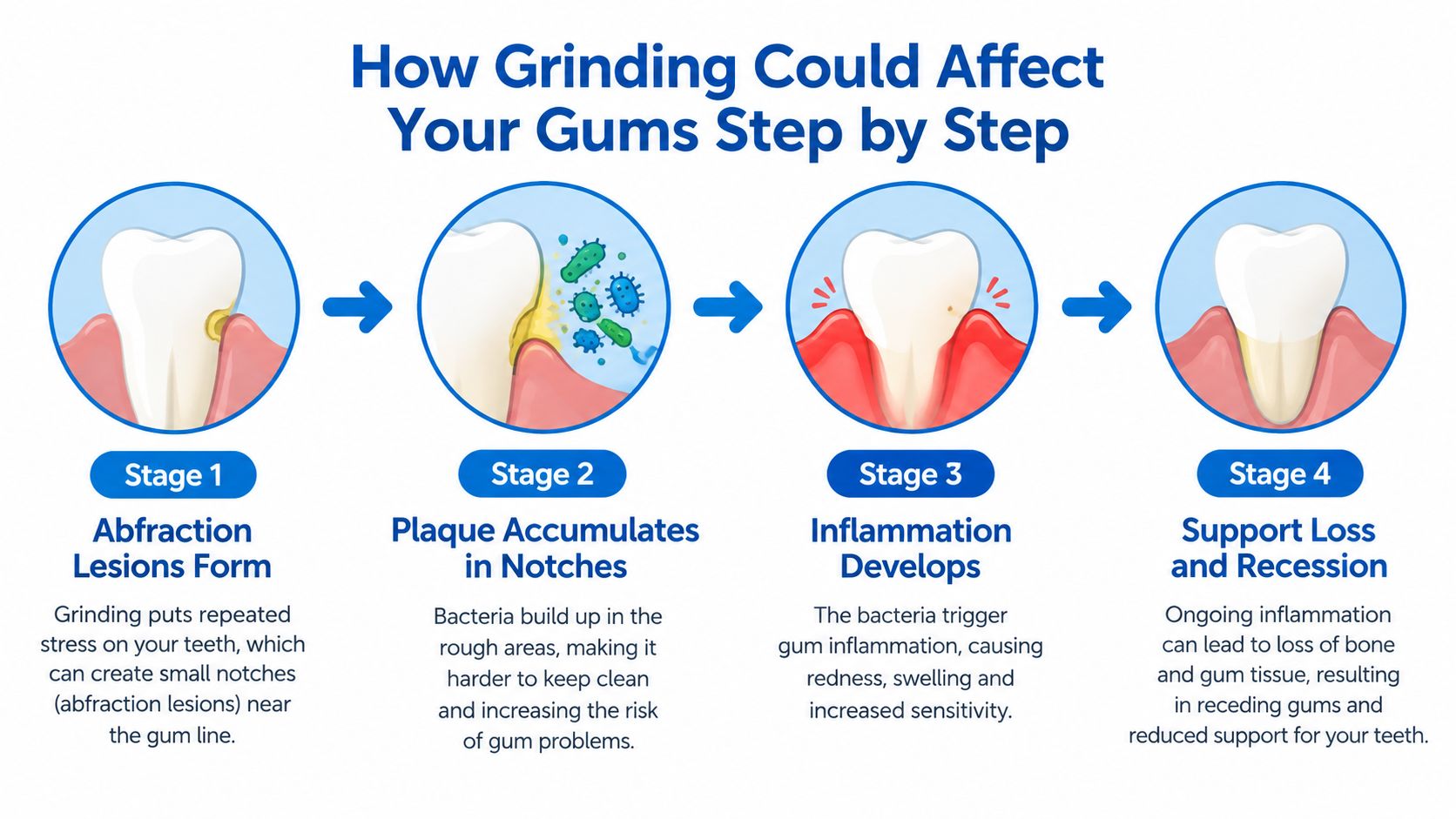
Abfraction is a word that sounds technical, but the idea is easy to picture. Repeated flexing pressure can create a small wedge-shaped notch near the gumline, much like a wooden shelf edge slowly cracking where it keeps bearing weight. The notch is part of a wear pattern, not the same thing as gum tissue disappearing, and not the same thing as decay.
Gum recession is gum tissue moving down the tooth
Gingival recession means the gum margin slowly shifts down the tooth root, exposing root surface that used to be covered. That exposed root can become sensitive and more vulnerable to plaque retention. Recession can happen alone, or it can appear alongside wear and inflammation.
One more distinction helps clear up confusion. Abrasion is wear from a mechanical source, usually brushing. Erosion is chemical wear, often linked to acid exposure. Bruxism can fit into the story, but it is not the same thing as either of those patterns, and it doesn't automatically mean recession is present.
How Grinding Could Affect Your Gums Step by Step
Grinding can influence gum health through a chain of effects, not by one single dramatic injury. The first link is mechanical stress. The second is what that stress does to the tooth, the attachment, and the surrounding tissues.
The force can create a vulnerable spot
When pressure is repeated at the gumline, a notch or flexure area can develop. That area may collect plaque more easily because cleaning around a depression is harder than cleaning a smooth surface. Once plaque sits there, the tissue near the margin can become more reactive.
Stress can change how the tooth sits in the mouth
A neutral academic review on occlusal trauma notes that chronic excessive bite forces mainly cause periodontal-ligament widening, tooth mobility, and lamina dura changes, while bone loss or increased attachment loss is not demonstrated unless there is existing inflammatory periodontal disease (review on occlusal trauma). That matters because grinding alone is more clearly linked to force and mobility than to recession by itself.
Inflammation is what turns stress into tissue loss
If plaque, bleeding, or active periodontal disease are already present, extra force can make the environment less stable. The same mechanical pressure that a healthy periodontium may tolerate can become more problematic when support is already reduced.
Clinical shortcut: grinding is best thought of as a load on the system. If the system is already inflamed or thin, the load matters more.
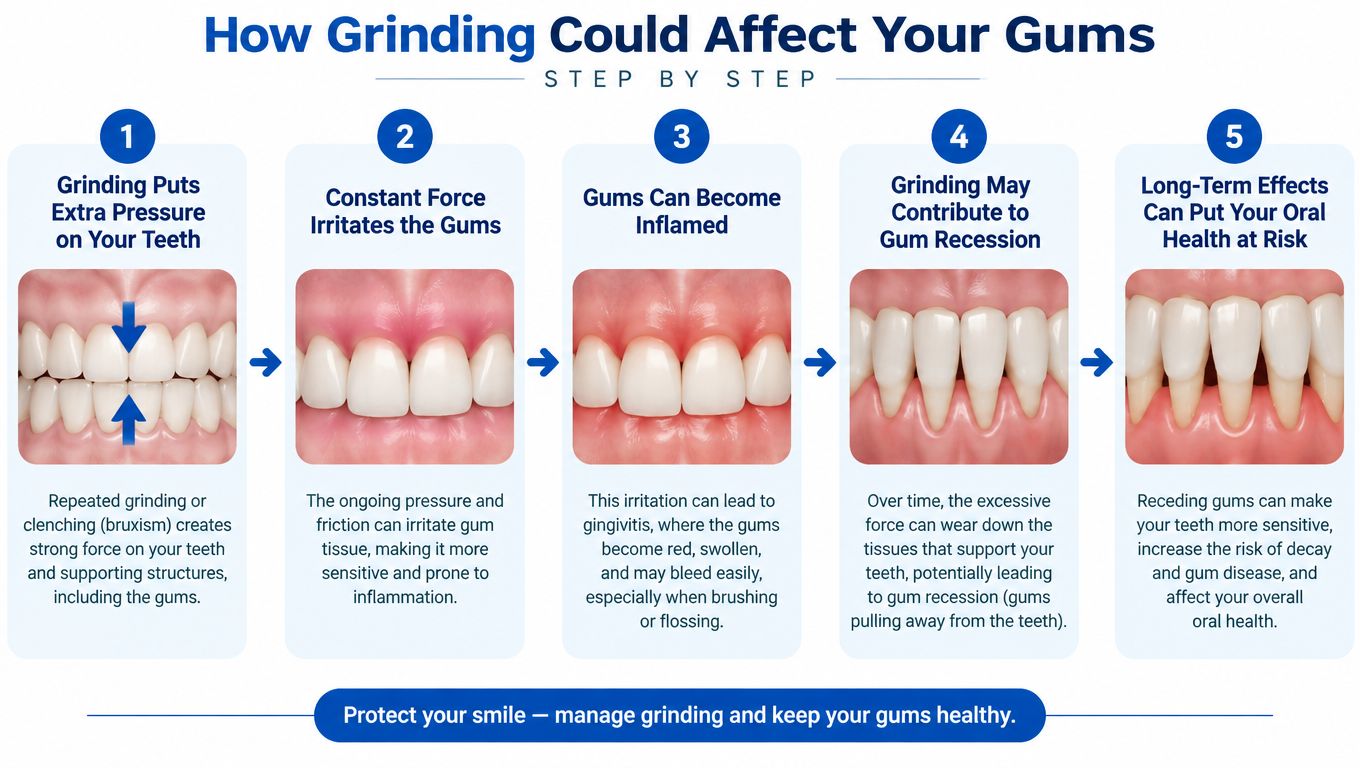
The last piece is practical, not theoretical. A person who clenches often wakes with a dry mouth, a tired jaw, and teeth that feel “worked over.” That doesn't prove recession, but it does mean the tissues around the teeth may be taking repeated stress that deserves a closer look.
What the Research Does and Does Not Show
The evidence points in more than one direction, and that is exactly why this question is hard to answer cleanly. One longitudinal study in people with bruxism found gingival recession in 44.7% after 1 year, 64.7% after 2 years, and 77% after 36 months (longitudinal study). In that report, recession appeared most often on the lower incisors and on the buccal surfaces of canines and premolars, areas where gum loss and root exposure are easier to see.
Why the studies do not match perfectly
Other research does not draw the same line. A 2018 quantitative study reported that tooth wear from bruxism was not associated with increased clinical recession, and it did not show a clear link between bruxism or abfraction and gingival recession (2018 quantitative study and later 2023 finding). The same source also described a later 2023 finding in which self-reported bruxism was significantly associated with mid-buccal recessions, with a mean of 4.3 affected teeth per subject and an overall extent of 14.2% across teeth.
Both findings can be true because the studies are not always measuring the same thing. Some rely on self-reported grinding, others on clinical signs, and others on sleep-based testing. Some include people with thin tissue, plaque, orthodontic history, or inflammation, while others try to isolate bruxism on its own.
What that means in real life
People often want a simple yes-or-no answer. The research supports a more careful one. Bruxism can act as a contributing biomechanical stressor, but it is not a universal or sole cause of recession. Recession usually reflects several risks working together, with thin tissue, inflammation, and brushing trauma doing much of the direct damage.
The practical lesson is straightforward. Grinding may help push vulnerable gums in the wrong direction, but it usually does not explain recession by itself. A clinician has to look at the full pattern, not just the habit.
Other Common Causes of Receding Gums to Consider
Before blaming grinding, it helps to step back and look at the more established drivers of recession. The most important one is often thin gingival tissue, because delicate tissue has less reserve against everyday cleaning forces and inflammation. A person can grind and still keep healthy gums if the tissue is thick and the mouth is otherwise stable.
The causes clinicians look for first
Aggressive brushing is a major one. A medium or hard brush, especially with a sawing motion, can wear away the margin over time. Orthodontic movement can also matter when teeth are moved outside the natural bone envelope, because the surrounding tissue may become stretched and more fragile.
Active periodontal disease is the most serious concern because it involves plaque biofilm and the body's inflammatory response. Smoking, lip or tongue piercings, and an uneven bite can also contribute to tissue stress. Those factors are often more direct explanations for recession than grinding alone.
The site also matters. Local recession around one or two teeth points to a different pattern than broad recession across the mouth. That is why a clinician asks about brushing habits, past orthodontics, inflammation, and trauma instead of jumping straight to bruxism.
Useful background on the broader causes of recession is summarized in this patient education resource, which also highlights the importance of early evaluation: receding gums overview.
The hardest cases are rarely caused by one habit alone. Thin tissue, brushing trauma, inflammation, and bite stress can stack up quietly.
Signs a Clinician Looks For During an Exam
A periodontal exam starts with the wear pattern. Flat, even biting surfaces on matching teeth suggest repeated grinding more than a random chip or isolated injury. Uneven wear can point to something else, so the pattern matters as much as the amount.
What the gumline and the tooth surface can reveal
The next clue is the abfraction lesion, usually a small notch on the cheek side near the gumline. Its depth and location can suggest flexural stress from repeated loading. That doesn't prove grinding on its own, but it does help a clinician decide whether pressure is part of the picture.
A clinician also checks mobility. A tooth that moves more than expected can indicate reduced support, and heavy bite stress can make that finding more relevant. Recession is then charted site by site, because generalized loss points the examiner toward thin biotype or periodontal disease, while a more localized pattern may fit a heavy-contact area better.
Bleeding on probing, plaque retention, and frenum pull round out the exam. If the gums bleed easily, inflammation is part of the story. If a frenum tug is pulling the margin, the recession may be mechanically driven in a different way.
A detailed clinical exam often uses advanced imaging and navigation when bone support or implants are part of the discussion, which is why many periodontal practices pair soft tissue evaluation with technology such as 3D imaging and navigation systems.
Why no single sign settles the question
One worn tooth doesn't prove bruxism. One notch doesn't prove recession from grinding. The diagnosis comes from the combination, along with the patient's symptoms and history.
- Wear facets: matched polishing on opposing teeth can point toward clenching or grinding.
- Gum pattern: isolated recession suggests a different cause than widespread recession.
- Bleeding: inflammation shifts the focus toward periodontal disease.
- Mobility: support changes raise concern that the bite load is affecting the attachment.
Protecting Your Gums and Treating Existing Recession
A night guard is often the first protective step. A custom occlusal splint does not grow gum tissue back, but it can reduce repeated force during sleep and help protect teeth from further wear. For many patients, that is the right starting point because it addresses the mechanical part of the problem.
Protect the force, then treat the tissue
Small habit changes can support the guard. Stress management may reduce clenching, and some patients notice less jaw tension when they cut back on late-day stimulants. Those changes do not reverse recession on their own, but they can lower the bite load that keeps irritating the area.
If the gumline has already moved, coverage procedures may be discussed. Connective tissue grafting is often used to add tissue and cover exposed root surfaces. In selected cases, the pinhole surgical technique may also be considered. The best option depends on where the recession is, how much tissue remains, and whether the surrounding gum is thin or inflamed.
If periodontal disease is part of the picture, the inflammation has to be addressed first. That may involve scaling and root planing, periodontal maintenance, or laser therapy when clinically appropriate. These options are described in more detail in the overview of periodontal services. The goal is to calm the disease process before asking the tissue to heal.
Dental implants only enter the discussion if a tooth is lost. They replace missing teeth, but they do not treat recession around a natural tooth that is still present. That distinction matters because the treatment should match the cause, not just the visible symptom.
Simple sequence: reduce the force, control inflammation, then repair what the gumline has already lost.
What to Do Next and When to See a Periodontist
A night guard can protect against more grinding damage, but it does not make receded gum tissue grow back on its own. That is the part many patients misunderstand. Once the gumline has moved, the next step is usually a periodontal evaluation, not just another appliance.
Warning signs that should not be ignored
The most common reasons to book an exam include teeth that look longer, sensitivity at the gumline, visible notches near the enamel, loose teeth, bleeding when brushing, or a sore jaw on waking. A patient doesn't need all of those signs to warrant a visit. One or two, especially if they're getting worse, are enough.
Bringing a simple timeline helps. Note when the jaw soreness started, whether the teeth feel tighter or looser, and whether the gumline change seems local or widespread. That information helps a clinician decide whether bruxism, abfraction, thin tissue, or periodontal disease is the main issue.
The best question to ask is direct. Is grinding part of the problem, or is the recession more likely tied to inflammation, tissue thickness, or brushing trauma? That answer changes the treatment plan.
Recession is manageable when it's caught early, and treatment can be adapted to the cause rather than guessed at. Readers in Wilmington, Newark, Dover, Pike Creek, Hockessin, Bear, Middletown, and nearby Delaware communities can ask for an evaluation at the office that's most convenient for them.
Periodontal Associates of Delaware provides evaluation and treatment for gum recession, gum disease, and bite-related concerns across Wilmington, Newark, and Dover. Patients who are worried about grinding, recession, or tooth mobility can request an appointment and have the situation assessed with periodontal expertise, advanced imaging, and treatment options that fit the cause. Visit Periodontal Associates of Delaware to schedule care at the nearest Wilmington, Newark, or Dover office.