Waking up to blood on a toothbrush can stop the morning cold. For many adults in Wilmington, Newark, Dover, and nearby Delaware communities, that moment comes with a simple question, is this just irritation, or is it the start of something bigger? Levels of gingivitis help answer that question in a clear way, because gum inflammation is not all the same. Some gums only look a little different, while others bleed easily and need prompt attention.
Gingivitis is widely described as the earliest and most common inflammatory form of periodontal disease, and it often shows up before pain ever starts. It stays in the gum tissue itself, which means the problem can feel small while still being real. That's why bleeding, redness, and swelling shouldn't be ignored, even if teeth still feel fine.
Table of Contents
- Understanding the Early Signs of Gum Disease
- The Four Clinical Levels of Gingivitis
- Localized Versus Generalized Disease Extent
- Why Untreated Gingivitis Leads to Periodontitis
- Modern Treatment Options for Gum Inflammation
- Daily Care and Maintenance for Healthy Gums
- Schedule Your Evaluation Today
Understanding the Early Signs of Gum Disease
A common first sign is simple, a person brushes, spits, and sees pink foam in the sink. That can feel minor, but bleeding gums usually mean the tissue is reacting to plaque buildup and local inflammation. Gingivitis is confined to the soft gum tissue, so it doesn't mean bone loss has started, but it does mean the mouth is asking for better care.

Healthy gums usually look pink and feel firm. Inflamed gums can look redder, puffier, or shinier, and they may bleed with brushing or flossing. The key point is that gingivitis is common, but common doesn't mean harmless. It's a signal that the balance around the gumline has shifted.
Practical rule: if bleeding shows up repeatedly, the gums are telling the patient to take the problem seriously, not to brush harder and hope it disappears.
The encouraging part is that early gingival inflammation is often easier to manage than later periodontal disease. A professional exam can tell whether the bleeding is limited, widespread, or tied to deeper tissue changes. For patients who feel anxious about gum surgery, that first evaluation is often just a conversation, a careful exam, and a plan.
The Four Clinical Levels of Gingivitis
Dentists don't have to rely on vague words like mild or severe. The Gingival Index gives inflammation a clinical grade from 0 to 3, which makes the condition easier to describe and track over time (NCBI Bookshelf). That matters because two mouths can look similar in a mirror while behaving very differently during probing.
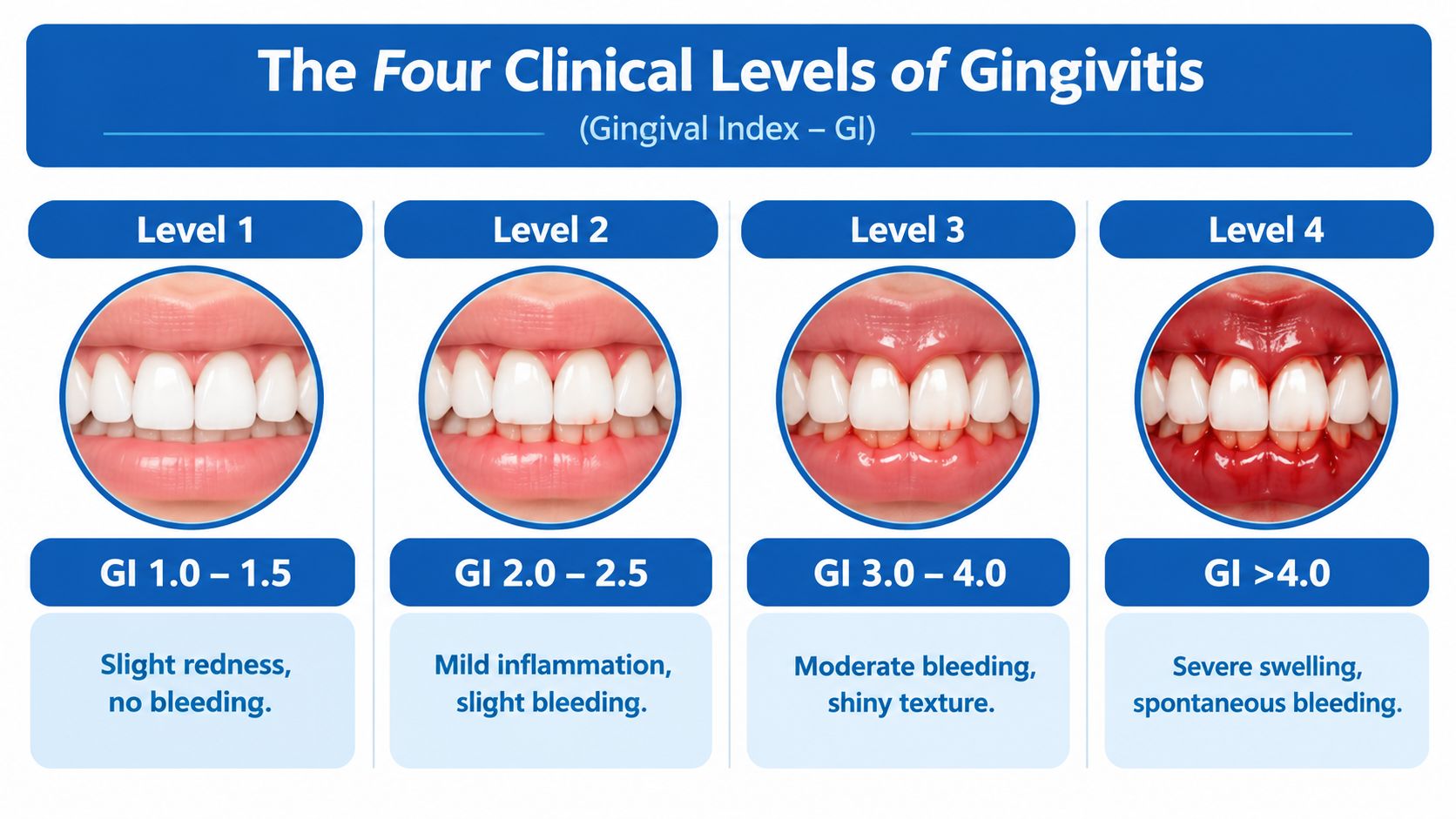
What each grade looks like
GI 0 means the tissue appears healthy, with no visible inflammation.
GI 1 shows slight color change or mild edema, but no bleeding on probing.
GI 2 brings redness, edema, glazing, and bleeding on probing.
GI 3 means marked redness, obvious swelling, ulceration, and a tendency toward spontaneous bleeding.
Those differences sound small on paper, but they matter in the chair. A gum that merely looks a bit off is not the same as one that bleeds when touched with a probe. Bleeding is one of the clearest signs that inflammation is active, not just cosmetic.
A useful way to think about it is like a traffic light. GI 1 is a warning, GI 2 is a stronger alert, and GI 3 means the tissue is under heavier stress. That doesn't mean every higher grade is an emergency, but it does mean the mouth needs a more careful periodontal review.
Gums don't need to be painful to be unhealthy. Bleeding is often the first objective clue that inflammation has moved beyond a simple color change.
Localized Versus Generalized Disease Extent
The next question is how much of the mouth is affected. Periodontal classification uses bleeding on probing to sort gingivitis into localized and generalized disease, which helps clinicians talk about extent instead of guessing from appearance alone (British Society of Periodontology.pdf)). Localized gingivitis affects 10% to 30% of sites, while generalized gingivitis affects more than 30%.
That difference matters because inflammation in one area can sometimes be tied to a hard-to-clean spot, a crooked tooth, or a local plaque trap. More widespread bleeding suggests the problem is not isolated, so the whole routine may need attention, not just one troublesome corner of the mouth. During an exam, a periodontist or hygienist checks multiple sites and looks at bleeding patterns, pocket depth, and overall tissue response.
For patients, this helps answer a question that comes up often, why can one clinician sound calm while another sounds more concerned? Because the mouth may look only mildly red, yet still bleed at enough sites to qualify as generalized inflammation. The mirror doesn't always show extent, but the probe does.
Simple takeaway: localized means a smaller part of the mouth is involved, generalized means the inflammation is spread more widely, and that spread changes the treatment plan.
A helpful related resource on gum support tissues and soft tissue care is this overview of frenectomy and gum recession, especially for patients who notice both irritation and recession in the same area.
Why Untreated Gingivitis Leads to Periodontitis
Gingivitis matters because it can be the starting point for deeper periodontal disease if the inflammation stays active. Plaque at the gumline keeps triggering the body's immune response, and over time that response can begin to damage the structures that support the teeth. Gingivitis itself is limited to the gum tissue, but periodontitis involves the attachment apparatus and bone, which is a much bigger problem.
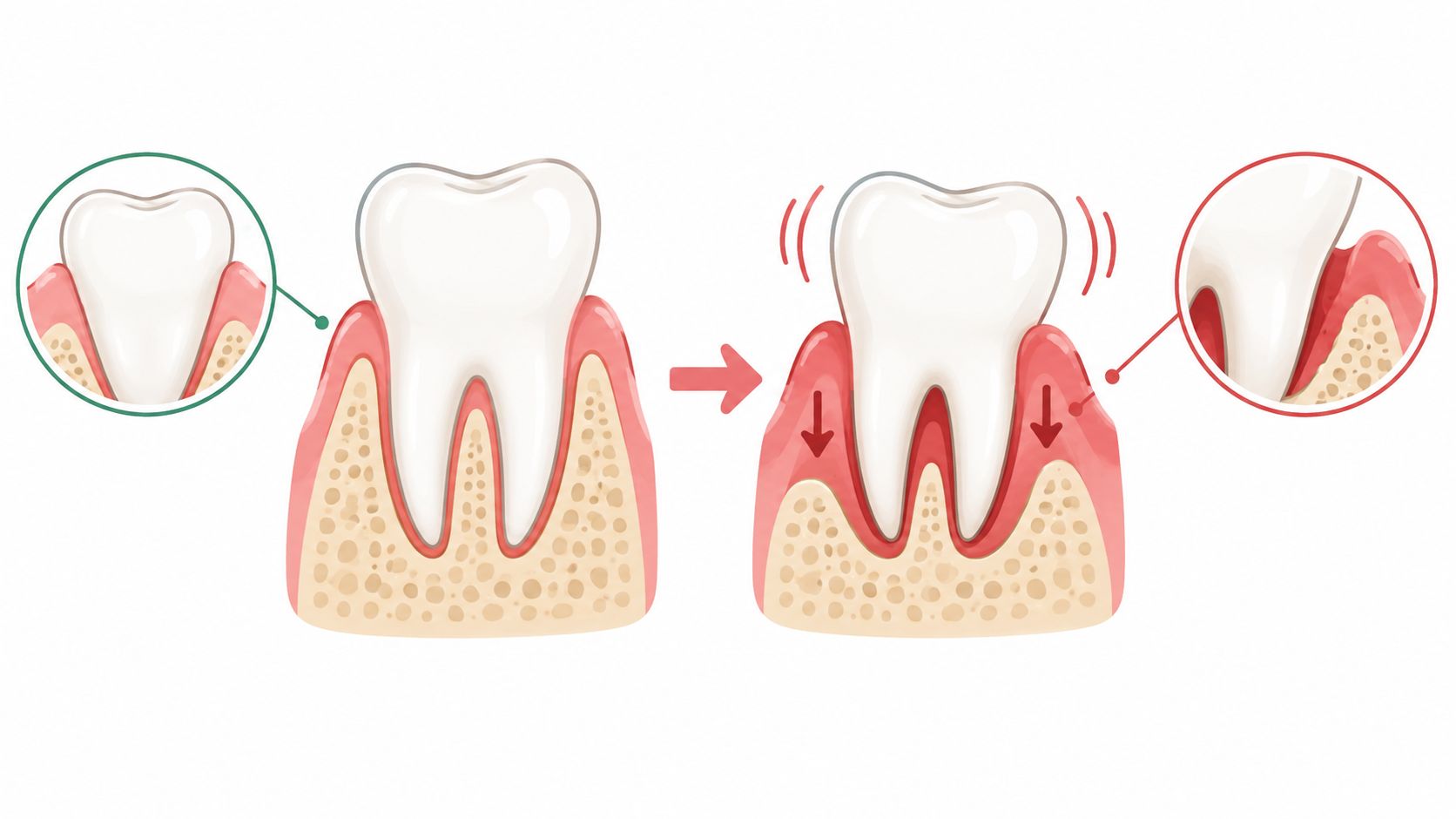
That's why early care is so important. A mouth that bleeds at the gumline may still be reversible with professional cleaning and strong home care, but once the deeper support system is involved, treatment gets more complex. For patients in New Castle and Kent Counties, that's the practical reason to act before soreness or looseness ever appears.
The most helpful mindset is to treat bleeding as a warning, not as a nuisance. When inflammation continues, the risk shifts from gum irritation to structural loss. That's the point where people start hearing words like bone loss, pocketing, and periodontal therapy.
In plain terms, gingivitis is the version of gum disease people want to catch. Periodontitis is the version people want to avoid altogether. Prompt evaluation at any Wilmington, Newark, or Dover office gives the team a chance to stop the process while the gums can still recover well.
Modern Treatment Options for Gum Inflammation
Treatment starts with a close look at the cause and the extent of inflammation. For many patients, scaling and root planing is the first non-surgical step, because it removes plaque and hardened deposits from below the gumline and creates a cleaner surface for healing. When the gum tissue is inflamed but the deeper support is not severely damaged, that approach may be the practical starting point.
For patients who want minimally invasive care, LANAP laser gum surgery using the FDA-cleared PerioLase MVP-7 is one option used by Periodontal Associates of Delaware. It targets diseased tissue while preserving healthy gum, which can be appealing for people who are anxious about more traditional surgery. In the same treatment planning process, i-CAT 3D cone beam imaging can help the team judge depth, anatomy, and extent more precisely before a procedure is chosen.
The right choice depends on what the exam shows. A small area of inflammation might only need nonsurgical therapy and better home care. More complex disease may need a different plan, especially if there's recession, deeper pocketing, or bone changes.
A practical point matters here, treatment is not one-size-fits-all. Some patients do well with conservative therapy and maintenance, while others need advanced periodontal care to control inflammation more reliably. Individual results vary, and a board-certified periodontist can explain which path fits the mouth in front of them.
For patients comparing treatment paths, this resource on laser gum treatment cost can help frame the conversation without guessing at a plan before the exam.
Daily Care and Maintenance for Healthy Gums
Daily habits do a lot of the heavy lifting after treatment. Gentle but thorough brushing, daily flossing, and any prescribed rinse can keep plaque from rebuilding at the gumline. The goal is simple, reduce bleeding and keep the gums calm enough that inflammation doesn't keep coming back.
A few practical habits help most:
- Brush along the gumline: Use a soft brush and short, controlled strokes so the bristles clean the edge of the gums without scrubbing them raw.
- Floss every day: Slide the floss under the gum edge carefully, because plaque hides where the brush can't reach.
- Use rinse only as directed: Antimicrobial rinses may help in some cases, but they work best as part of a full home-care routine.
- Keep maintenance visits: People with a history of periodontal problems often need more frequent follow-up so the team can catch bleeding early.
For patients with prior periodontal treatment, maintenance visits every few months are often part of the plan because gums can look fine while inflammation returns. That's also why grinding and bite stress deserve attention, especially when recession or soreness keeps reappearing. This guide on teeth grinding and receding gums can help connect the dots.
Healthy gums are maintained, not just treated. The daily routine keeps the office visit from becoming a repeat emergency.
Schedule Your Evaluation Today
The biggest takeaway is simple. Levels of gingivitis are measurable, visible, and treatable, but only if the problem gets checked early. Bleeding, redness, and swelling are not just cosmetic changes, they're signs that the gums may need professional attention before the condition moves deeper.
Adults across Wilmington, Newark, Dover, Pike Creek, Hockessin, Bear, Middletown, and surrounding areas shouldn't wait for pain, loose teeth, or obvious recession before getting evaluated. A board-certified periodontist can look at the bleeding pattern, explain what the gums are showing, and recommend a plan that fits the person, not just the chart. Individual results vary, so a personalized exam matters.
Periodontal Associates of Delaware provides periodontal evaluation, non-surgical therapy, laser gum treatment, implant planning, and advanced imaging across its Wilmington, Newark, and Dover offices. If bleeding gums or gum inflammation have become part of daily life, a careful evaluation can make the next step much clearer.
Periodontal Associates of Delaware helps adults with bleeding gums, gum recession, and periodontal disease understand what's happening and choose a treatment plan that fits their needs. For a personalized evaluation at the nearest Wilmington, Newark, or Dover office, visit Periodontal Associates of Delaware and request an appointment today.