Laser gum treatment cost is commonly $1,000 to $4,000 per quadrant and often $4,000 to $15,000 for full-mouth treatment. That range exists because the bill is shaped by disease severity, how many quadrants need care, what gets bundled into the visit, and how insurance processes the claim.
A person sitting in the consult room usually is not asking for a textbook answer. They want to know why one quote looks manageable, another looks high, and whether the difference reflects better care or just a different way of pricing the same problem. The honest answer is that laser periodontal treatment is usually priced by clinical need, not by a single flat menu price. As the disease becomes more widespread, the number of treated areas, the amount of follow-up, and the need for add-on procedures can all change the total.
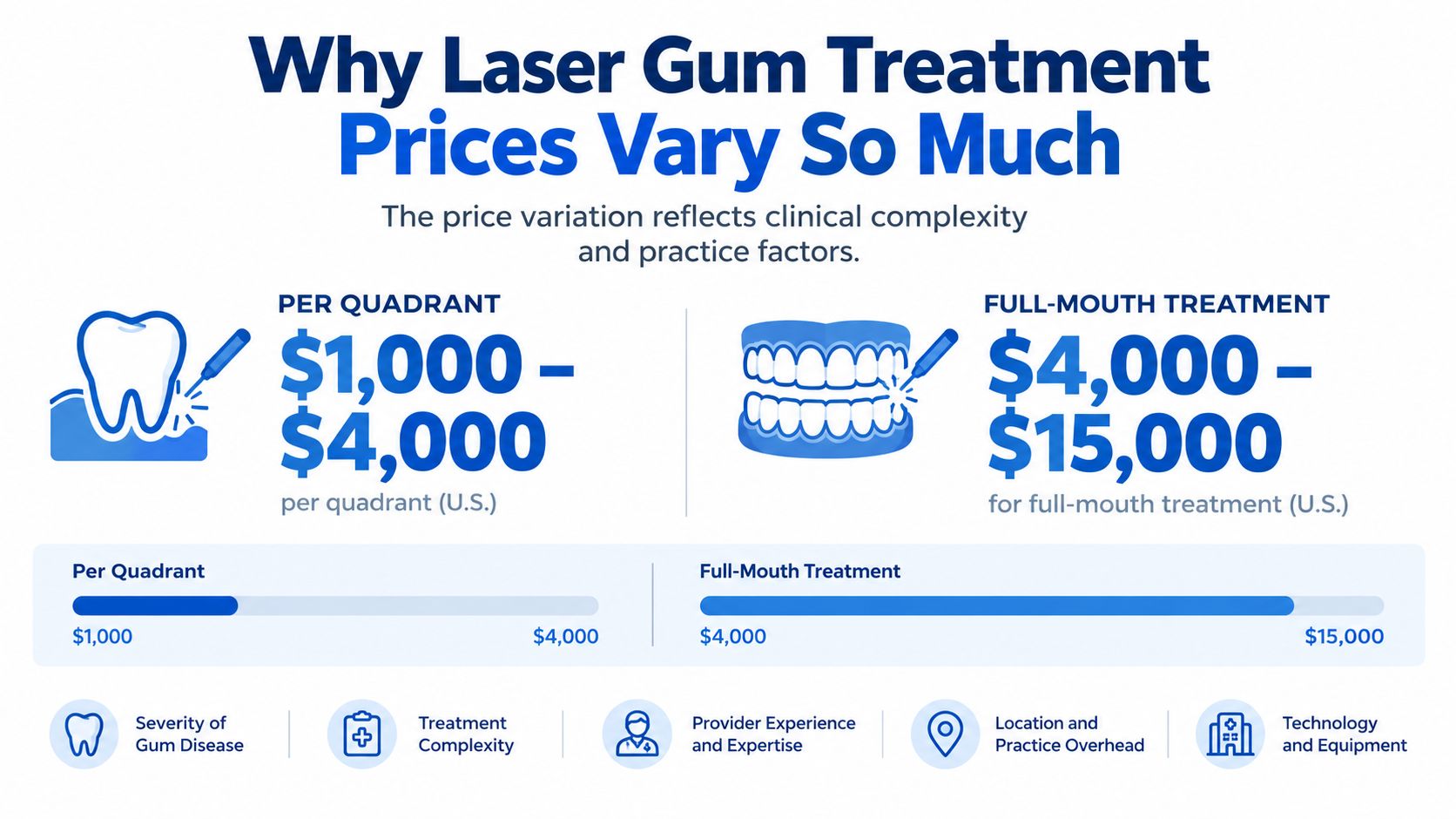
Table of Contents
- Why Laser Gum Treatment Prices Vary So Much
- How Quadrant Pricing Works and What It Means for You
- What Drives the Cost of LANAP and Other Laser Gum Therapy
- Comparing LANAP to Traditional Gum Surgery and Other Options
- Insurance Coverage and Financing for Laser Periodontal Care
- Common Misconceptions About Laser Gum Treatment Cost
- A Practical Checklist Before Your Periodontal Consultation
- Making an Informed Decision About Your Gum Health
Why Laser Gum Treatment Prices Vary So Much
The first thing to understand is that laser gum treatment cost is usually quoted as a range because the mouth isn't treated as one simple unit. Consumer pricing guides commonly place LANAP around $1,000 to $4,000 per quadrant, with full-mouth treatment often estimated at $4,000 to $15,000. That spread is not random. It reflects the fact that two patients can share a diagnosis of gum disease and still need very different amounts of care.
The same diagnosis can mean very different work
A localized infection may be treated in one area, while more advanced disease can involve several sections of the mouth. In practical terms, that means a patient with limited damage may be quoted near the lower end, while someone with more widespread pocketing or bone loss may need more chair time, more visits, and more treatment steps. A conservative quote may also leave out items such as imaging, sedation, or follow-up care, which makes the headline number look smaller than the final total.
Practical rule: a low quote is only useful if it clearly shows what's included and what's missing.
What shifts the number up or down
Geography matters, too. The same U.S. guidance places the Mid-Atlantic at roughly $1,300 to $3,000 per quadrant, while New England and the South Atlantic are often cited around $1,500 to $3,200 per quadrant. That doesn't mean one office is overcharging. It usually means local operating costs, staffing, and regional market expectations are different.
Technology and treatment planning matter as well. Laser protocols can be staged, and some quotes include full staging, imaging, and maintenance while others don't. Periodontal Associates of Delaware uses advanced imaging and laser-based periodontal care as part of treatment planning, which is why a quote should be read as a bundle of services, not just a single procedure label.
The safest way to compare estimates is to ask what's included, what's staged later, and whether maintenance is part of the number. That makes it possible to compare two quotes on equal terms instead of comparing a full treatment plan with a partial one.
How Quadrant Pricing Works and What It Means for You
Most periodontal offices don't price laser therapy as one flat mouth fee. They break the mouth into four quadrants, upper right, upper left, lower right, and lower left, then price treatment based on how many of those areas need care. That structure is similar to pricing a house by room instead of quoting one number for the entire building.
Why the mouth is divided this way
A small, localized problem can sometimes be treated in one quadrant. A more diffuse infection may need two, three, or all four. That's why the total cost changes so much from patient to patient, even when the procedure name sounds the same. The clinical reality is simple, more involved disease means more treatment time and more follow-up.
A patient with mild localized disease might land near $1,500 for one quadrant, while a two-quadrant plan might total around $3,500 depending on what's included. More advanced cases that involve all quadrants can move into the $8,000 to $15,000 range, especially when severity increases the amount of work needed and the number of visits grows. Those are planning figures, not guarantees, but they show how quickly the math changes when disease is not confined to one area.
Why staged care can help
Quadrant pricing also gives patients flexibility. Instead of committing to full-mouth treatment all at once, care can sometimes be staged so the worst areas are treated first. That can spread the cost over time and make it easier to prioritize the teeth and gums most at risk.
| Quadrant Pricing Scenarios for LANAP | Mild Disease | Moderate Disease | Advanced Disease |
|---|---|---|---|
| Treatment Scope | One quadrant | Two quadrants | Four quadrants |
| Estimated Pattern | Near the low end of the range | Mid-range total | Full-mouth total |
| What usually drives it | Localized pocketing | More widespread inflammation | Generalized disease and longer treatment time |
A staged approach doesn't make treatment cheaper by magic. It makes the plan easier to manage and easier to match to the disease pattern in the mouth.
The main takeaway is that quadrant pricing is not a trick. It's a way of matching the fee to the amount of work the disease requires.
What Drives the Cost of LANAP and Other Laser Gum Therapy
A patient can bring in two quotes for the same diagnosis and still see very different totals. The reason is usually not a mystery charge. It is the combination of disease extent, added procedures, and how the office packages the visit.
Clinical factors that change the fee
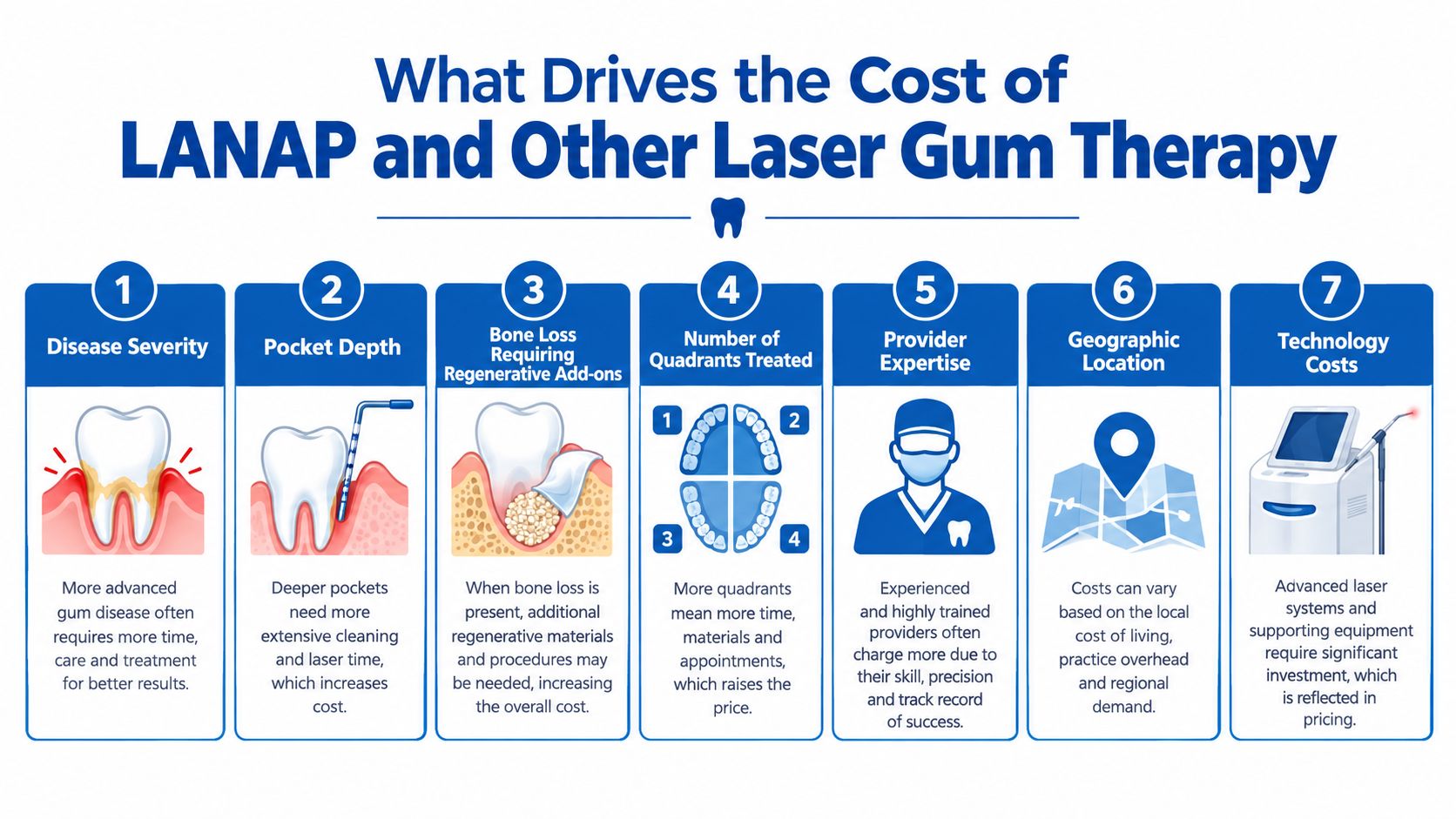
Disease severity is the first driver. Deeper pockets, more inflammation, and more bone loss usually mean more time, more steps, and more follow-up care. The number of teeth involved matters for the same reason. A localized problem is simpler to treat than infection spread across several areas.
When bone support has already been lost, the plan may need regenerative add-ons. That can raise the total because the treatment is no longer just laser therapy, it becomes periodontal repair with extra materials and extra chair time.
Laser treatment may also be paired with other procedures if the gums need more than one type of correction. Gingivectomy, crown lengthening, and bone grafting can all change the estimate when they are clinically appropriate. Each one adds work because the office is treating a larger problem, not only the infected tissue.
Practice factors that patients often miss
The office itself affects price too. Training level, the laser platform used, local overhead, and whether sedation is included all play a role. Diagnostic services may be billed separately when the case needs detailed charting, 3D cone-beam imaging, or other tests to map the disease accurately. Learn more about advanced periodontal imaging and treatment technology
Follow-up visits matter as well. Some plans include post-operative checks and maintenance care in the quoted fee, while others list them separately. A patient who sees only the laser line item may think two estimates are the same when they are not.
Consumer guidance on periodontal surgery pricing points in the same direction, costs can vary widely with procedure type and case complexity.
- Disease severity: More advanced infection usually means more chair time and more steps.
- Pocket depth: Deeper pockets are harder to clean and often need more attention.
- Bone loss: Regenerative add-ons may be needed when support has already been lost.
- Number of quadrants: More treated areas naturally increase the total.
- Provider expertise: Specialized training can affect both planning and pricing.
- Geographic location: Regional overhead and market norms vary.
- Technology costs: The laser platform and related tools have to be recovered through the fee.
The clearest next step is an itemized estimate. It shows whether the quote covers laser treatment alone or a broader periodontal plan built around it.
Comparing LANAP to Traditional Gum Surgery and Other Options
LANAP is one option in a wider range of periodontal care, and the price question only makes sense when it's compared with the severity of the disease. A basic deep cleaning is usually less expensive up front than surgery, while larger surgical cases can exceed laser-based treatment once grafting and sedation are added. That's why the cheapest line item isn't always the lowest total cost of care.
How the options usually differ
Scaling and root planing is the non-surgical baseline for many cases. Laser-assisted care may be used when the goal is to reduce infected tissue and bacteria while limiting trauma to healthy tissue. Traditional osseous surgery is usually reserved for more advanced problems, especially when access to bone and deep pockets is needed.
The main price difference often comes from what gets bundled into the visit. A lower initial fee may still lead to separate charges for anesthesia, imaging, antibiotics, or multiple follow-ups. A more complete surgical quote can look higher at first but may be clearer about the full scope of treatment.
| LANAP vs. Traditional Gum Surgery and Non-Surgical Options | Typical Cost Range | Best For | Average Visits | Recovery |
|---|---|---|---|---|
| LANAP | Often quoted per quadrant, commonly within the laser range noted above | Patients who need periodontal therapy with a minimally invasive approach | Varies by case | Often less downtime than more invasive surgery |
| Scaling and Root Planing | Usually lower than laser surgery | Mild to moderate disease | Often staged | Recovery is usually shorter than surgical care, but varies |
| Osseous Surgery | Can be higher once grafting and sedation are included | Advanced disease and deeper defects | Often more involved | Longer healing and more post-op care |
| Localized Per-Tooth Therapy | Quoted by teeth or small areas | Narrow, localized treatment | Limited to affected teeth | Depends on the extent of work |
Cost is only part of the decision
Laser treatment can reduce the need for a scalpel in some cases, but that doesn't make it automatically cheaper overall. It may mean fewer follow-up issues, less downtime, and a treatment plan that fits better with work and family schedules. The practical question is not “Which option costs the least today?” It's “Which option addresses the disease with the least total burden over time?”
For patients comparing a few estimates, the best comparison is the same one used in medicine generally. Ask what the procedure treats, how many visits it involves, and what happens if the disease is more advanced than expected.
Insurance Coverage and Financing for Laser Periodontal Care
A treatment quote can change a lot once insurance is involved. Laser periodontal care is often billed under periodontal procedure codes such as D4240, D4260, and D4341, so plans usually review it the same way they review other gum disease treatment. Some dental guidance summarizes reimbursement as roughly 20% to 80%, depending on plan design, deductibles, and whether adjunctive procedures are needed.
How the claim gets processed
Coverage is determined by the periodontal procedure code, not by the technology used. In practice, that means a plan may treat the visit as disease treatment rather than as a separate laser benefit. Reimbursement can follow the same basic path used for conventional periodontal surgery, which is why a predetermination is worth requesting before treatment begins.
Practical rule: ask the office to submit a predetermination whenever the estimate is large enough that surprise billing would be a problem.
Medical insurance can sometimes enter the picture when gum infection is connected to broader health concerns, but dental and medical benefits usually follow different rules. A quote should be checked against both sets of benefits if there is any chance a medical claim might apply.
Where financing fits
If dental benefits do not cover the full balance, financing can spread the cost over time. Some practices offer in-house plans, and many patients also use third-party financing when a larger periodontal plan has to be completed in stages. Another common approach is to split care across benefit years so the annual maximum resets before the remaining treatment is finished.
See the practice's insurance guidance for periodontal treatment
- Predetermination: Confirms expected coverage before treatment starts.
- Staged treatment: Can help spread costs across more than one benefit year.
- Financing plans: Useful when out-of-pocket costs are larger than expected.
- Benefit coding: Matters because the claim is usually processed as periodontal care, not cosmetic care.
The cleanest insurance question is direct. Ask what portion is likely to be covered, how the claim will be coded, and whether the estimate assumes the deductible has already been met.
Common Misconceptions About Laser Gum Treatment Cost
A consultation estimate can look higher than expected, and that often leads patients to assume laser treatment is always more expensive than traditional surgery. The full picture is more layered. Once grafting, sedation, follow-up care, and the extent of disease are included, laser therapy and osseous surgery can fall into a similar range, and consumer guidance and insurer materials indicate that periodontal surgery pricing varies widely by procedure and complexity.
What patients often get wrong
Another common belief is that insurance never helps with laser therapy. In practice, many plans review it as periodontal treatment rather than as a separate laser benefit, so reimbursement often depends on the procedure code and plan design, not the instrument used. A predetermination can also shift the estimate once the claim is reviewed against the benefits on file.
A third misconception is that the first quote is the final number. Severity staging, extra procedures, and geographic differences can change the estimate after the exam, just as a repair bill changes once a mechanic sees what is worn down. A quote without diagnosis details is only a starting point.
The last misconception is that the lowest estimate is automatically the smartest choice. A low quote can leave out imaging, maintenance, or the provider experience needed when the disease is complex. In periodontal care, the cheapest number can become the most expensive path if it leads to repeat treatment.
| Misconception | Reality |
|---|---|
| Laser always costs much more | Final pricing depends on the full plan, not just the tool |
| Insurance never covers it | Many plans review periodontal care under standard surgery benefits |
| One quote is final | Disease severity and add-ons can change the estimate |
| Lowest price is best value | Experience, technology, and follow-up affect the actual cost |
Cost makes the most sense when it is tied to the clinical need in front of the patient. A laser is not priced because it is a laser. It is priced according to what the gums and bone require.
A Practical Checklist Before Your Periodontal Consultation
A good consult starts with good information. Patients who bring the right records usually get a more accurate estimate and a clearer explanation of why the number looks the way it does. The goal is to make the appointment feel less like guessing and more like planning.
What to bring and what to ask
A current periodontal exam should include six-point probing depths and full charting, so ask whether that's part of the visit. Bring recent radiographs if they're available, especially if they were taken within the last year, and list any medications that can affect healing or bleeding. If scaling and root planing has already been done, bring those records too.
It also helps to ask for an itemized estimate. The office should be able to separate the laser procedure, anesthesia, follow-up visits, and any adjunctive therapy such as localized antibiotic placement or occlusal adjustment. Patients should also ask whether the office submits predeterminations and whether the quoted number includes maintenance cleanings after treatment.
- Request full charting: Six-point probing depths help show where disease is active.
- Bring imaging: Recent radiographs make the consultation more precise.
- List medications: Blood thinners and other drugs can matter for healing and bleeding.
- Ask for itemization: Separate the laser fee from anesthesia and add-on care.
- Confirm insurance steps: Predeterminations can reduce billing surprises.
- Check maintenance details: Ask whether follow-up cleanings are included.
Request a consultation at the nearest Delaware office
A final question should be about training and experience. Ask whether LANAP certification is documented and how often the procedure is performed, because operator experience can influence case planning and the need for revisions later.
Making an Informed Decision About Your Gum Health
Laser gum treatment cost matters, but it only makes sense when it's read alongside the clinical question. The key question is not whether the quote is high or low. It's whether the treatment plan gives the gums a stable path forward, with a clear view of pocket depth, tissue response, and long-term tooth retention.
Delaying treatment can make the total bill larger later, because untreated periodontal disease may lead to extractions, bone grafting, or implant therapy. That's why many patients do better when they compare options early, before the problem has progressed. The most reliable estimate still comes from an in-person evaluation, not an online chart.
What a good decision usually balances
- Recovery time: How long daily life is interrupted.
- Comfort: How much post-op soreness to expect.
- Tissue response: How the gums are likely to heal.
- Stability: Whether the plan supports long-term disease control.
- Cost structure: Whether the fee is staged, bundled, or split across visits.
Bottom line: the right treatment is the one that matches the disease pattern, the patient's budget, and the need to keep teeth stable over time.
Periodontal Associates of Delaware offers periodontal evaluation, LANAP using the FDA-cleared PerioLase MVP-7, and implant planning with advanced imaging and navigation across Wilmington, Newark, and Dover. Adults in New Castle and Kent Counties who want a clear cost conversation can ask about treatment scope, insurance, and financing during the visit.
Periodontal Associates of Delaware helps patients compare laser gum treatment cost with the actual clinical plan, not just a headline number. If gum disease, recession, bone loss, or missing teeth are part of the picture, schedule a consultation at the nearest Wilmington, Newark, or Dover office and bring any questions about pricing, insurance, or staged treatment. Visit Periodontal Associates of Delaware to request an appointment and get a personalized periodontal evaluation.