The evening after laser treatment is often the moment that feels longest. An adult in Wilmington, Newark, Dover, or a nearby place such as Pike Creek, Hockessin, Bear, or Middletown may have gum disease, recession, or a tooth that feels loose. The laser visit is over. Numbness is fading. Dinner is still a question, and so is tomorrow's workday.
Laser gum surgery healing time is the phrase people use when they want eating, working, and brushing to feel ordinary again. It is not one date on a calendar.
Table of Contents
- What Laser Gum Surgery Healing Time Really Means
- Two Healing Timelines After Laser Gum Surgery
- A Week by Week Laser Gum Surgery Timeline
- Everyday Recovery Examples After Laser Treatment
- How Laser Type and Procedure Change Recovery
- Factors That Slow or Support Gum Healing
- Planning Follow-Up and Your Next Appointment
What Laser Gum Surgery Healing Time Really Means
The first night is where many patients notice how the treated area behaves. The mouth may feel quiet while numb, then soreness can rise a few hours later. A clinical overview from the National Center for Biotechnology Information states that pain after periodontal surgery is typically most intense about 5–6 hours after treatment.
Some bleeding during the early hours can also be expected. The same overview notes that light bleeding can be normal during the first 12 hours. Persistent hemorrhage or ongoing oozing may interfere with healing. The same overview notes that secondary bleeding linked to infection can occur up to two weeks later. Heavy bleeding, swelling that keeps growing, fever, or severe pain means you should call the office the same day.
What the first hours can and cannot tell you
Laser gum surgery healing time begins with comfort, but feeling better does not mean the tissue has finished repairing.
- Numbness fading: Soreness may become noticeable as the anesthetic wears off. A comfortable ride home does not predict the whole evening.
- A stable clot: Light oozing can fit the first half-day. Bleeding that will not slow needs attention.
- A personal plan: Many patients manage with the medicines, rinses, and food limits their periodontist recommends. Those steps cannot guarantee a pain-free recovery.
Practical rule: Compare first-night symptoms with the instructions your periodontist gave you. How your gums feel before bedtime cannot show the full result.
The first hours reveal only how the mouth is responding right away. Surface repair takes longer, while changes involving pockets, attachment, and bone take longer still. Disease severity, smoking, diabetes, medicines, and the number of treated teeth can affect both comfort and tissue recovery. For example, one shallow treatment site may settle sooner than several sites affected by advanced bone loss. A single recovery date cannot capture those differences. The checkpoints ahead distinguish early comfort from the longer process of repair and periodontal stability.
Two Healing Timelines After Laser Gum Surgery
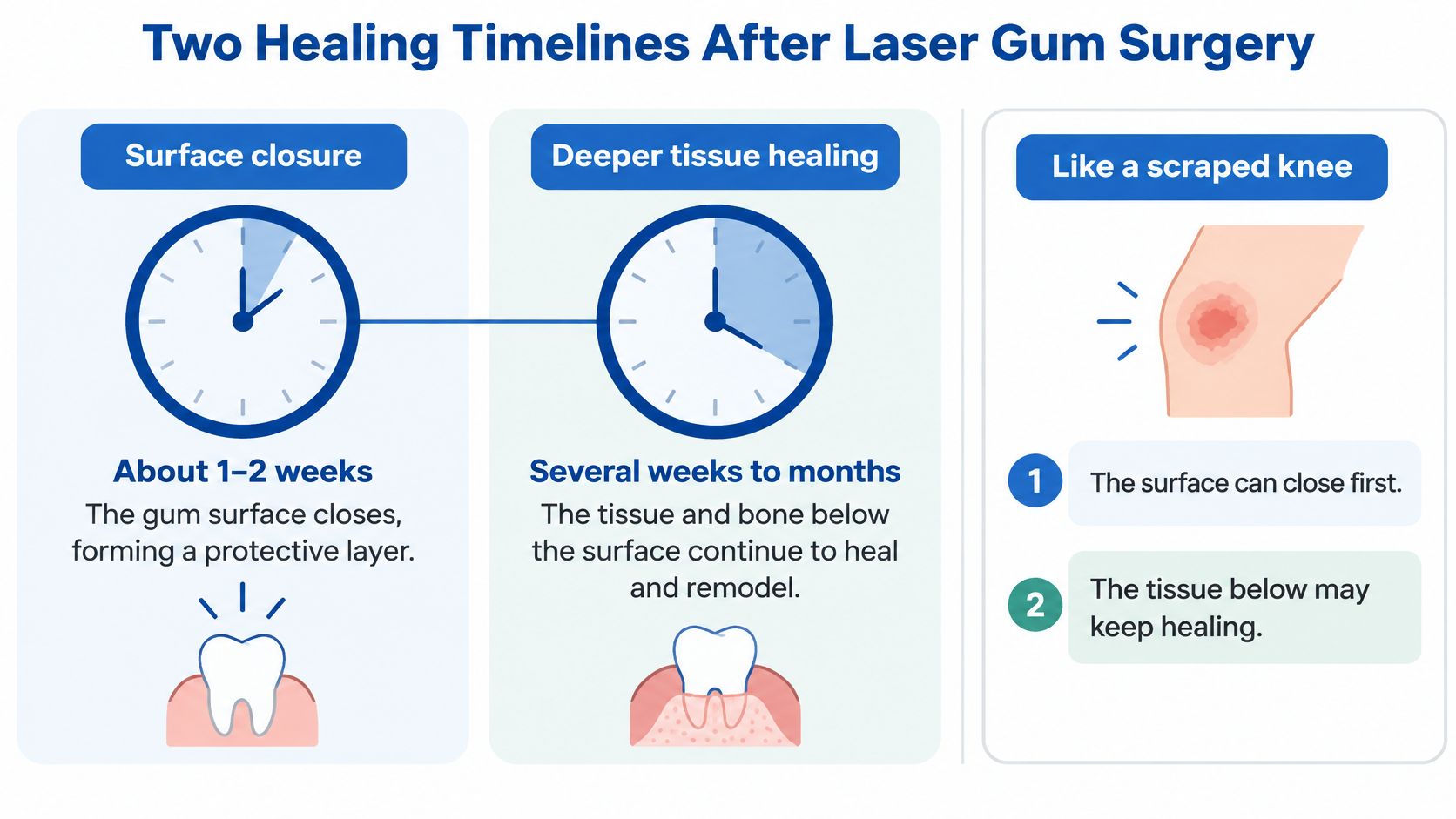
Think of a scraped knee: the skin closes in about a week, but the tissue underneath keeps rebuilding for much longer. After laser periodontal treatment, recovery also runs on two clocks. One tracks early comfort and visible surface repair; the other tracks deeper attachment and bone remodeling.
Clock one, the surface you can see
Surface closure describes what patients can see and feel. A literature review reports that surface epithelialization generally takes 5–14 days, while complete epithelialization takes about one month, according to this review of periodontal wound repair. Gums can look clean and calm within two weeks while the attachment underneath is still forming, so a good appearance alone does not mean the job is finished.
Clock two, the foundation you cannot see
Deeper tissue healing follows a slower course. The same review notes that connective-tissue restoration may take approximately seven weeks, and deeper periodontal remodeling can continue for 4–12 months or longer. Reduced swelling is encouraging, but it does not show whether the ligament and bone interface have finished rebuilding.
A human histologic investigation summarized in a 2022 peer-reviewed series and related analysis enrolled 8 patients and treated 12 teeth with full-mouth LANAP before planned extraction. After 9 months, researchers could examine 10 teeth under a microscope. Five showed some periodontal regeneration, with new cementum, periodontal ligament, and alveolar bone. Other sites healed by new attachment or a long junctional epithelium. Regeneration happened at five of the ten teeth that could be studied, so it is achievable, though the result varies by site.
Early comfort can improve while attachment is still maturing. Pain level alone should not determine when probing or regular cleaning resumes.
Before those steps return, a periodontist considers tissue appearance, pocket depth, tooth mobility, and the maintenance schedule. The factors in the next section, especially smoking and diabetes, can speed up or slow down both clocks.
A Week by Week Laser Gum Surgery Timeline
A follow-up visit is a checkpoint, not a finish line. The first clock tracks comfort and surface repair; the second tracks changes in the periodontal pocket and attachment over months. Those clocks can move at different speeds, so feeling better does not confirm that deeper tissue has finished healing.
The first two weeks
Pain findings vary across studies. In a randomized comparison of 20 participants, summarized in a 2026 systematic review, researchers found no significant pain difference on days 1 or 7. The laser group reported lower pain on day 3 (p = 0.003), while analgesic use did not differ significantly. At 1 week, 83.4% of laser-treated sites received an “excellent” healing rating, compared with 25.0% of control sites. Across the studies reviewed, pain results were inconsistent, and none of four randomized studies was judged to have a low overall risk of bias.
A separate meta-analysis of adjunctive low-level laser therapy found faster re-epithelialization and improved wound healing by day 14 at donor sites after free gingival graft surgery, with later checks through days 21–30, according to PubMed's record of that analysis. A graft donor site is not the same as every laser-treated periodontal pocket. The finding illustrates why early surface repair and comfort do not establish that deeper attachment has matured.
Later periodontal reviews
Periodontal assessments may include 6 weeks, 3 months, 6 months, and 12 months. A 2024 randomized split-mouth study of 10 participants, summarized in the 2026 systematic review, found significant differences in pocket depth and clinical attachment at 6 and 24 weeks. In a separate 22-patient LANAP case series, early checks at 7–12 days were part of the reported follow-up schedule.
| Phase | Typical window | What is being judged |
|---|---|---|
| Early comfort | First week | Symptoms and the initial tissue response |
| Surface check | About 1–2 weeks | Soft-tissue healing, not final attachment |
| Early remodeling | About 6 weeks | Tissue maturity and tolerance of home care |
| Periodontal review | 3, 6, and 12 months | Pocket depth, attachment, and stability |
These are common checkpoints, not guaranteed appointment dates. Your periodontist may adjust them based on the procedure and how the tissue responds. The distinction matters: the surface can look calmer while pocket depth and attachment still need follow-up to assess whether the deeper result is holding.
Everyday Recovery Examples After Laser Treatment
A desk worker treated around a few back teeth may be able to answer email the next morning, while chewing on the treated side takes several days to feel comfortable. Talking can feel tiring for a day or two. A lighter schedule and chewing on the other side may be enough, though a physically demanding job can call for more rest.
Temperature sensitivity may occur with hot coffee or ice water. It usually eases within about one to two weeks as the surface closes. These are common patterns, not guarantees.
A wider case and a longer soft-food stretch
When treatment covers many teeth, meals may need to stay soft longer, and the first week can feel slower. A clinical LANAP education source reports that patients typically follow a soft diet for several days to one week and avoid brushing directly at the surgical site during that period, as described in this LANAP postoperative education article. Instructions may differ with pocket depth, tissue response, treatment area, or added procedures.
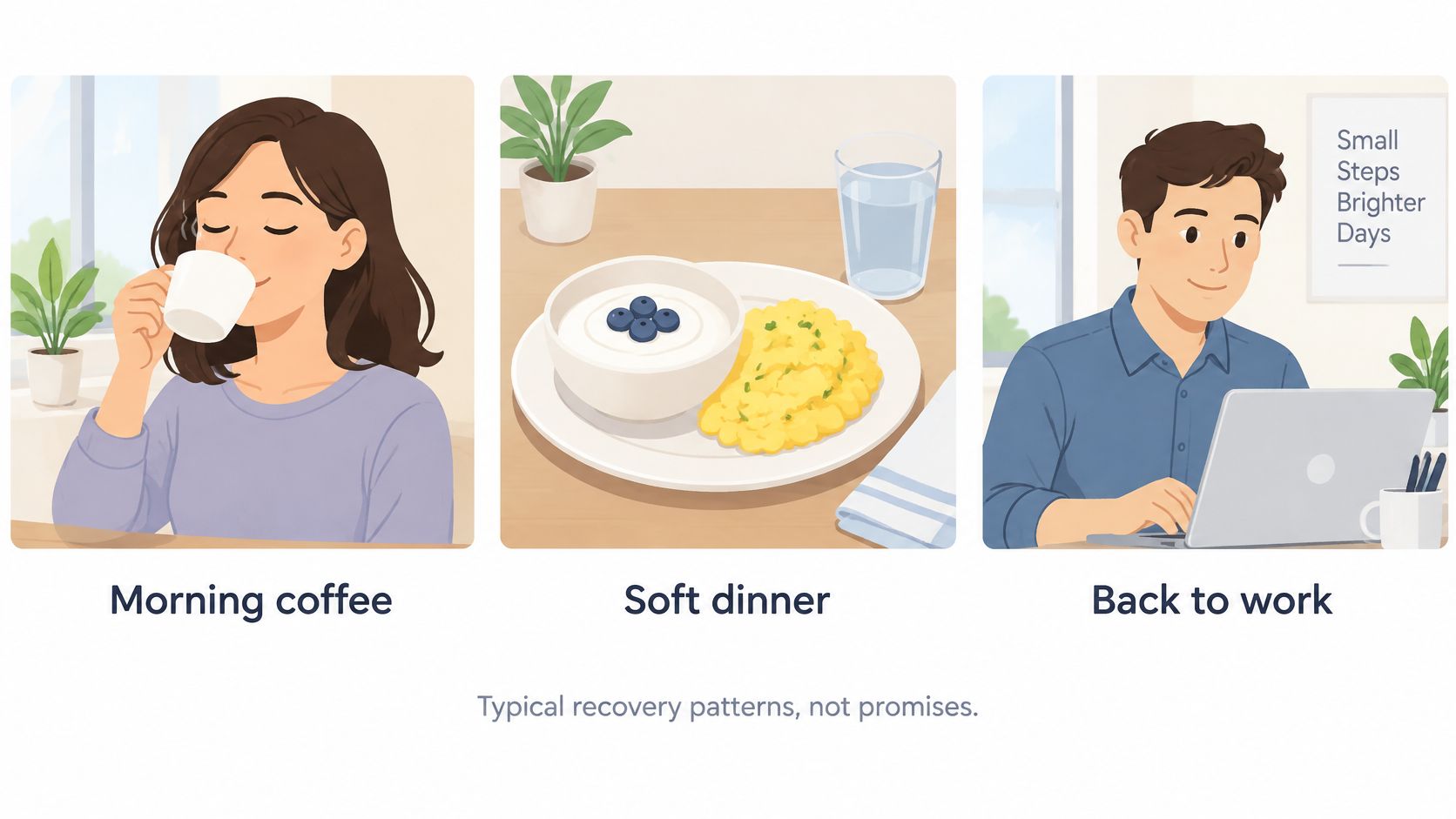
Soft foods protect the forming clot from pressure. Yogurt, eggs, pasta, and tender fish need little chewing. Seeds, chips, and crunchy crusts can disturb the clot near the root, as can brushing or flossing the treated area too soon. Clean the rest of your mouth as instructed, and leave the surgical site alone until your periodontist says it is safe.
Some laser procedures include stitches, while others do not. Ask your periodontist at the first visit whether your treatment plan includes stitches and, if so, when they will be removed. For more information about gum surgery stitches, including care and removal timing, consult this guide.
How Laser Type and Procedure Change Recovery
When soreness fades quickly, it can be tempting to assume the gum has fully healed. These are different clocks: early comfort and surface repair come first, while deeper attachment and bone remodeling continue for months. Wavelength, power, and whether the gum is opened all influence the first clock, and the procedure and health of the treated tissue affect the second.
Wavelength and flap design
A randomized trial of periodontal flap surgery, summarized in the PubMed-indexed review of laser periodontal surgery, found that adding a diode laser did not significantly improve tissue healing and produced more pain at treated sites. Researchers checked both laser-assisted and conventional sites at 3, 7, and 14 days, with comparable healing. The same review summarizes a 2024 systematic review: diode lasers may reduce pain on day 1 and may improve wound healing at one week, but the pain advantage did not persist at days 3 and 7. The PubMed-indexed review of laser periodontal surgery reports that Nd:YAG and CO2 laser gingivectomy had recovery periods similar to electrosurgery, while Er:YAG procedures generally recovered faster.
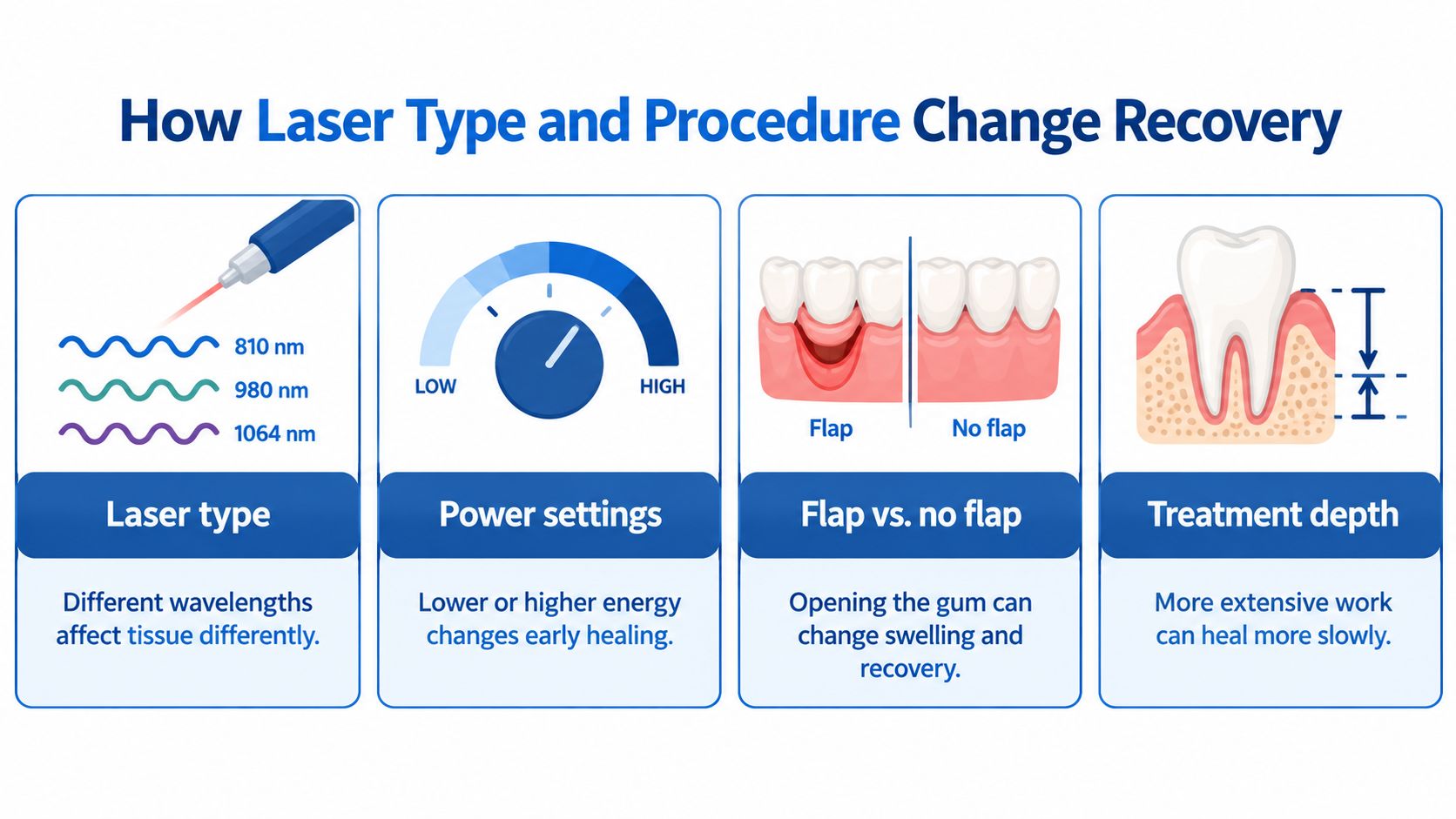
The American Academy of Periodontology notes that an unsuitable wavelength or power can damage periodontal tissue. Its evidence review says current studies are insufficient to establish laser therapy as superior or equivalent to conventional care for reducing probing depth or gaining clinical attachment. A claim of faster healing for every laser procedure is not supported.
Matching the protocol to the case
For suitable periodontal cases, Periodontal Associates of Delaware, a board-certified practice with offices in Wilmington, Newark, and Dover, uses LANAP with the FDA-cleared PerioLase MVP-7. When a treatment plan includes replacing missing teeth, implant planning may use i-CAT 3D cone beam imaging and X-Nav dynamic surgical navigation. Traditional surgery may also fit the diagnosis. The choice depends on pocketing, how many teeth need treatment, and the available bone support. The overview of pocketing in teeth explains how pocket measurements help describe disease depth.
A systematic review found that laser-assisted pain control helped in some selected settings, but the trials were too few to confirm the benefit. One clinical review advises that probing may be avoided for 6–12 months while the cementum and ligament interface heals, as discussed in this PLOS One analysis. Ask how the measured pocketing and planned procedure affect both early comfort and the longer-term assessment of healing.
Factors That Slow or Support Gum Healing
The device is only part of the timeline. The person holding the toothbrush matters just as much.
What stretches the clocks
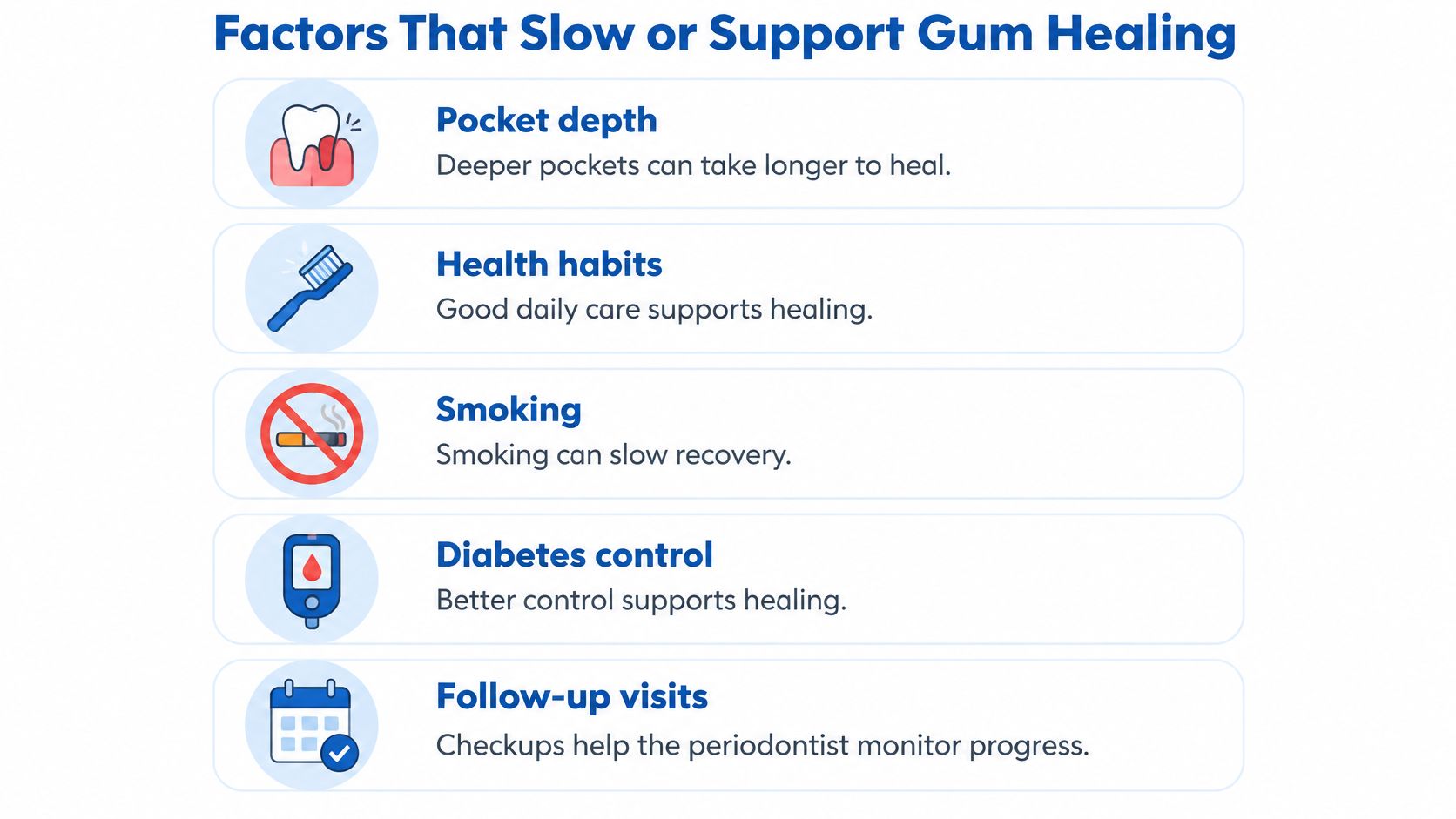
- Pocket depth: Deeper pockets mean more root surface and more tissue that has to reorganize. A shallow area often feels settled sooner than a site with advanced bone loss.
- How many teeth: Full-mouth treatment asks more of the body than a few localized sites. Fatigue and a longer soft-food stretch are common, not a sign the laser failed.
- Smoking: Tobacco reduces blood flow. A stable clot needs that blood supply. Laser treatment does not cancel the risk.
- Diabetes: High blood sugar can slow repair. Better daily control supports healing. It does not guarantee it.
- Plaque control: Bacteria left at the gumline can undo a clean surgical site. Gentle cleaning only where it is allowed protects the clot.
- Medicines: Drugs that affect clotting or immunity can change bleeding and repair. The periodontist should know the full list before treatment.
A prescribed rinse or antimicrobial, cleaning only the areas that are cleared, and a bite that feels even all support the early clot. If a tooth feels high, that is worth a call. Grinding on a sore tooth can irritate the healing attachment.
When to call instead of waiting
These are not a normal second stage of healing:
- Bleeding that will not slow with the instructions you were given
- Swelling that increases after the early window
- Fever, pus, or drainage
- Pain that worsens instead of easing
Call promptly for those signs. Waiting to see if they pass can disturb the clot and delay the repair the surgery was meant to start.
Bring the medication list and a short note about smoking, blood sugar, and home care to the next visit. That checklist gives the periodontist a real picture while the gums are still changing.
Planning Follow-Up and Your Next Appointment
Feeling more comfortable after the first week can be reassuring, but it does not show whether attachment or bone has changed. The two clocks keep running: surface repair unfolds over days and weeks, while pocket depth, recession, furcations, and tooth stability may need reassessment over 6–18 months.
Why the late visit still matters
A 22-patient retrospective case series followed people with moderate to severe chronic periodontitis treated with single-session LANAP. At reassessment 12–18 months later, 93.5% of recorded probing depths were 3 millimeters or less, and mean recession was 0.1 millimeter. The report also described early checks around 7–12 days and 10–14 days in this retrospective LANAP case series. These results describe a group; your own review at 12–18 months will show how your attachment is progressing.
Your gums can feel better before deeper tissue has finished remodeling. At a review, the periodontist assesses tissue appearance, pocket depth, tooth mobility, and attachment, and may consider radiographic findings. The factors covered earlier, especially smoking, diabetes, and plaque control, also shape what the late visit shows. Before deciding healing is complete, ask the periodontist to check pocket depth and tooth mobility, and whether a radiograph is needed.
Ongoing periodontal maintenance provides continued checks of gum pockets after the early comfort phase. Adults in New Castle and Kent Counties with gum disease, recession, or missing teeth can request an evaluation at the Wilmington, Newark, or Dover office through the appointment page. The visit is for diagnosis and a personal plan. It cannot guarantee a specific recovery time, cure, fee, or insurance outcome.
Periodontal Associates of Delaware provides periodontal care, including laser treatment for gum disease and implant planning when teeth are missing, at offices in Wilmington, Newark, and Dover. An evaluation can help map a realistic recovery timeline for your mouth. Request a visit with Periodontal Associates of Delaware at the office closest to you.