Periodontal disease has no fixed timeline, and in many adults it builds over years rather than months, though progression differs widely between people and between teeth. Newly noticed bleeding doesn't necessarily mean the disease just started.
The surprising part is that gum disease can damage the tissues supporting teeth without causing much discomfort. The Centers for Disease Control and Prevention's gum disease guidance distinguishes early gum inflammation from destructive periodontitis, which may develop before someone recognizes a serious problem.
For adults asking how long does periodontal disease take to develop, the most useful answer comes from measurements, not a calendar. A periodontal examination can establish what has happened around individual teeth and help determine whether treatment or closer monitoring is needed.
Table of Contents
- Gum Disease Stages and How Long Each May Take
- Warning Signs That Disease May Be Active Now
- Risk Factors and Why Some Teeth Progress First
- How Periodontists Stage and Grade Gum Disease
- Monitoring and Prevention Between Visits
- Book a Periodontal Evaluation Before the Next Change
Gum Disease Stages and How Long Each May Take
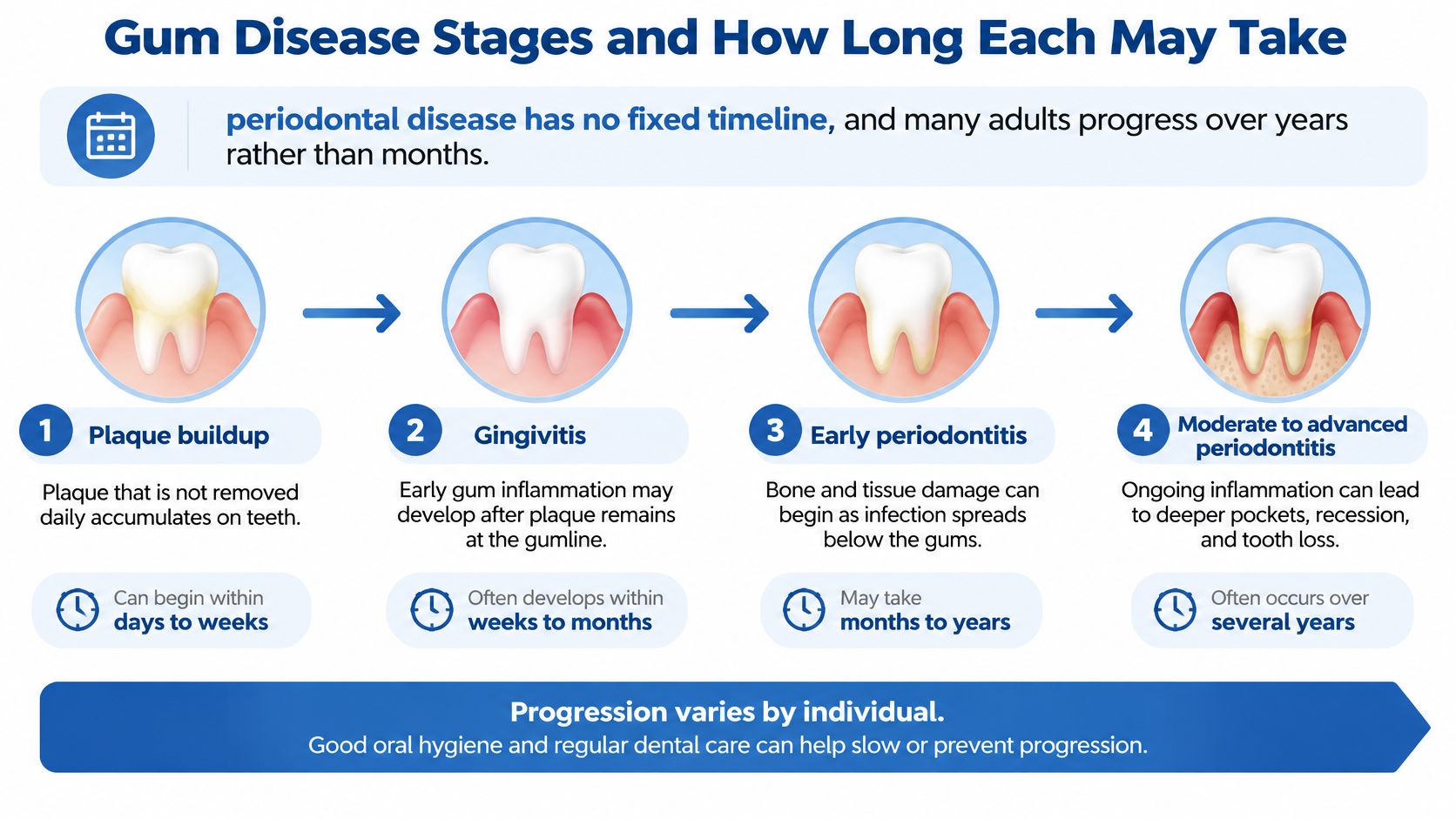
Gum disease usually follows a biological sequence, but that sequence isn't an appointment schedule. Some people develop inflammation without progressing to destructive disease, while susceptible people may lose supporting tissue at particular teeth.
The National Institute of Dental and Craniofacial Research's periodontal disease guide explains that gingivitis causes red, swollen, easily bleeding gums without loss of supporting bone or connective tissue. When inflammation remains untreated, bacteria can spread below the gumline, and the body's response can contribute to tissue and bone breakdown.
From plaque to supporting-bone loss
Plaque is a bacterial film that collects on teeth. Daily cleaning removes that film, but plaque left in place can harden into tartar, also called calculus, which requires professional removal.
Gingivitis affects the gums before the supporting structures are destroyed. Professional cleaning and consistent home care can often reverse this early inflammation, which is why the difference between gingivitis and periodontitis matters when considering treatment.
Gum disease stages and typical timing
| Stage | What Happens | How Long It May Take | Reversible? |
|---|---|---|---|
| Plaque buildup | Bacteria form a film on teeth that isn't removed daily | Accumulates when daily cleaning is missed | Yes, with effective brushing and cleaning between teeth |
| Tartar formation | Plaque hardens into calculus near and below the gumline | After plaque remains long enough to harden; no universal interval | Tartar needs professional removal |
| Gingivitis | Gums become red, swollen, and may bleed; supporting bone isn't yet lost | After persistent plaque exposure; no fixed onset | Usually yes, with professional cleaning and home care |
| Early periodontitis | Infected pockets form, and supporting tissue begins to break down | Often over years in susceptible people; faster progression can occur | Lost bone doesn't return on its own; treatment aims to stop further loss |
| Advanced periodontitis | Significant bone and connective tissue loss can make teeth loose | Commonly develops over many years, but can progress faster | Damage may be permanent; treatment aims to preserve teeth and function |
A map rather than a countdown
With early periodontitis, the important change isn't just more redness. The attachment between the tooth and its supporting tissues has begun to break down, creating a problem that brushing alone can't reverse.
Advanced disease involves greater loss of support and may interfere with chewing or tooth stability. However, a diagnosis of periodontitis doesn't automatically mean every affected tooth must be removed.
Practical rule: The stage table describes what can happen, not when it must happen. Waiting for the next stage isn't a safe way to decide when care is needed.
Warning Signs That Disease May Be Active Now
Symptoms are a poor clock. Bleeding noticed recently may reflect recent inflammation, longstanding disease, or a change at a previously affected site. Conversely, a person with little discomfort may still have clinically important attachment or bone loss.
The National Institute of Dental and Craniofacial Research's gum disease overview identifies bleeding, recession, pocketing, and changes in tooth support as reasons for assessment. A symptom helps identify a concern, but it doesn't establish how long the underlying process has been present.
What each sign should prompt
The timing below is practical booking guidance, not a test of disease severity. When symptoms worsen or occur together, the practice should be contacted sooner rather than waiting for a routine cleaning.
Gum warning signs and when to book an exam
| Sign | What It May Indicate | When to Book an Exam |
|---|---|---|
| Bleeding when brushing or flossing | Gingivitis or active inflammation | Within a few weeks, sooner if it keeps happening |
| Red or swollen gums | Ongoing inflammation at the gumline | Soon, especially if it persists |
| Persistent bad breath | Bacteria below the gumline, among other possible causes | Soon, particularly with other signs |
| Gum recession or teeth that look longer | Gum tissue pulling away, with possible bone loss | Soon |
| Sensitivity at the gumline | Exposed tooth roots | Soon |
| Pus or deep pockets | Possible active infection or an area requiring treatment | Right away |
| Loose or shifting teeth | Possible advanced loss of tooth support | Right away |
Not every symptom has a single explanation. Recession doesn't prove active periodontitis, and bad breath alone doesn't establish an infection below the gums. Loose teeth, however, warrant prompt attention because the supporting structures need assessment.
What symptoms cannot establish
A patient may notice that bleeding improves after better brushing. That improvement is welcome, but it doesn't show whether earlier bone loss exists or whether all deeper areas are clean.
A periodontal examination checks pocket depths, bleeding on probing, attachment levels, and bone on dental X-rays. The periodontist uses those findings together rather than treating a symptom's duration as proof of severity.
Less bleeding is encouraging. It isn't, by itself, evidence that lost supporting bone has returned.
Risk Factors and Why Some Teeth Progress First
Years of exposure matter, but age alone doesn't predict an individual outcome. Earlier national findings summarized in a CDC periodontal disease analysis found that about 4% of adults aged 20 to 34 met the study definition of periodontal disease, compared with approximately 12% of adults aged 50 to 64.
That population pattern doesn't mean younger adults are protected or older adults must develop severe disease. It means clinicians need to consider both accumulated damage and the factors that may influence future progression.
Why similar inflammation can lead to different outcomes
A periodontist looks beyond the amount of visible plaque. The patient's inflammatory response, healing capacity, and ability to keep particular areas clean all influence the assessment.
Risk factors that can change the pace of gum disease
| Risk Factor | How It May Speed Progression | What Changes in the Timeline |
|---|---|---|
| Smoking or tobacco use | Reduces blood flow to gums and weakens healing | Disease may advance faster and respond less predictably to treatment |
| Poorly controlled diabetes | Heightens the inflammatory response in gum tissue | Progression may accelerate |
| Heavy plaque and calculus | Keeps bacteria near and below the gumline | Inflammation persists and can recur |
| Genetics and immune factors | Some people respond more strongly to the same bacteria | Faster progression may occur despite good hygiene |
| Stress and obesity | Associated with greater systemic inflammation | Progression may be more likely in susceptible people |
| Local tooth anatomy | Crowding and deep grooves can trap plaque | Specific areas may progress before the rest of the mouth |
These factors don't function as a stopwatch, and none establishes a diagnosis by itself. Their value is in explaining why the same appearance at the gumline can lead to different treatment and monitoring recommendations.
Medication-related dryness can also make daily oral care more challenging. Understanding whether dry mouth can contribute to gum disease can help patients recognize another concern worth including in the medical history.
Why one tooth may deteriorate before another
A roof leak offers a useful comparison. Water may repeatedly enter at a damaged seam while the rest of the roof stays dry, so the damage concentrates around that opening.
Similarly, one tooth may have a hard-to-clean groove or a persistent deposit below the gumline while neighboring sites remain relatively stable. A healthy-looking area elsewhere in the mouth doesn't cancel out a problem at that site.
The American Academy of Periodontology's diagnosis and examination literature review describes a six-year study of 156 people aged 13 to 20 in which teeth beginning with 0 to 2 mm of attachment loss that later developed at least 3 mm of loss had more baseline inflammation and approximately four times as much subgingival calculus as teeth that didn't develop the lesion. Persistent gingivitis and calculus at repeated examinations were associated with still greater progression.
That finding illustrates the importance of local conditions, not a universal deadline. A vulnerable site can deteriorate while another site in the same mouth remains stable.
Separate changes from monitoring needs
Some contributors can be addressed through home care, professional cleaning, medical coordination, or behavioral support. Others, such as inherited susceptibility or difficult tooth anatomy, require a more customized cleaning approach and closer observation.
A useful plan identifies both categories without assigning blame. Periodontal disease isn't a moral judgment about brushing, and a patient shouldn't assume that an inherited risk makes treatment pointless.
The relevant comparison is each site against its earlier measurements. How long a tooth has bled is less informative than whether its attachment or supporting bone has changed.
How Periodontists Stage and Grade Gum Disease
Periodontitis receives separate labels for stage and grade. Stage describes the damage already present and the complexity of care, while grade describes the likely pace of progression.
The American Academy of Pediatric Dentistry's periodontal classification document describes four stages and three grades: Stage I is initial disease, Stage II moderate disease, Stage III severe disease with potential for additional tooth loss, and Stage IV advanced disease with potential for loss of the dentition.
Grade describes pace, not appearance
| Grade | Likely Rate of Progression | What Helps Establish It |
|---|---|---|
| Grade A | Slow | Evidence of limited progression relative to the clinical findings |
| Grade B | Moderate | Findings consistent with an intermediate progression pattern |
| Grade C | Rapid | Evidence of faster destruction, considered alongside relevant risk modifiers |
Grade isn't assigned from a photograph or a single report of bleeding. Clinicians consider the amount of destruction, earlier records when available, and the patient's medical and behavioral history.
For example, two adults might have similarly red gums during an examination. One may have limited historical damage and stable records, while the other has lost attachment since an earlier visit. Their appearances may overlap, but their care needs differ.
Measurements make the labels useful
Periodontists assess probing depths, attachment loss, radiographic bone loss, tooth mobility, and the distribution of affected teeth. Understanding pocketing around teeth helps explain why a small measuring instrument is essential to this process.
A pocket depth measures the space between the gum edge and the base of the pocket. Attachment measurements help account for the position of the gumline, so a shallow-looking space doesn't automatically rule out previous damage.
Staging and grading guide treatment priorities and follow-up intensity. They aren't a prediction of the exact date a tooth will loosen, and they shouldn't be interpreted as a guarantee of future tooth loss.
Monitoring and Prevention Between Visits
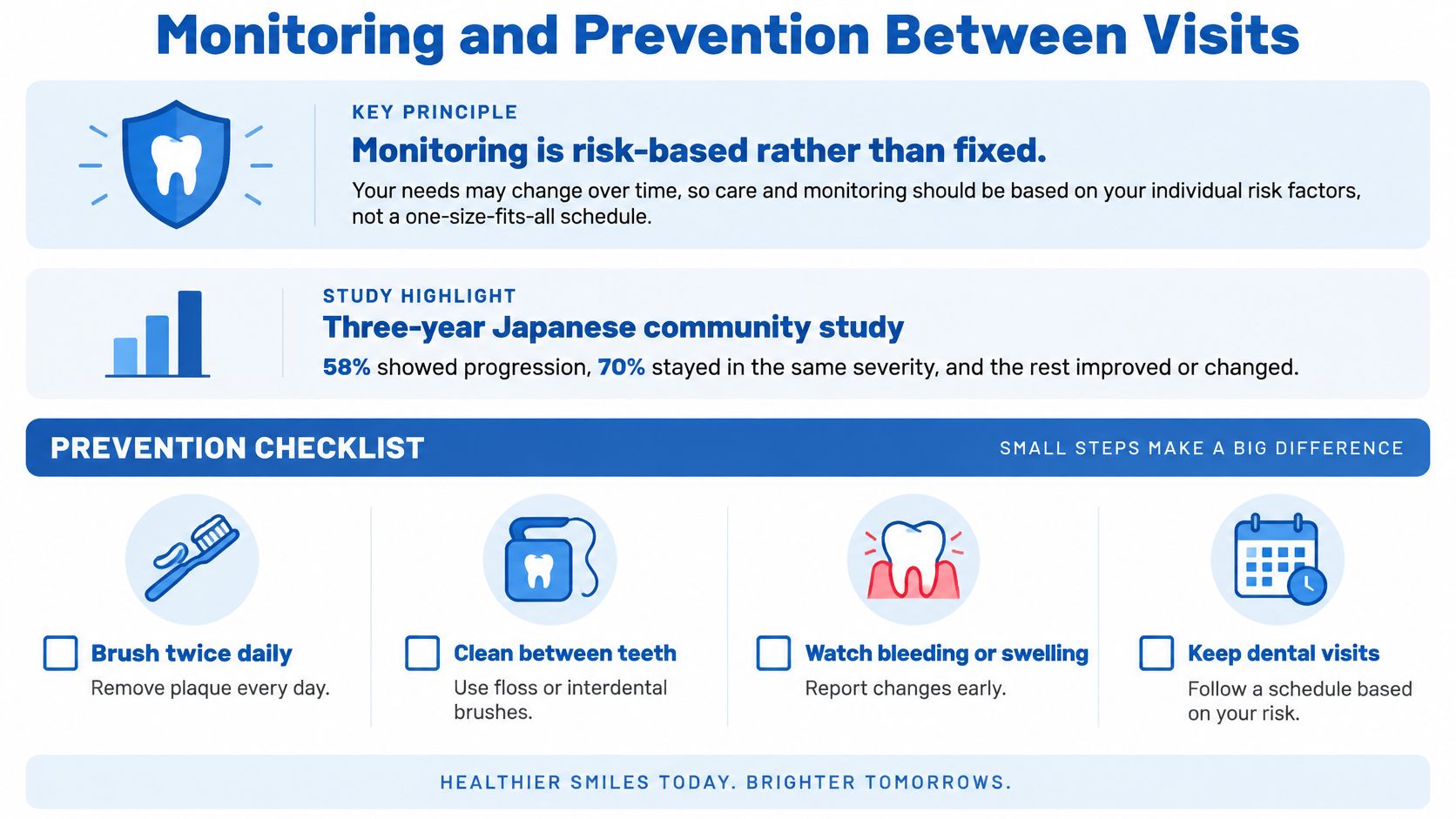
Monitoring should be risk-based rather than fixed. The appropriate interval follows a baseline assessment and can change as the periodontist evaluates treatment response and stability.
A Japanese community study published in BMC Oral Health found that over three years, 58% of participants showed progression, while 70% remained in the same severity stage and 15% moved to a higher stage. Those measures describe different outcomes: a person can develop measurable worsening without crossing the threshold into another stage.
Stable stage doesn't always mean stable disease
A broad stage label cannot capture every change around every tooth. Follow-up measurements allow the clinician to detect a developing problem before it becomes large enough to alter the overall classification.
Patients with stable findings may need less intensive surveillance. Previous periodontitis, persistent deep pockets, or documented deterioration may justify shorter reassessment intervals rather than a routine wait.
A practical home-care checklist
- Brush twice daily. Use fluoride toothpaste and a soft-bristled toothbrush, directing the bristles gently along the gumline.
- Clean between teeth daily. Floss or appropriately sized interdental brushes can reach surfaces a toothbrush misses. An interdental brush should fit without being forced.
- Follow the health plan. Tobacco cessation support and physician-guided blood sugar management belong alongside dental care when relevant.
- Keep periodontal maintenance visits. Professional care addresses deposits and areas that cannot be adequately managed at home.
- Report changes early. New bleeding, pus, looseness, or a change in the bite should prompt contact rather than waiting for the next scheduled visit.
Inflammatory biomarker testing is an area of investigation, but these tests aren't a universally validated substitute for clinical examination. Decisions still require interpretation of the tissues, tooth support, and changes over time.
Between-visit priority: Consistent home care supports professional monitoring. It doesn't replace measurements or remove hardened deposits below the gumline.
Book a Periodontal Evaluation Before the Next Change
Bleeding gums, recession, redness, or loose teeth are reasons to arrange a periodontal evaluation rather than estimate how much time remains. The appointment can distinguish a manageable area of inflammation from a site that needs active treatment.
Periodontal Associates of Delaware is a board-certified periodontal practice with offices in Wilmington, Newark, and Dover. Its periodontists hold diplomate status with the American Board of Periodontology, and a referral isn't needed to schedule.
Preparing for the appointment
A concise history helps the periodontist interpret the examination. Patients don't need to know the diagnosis before calling or remember precisely when every symptom began.
- Record the changes. Note when bleeding, sensitivity, recession, or shifting first became noticeable and whether it has continued.
- Bring a medication and health list. Include relevant diagnoses, especially diabetes, and recent changes in medical care.
- Mention tobacco exposure and previous treatment. Prior deep cleanings, gum procedures, and available dental records can help establish context.
- Identify the main concern. Fear of surgery, difficulty chewing, or concern about keeping a particular tooth should be discussed directly.
An evaluation doesn't commit a patient to surgery
The visit may include measurements around individual teeth and dental X-rays. The periodontist can explain which findings reflect existing damage, which suggest ongoing inflammation, and what additional information is needed.
At Periodontal Associates of Delaware, care may include nonsurgical therapy or surgical treatment matched to the diagnosis; LANAP, the only FDA-cleared laser protocol for treating periodontal disease, uses the FDA-cleared PerioLase MVP-7 and may be appropriate for selected patients. The practice also uses i-CAT 3D cone beam imaging when useful for evaluating bone and X-Nav dynamic surgical navigation for implant planning and placement when missing teeth require replacement.
Patients across New Castle and Kent Counties, including Pike Creek, Hockessin, Bear, Middletown, and surrounding communities, can choose among the Wilmington, Newark, and Dover offices. The purpose of the consultation is to establish an appropriate plan, not to assume that every patient needs gum surgery.
Individual results vary. Many patients see improvement with timely care, but treatment recommendations and expected responses depend on the diagnosis. A periodontist should assess each patient's situation before conclusions are drawn about tooth preservation or treatment suitability.
Periodontal Associates of Delaware offers periodontal evaluation and individualized care to replace guesses about gum disease timing with a clear assessment of tooth support and risk. Adults concerned about bleeding, recession, or bone loss can request an appointment at the nearest Wilmington, Newark, or Dover office.