In a 2024 literature update, 25 of 33 included studies found a significant relationship between smoking and increased dental implant failure. That pattern reframes the discussion: smoking isn't an automatic rejection, but it isn't a minor detail that careful surgery can overcome.
The useful question about dental implants for smokers is which risks can be changed before treatment, which require a different surgical plan, and which need closer monitoring afterward. A periodontist can separate those questions without promising an outcome or assuming that every smoker has the same prognosis.
Table of Contents
- How Much Smoking Raises Implant Failure Risk
- Who Can Still Get Implants While Smoking
- Quitting Timeline Before and After Surgery
- Laser and Planning Choices That Reduce Risk
- Consent Questions Smokers Should Ask First
- Why Bleeding Can Hide Trouble After Implants
- Confirm Your Candidacy and Book a Consultation
How Much Smoking Raises Implant Failure Risk
Smoking raises the odds of implant failure, including failure during early healing. A 2024 systematic review and meta-analysis evaluated 21 cohort studies at the implant level and 30 at the patient level, finding higher early failure odds among smokers; its estimates appear in the table below, attributed to the early implant failure meta-analysis.
An odds ratio isn't a failure percentage. An odds ratio of 2.59 doesn't mean that 259% more implants fail, and it doesn't give an individual's absolute probability of failure.
Reported smoking-related implant failure figures
The table also includes estimates from the 2021 implant failure meta-analysis, the dose-response systematic review and meta-analysis, and the 2023 retrospective study of smoking and implant failure.
| Measure | Who is compared | Reported value |
|---|---|---|
| Early implant failure, implant level (2024 meta-analysis) | Smokers vs nonsmokers | OR 2.59 (95% CI 2.08-3.23) |
| Early implant failure, patient level (2024 meta-analysis) | Smokers vs nonsmokers | OR 2.00 (95% CI 1.43-2.80) |
| Pooled implant failure odds (2021 meta-analysis) | Smokers vs nonsmokers | OR 2.402 (95% CI 2.176-2.652) |
| Implant failure, more than 20 cigarettes a day, patient level (dose-response review) | Heavy smokers vs nonsmokers | RR 4.00 (95% CI 2.72-5.89) |
| Implant failure, more than 20 cigarettes a day, implant level (dose-response review) | Heavy smokers vs nonsmokers | RR 2.45 (95% CI 1.42-4.22) |
| Implant failure, more than 20 cigarettes a day (2023 retrospective study) | Heavy smokers vs nonsmokers | OR 7.66 |
OR means odds ratio; RR means relative risk; CI means confidence interval. These measures shouldn't be treated as interchangeable.
At the implant level, investigators count individual implants. At the patient level, they count people experiencing failure, which matters when a person receives several implants. The early-failure results therefore answer related but different questions: whether a particular implant fails and whether a patient experiences a failure.
The pooled estimate includes implant failure more broadly, rather than only early failure. Its agreement with the early-healing findings suggests that the concern doesn't end when the surgical wound closes.
Why cigarette quantity changes the discussion
The heavy-smoking rows show why a yes-or-no smoking question isn't enough. The dose-response review found greater failure risk with increasing daily cigarette consumption, while the retrospective study reported a particularly strong association in its heavy-smoking group.
Those estimates aren't competing predictions for the same patient. Study design, follow-up, patient selection, and the unit being counted can produce different results. A retrospective study also can't establish that smoking alone caused each failure.
Practical preparation: A consultation should begin with a written record of current cigarettes per day and the jaw and tooth area where an implant is planned.
Smoking is a clinically important risk factor, not a minor technical variable. No single number in this table predicts one person's result.
Who Can Still Get Implants While Smoking
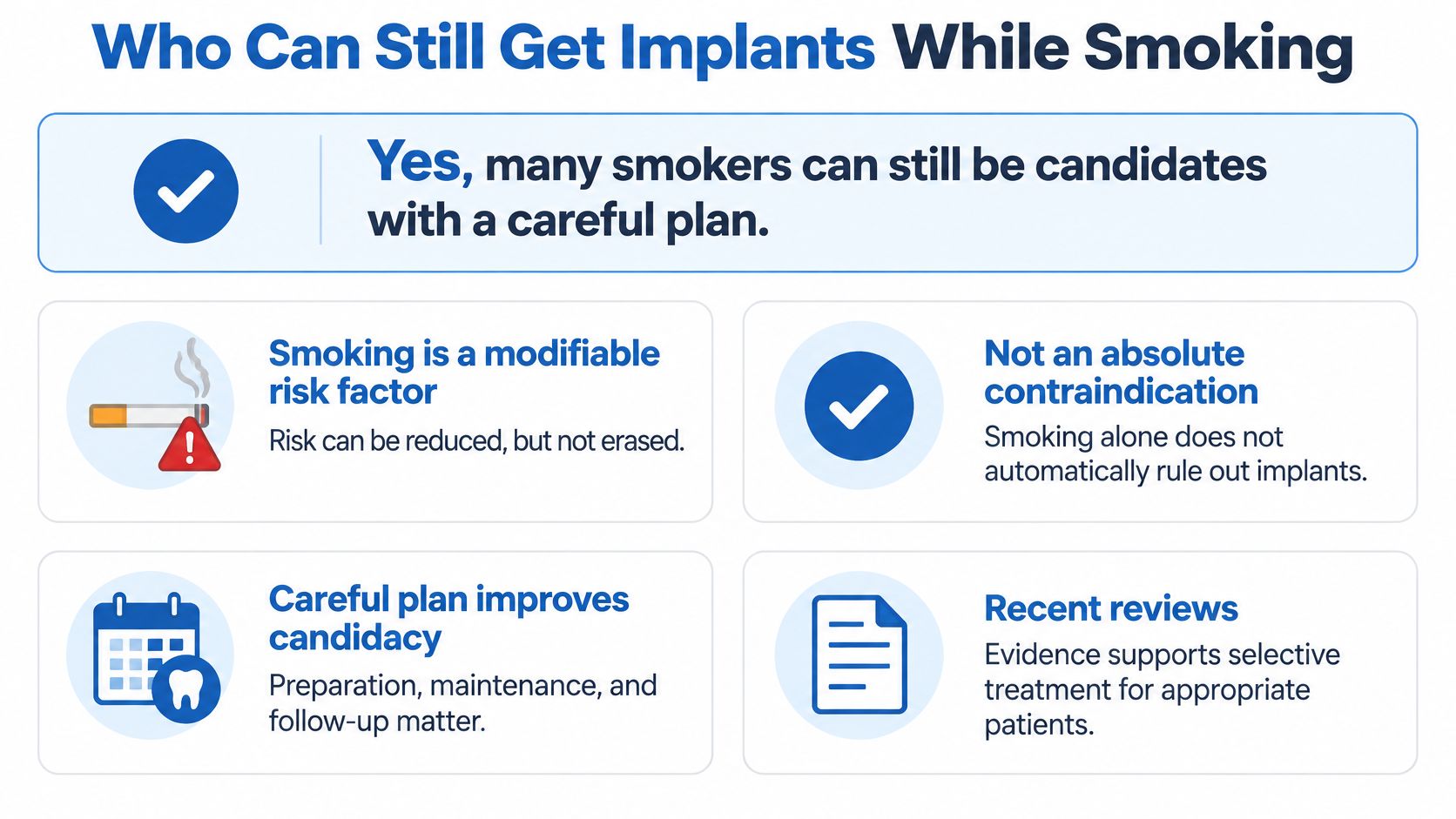
Many smokers remain candidates with a careful plan. Smoking is generally a modifiable risk factor, not an absolute contraindication, and a review addressing smoking and implant outcomes supports individualized treatment rather than a blanket exclusion.
Candidacy depends on whether the periodontist can establish a reasonable foundation for treatment and whether the patient can participate in risk reduction. An implant consultation should produce decisions, not just a general warning.
A consultation checklist
Daily cigarette count. Higher consumption calls for a more cautious discussion. The plan may prioritize cessation support and reassessment before a surgical date is selected.
Implant location. The upper jaw has shown a higher smoking-associated risk in the early-failure literature. For a posterior upper implant, sinus anatomy and available bone also influence whether treatment can proceed directly or requires additional preparation.
Active gum disease. Inflamed tissues and untreated periodontal pockets need attention before placement. Stabilizing disease may delay the implant, but it addresses a separate contributor to an unfavorable outcome.
Bone volume and quality. Thin or inadequate bone may require grafting before placement. For upper back teeth, the decision about a sinus lift and implant at the same time depends on the site's ability to support the planned treatment.
Previous implant history. An earlier failure deserves a review of the original site, healing course, restoration, and maintenance history. Repeating the same approach without identifying likely contributors wouldn't provide a sound basis for another attempt.
Ability to pause smoking. An achievable cessation plan can affect surgical timing. Difficulty stopping should prompt support and a frank discussion, not concealment or blame.
What survival figures can establish
A 2025 five-year retrospective cohort study evaluated 161 implants, reported 92.5% overall survival, and found a significant association between smoking status and survival. That overall percentage isn't a smoker-specific success rate and shouldn't be presented as one.
Survival also isn't the same as freedom from inflammation or maintenance needs. An implant can remain present while still requiring treatment.
The most useful consultation outcome is a written, quantified assessment: the relevant published risk range, the limitations of applying it personally, and the findings that would change the plan. A general approval or rejection provides much less guidance.
Quitting Timeline Before and After Surgery
A commonly cited clinical starting point is at least one week of abstinence before placement and about two months afterward, according to a clinical review of smoking and dental implants. This isn't a universal rule or proof that the same schedule suits every surgical site.
Cessation timeline around implant treatment
The preoperative and early-integration intervals below reflect that clinical recommendation. The other phases organize the conversations and follow-up needed around it.
| Phase | Timing | What to do |
|---|---|---|
| Consultation | At the first evaluation | Document cigarettes per day, set a quit or reduction goal, discuss medical support |
| Pre-surgery abstinence | At least 1 week before placement | Stop all tobacco use, as commonly cited in clinical guidance |
| Immediate healing | Day of surgery through early recovery | Avoid smoking and vaping, follow the written care instructions |
| Early integration | Up to about 2 months after placement | Continue abstinence as commonly cited, with ongoing counseling |
| Long-term maintenance | After the implant is integrated | Attend recall visits for probing and radiographs, and stay tobacco-free if possible |
| Nicotine replacement | Any phase | No implant-specific regimen is established; coordinate with the physician |
At the consultation, the goal is to make the plan workable before surgery creates a deadline. The periodontist should know about previous quit attempts, withdrawal concerns, and circumstances that make smoking harder to avoid.
Before placement, abstinence addresses tobacco exposure during wound preparation and early repair. Tobacco can impair healing and host defense, while nicotine narrows blood vessels in the soft tissues and may reduce perfusion.
During recovery, written instructions should specify restrictions and the next examination. Bone integration can't be judged by whether the gum feels comfortable, so a patient shouldn't restart smoking based on symptom improvement.
Cutting down isn't equivalent to quitting
A dose-response relationship doesn't establish exactly how much a temporary reduction improves an individual's outcome. Cutting down may be a step toward cessation, but it shouldn't be presented as a proven substitute for abstinence around implant surgery.
Likewise, there's no established implant-specific nicotine replacement regimen in the evidence discussed here. The periodontist and the patient's physician should coordinate counseling and any medication or nicotine replacement support rather than assume that every nicotine product is harmless.
A quit plan should include what happens after a lapse. Honest reporting allows the clinical team to reassess care without turning a setback into a hidden risk.
Extraction timing may create another opportunity to prepare. The decision about how long after extraction an implant can be placed should account for the extraction site, infection control, grafting needs, and readiness for surgery.
A practical next step is to record a quit date or physician-supported reduction goal and bring it to the surgical appointment. The record should include the support being used and any difficulties that need attention.
Laser and Planning Choices That Reduce Risk
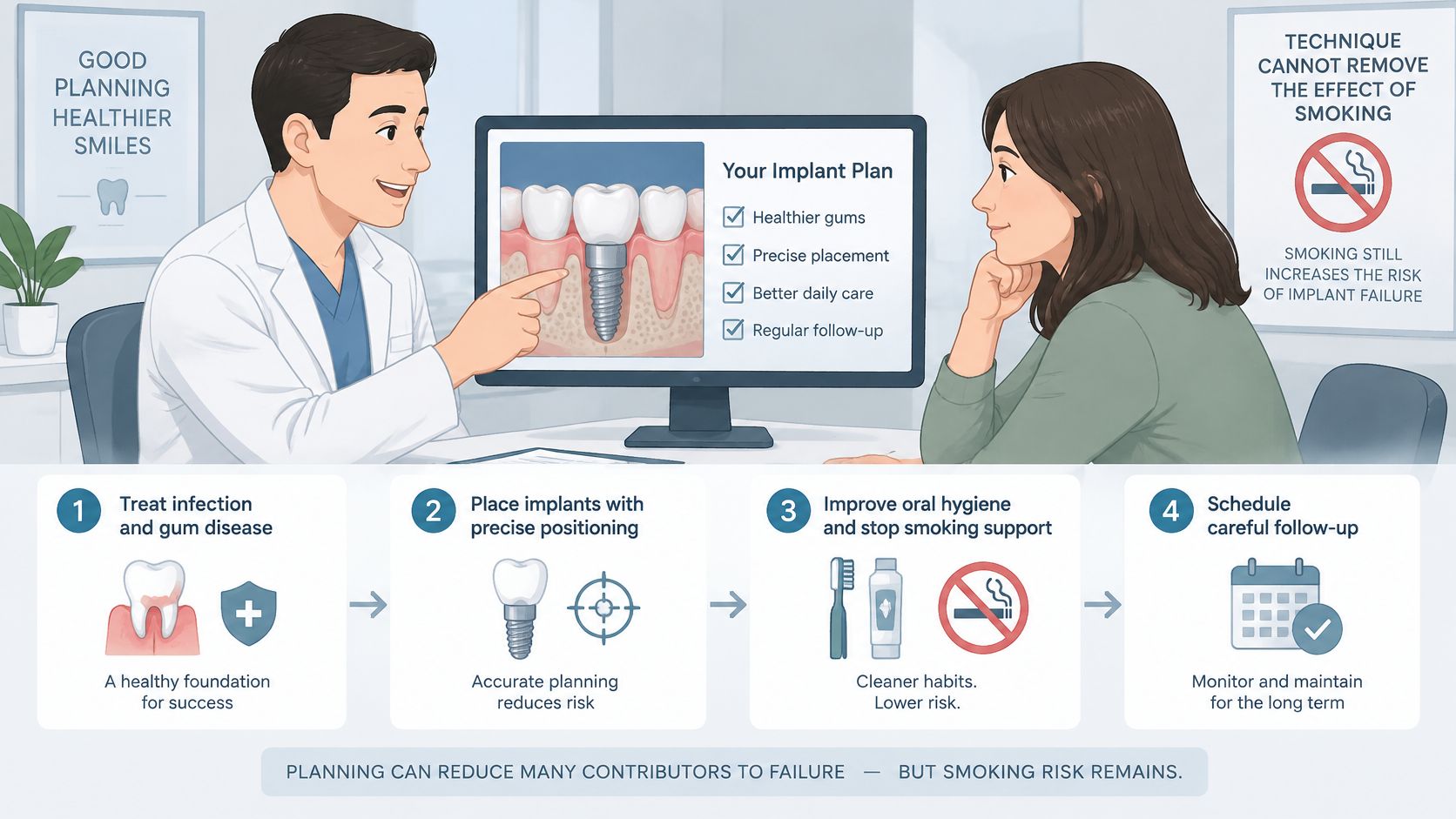
Technique can't erase smoking exposure, but planning can address other contributors to failure. Infection treatment, bone assessment, navigation, and grafting solve different problems, so they shouldn't be treated as interchangeable upgrades.
Periodontal Associates of Delaware offers periodontal treatment and implant planning using LANAP with the FDA-cleared PerioLase MVP-7, i-CAT 3D cone beam imaging, and X-Nav dynamic surgical navigation. The value of each depends on the diagnosis and surgical requirements.
Infection control and recovery
The first task is to treat active infection and stabilize periodontal disease. Depending on the findings, that may involve scaling and root planing, LANAP, or traditional periodontal surgery.
LANAP, the Laser-Assisted New Attachment Procedure, can promote regeneration of bone and tissue without scalpels or sutures. Compared with traditional gum surgery, it may involve less discomfort and bleeding and a faster recovery, although individual recovery varies.
Most LANAP patients return to normal activity within 24 hours. That describes recovery from periodontal treatment, not implant integration, and it doesn't mean that every patient is ready for implant placement immediately afterward.
For an anxious patient, distinguishing these stages matters. Treating gum disease first can be a planned part of preparation rather than an unexpected obstacle.
Bone assessment and placement
i-CAT 3D cone beam imaging helps the periodontist evaluate bone dimensions and plan the implant's position relative to surrounding anatomy. Its role is diagnostic: the scan helps identify whether the intended site can accommodate the proposed implant.
X-Nav dynamic surgical navigation guides placement during surgery. The practice uses imaging and navigation for placement with sub-millimeter precision, but positional precision doesn't guarantee biological healing in a smoker.
Grafting addresses a different limitation: an insufficient foundation. When bone is too thin, ridge preservation or augmentation may need to precede placement rather than be omitted to shorten treatment.
The resource on bone grafting for dental implants and cost considerations can help patients prepare for that discussion. The decision should begin with why a graft is necessary, whether it can be combined with placement, and what must heal before the next stage.
- Infection treatment addresses diseased tissues.
- Imaging defines the available anatomy.
- Navigation supports planned positioning.
- Grafting rebuilds deficient bone.
The consultation should identify which steps belong in the individual plan and why. More technology isn't a substitute for selecting the right treatment sequence.
Consent Questions Smokers Should Ask First
Informed consent should connect published risk to the actual treatment plan. A signature alone doesn't establish that a patient understands how smoking, periodontal status, and implant location affect the decision.
All cigarette, vaping, waterpipe, and other tobacco use should be disclosed before consent. A risk discussion based on incomplete exposure information can lead to inappropriate assumptions about preparation and follow-up.
Questions that make the decision clearer
Which cigarette count does the risk estimate assume?
A smoking label alone leaves out the amount consumed. The estimate should reflect current use rather than a past habit or an optimistic future goal.Would delaying surgery or reducing use change the plan?
This distinguishes a meaningful preparation period from a delay without a clear purpose. The answer should identify what finding or behavior would justify proceeding.Would grafting or treating gum disease first lower the risk?
Patients need to understand which concern each preliminary treatment addresses. A staged plan should have a clinical reason, not merely a longer schedule.What follow-up and probing schedule will be used?
Consent should include the maintenance commitment, not just the operation. The patient should understand who monitors the implant and how findings will be documented.Which signs mean the office should be contacted promptly?
Written instructions should address concerns such as worsening swelling, drainage, increasing discomfort, or a loose-feeling implant or restoration. The clinical team should clarify how to obtain an assessment.If an implant fails, what are the options?
A contingency discussion may include removal, healing, further site preparation, reassessment for another implant, or a nonimplant replacement. Another attempt shouldn't be assumed to be appropriate automatically.
What a useful consent discussion produces
A patient should leave knowing the proposed sequence, the reasons for any delay, and the responsibilities during recovery. Uncertainty should be acknowledged rather than hidden behind a general success rate.
Decision standard: A sound plan explains both why treatment is reasonable and what would make the periodontist reconsider it.
A written summary also helps when care involves a general dentist and a periodontal specialist. Both should understand the smoking plan, the restoration strategy, and who manages ongoing monitoring.
Individual results vary, and no consent form can guarantee integration or long-term survival. Many patients can do well with personalized care, but a periodontist should assess the individual findings before treatment is accepted.
Why Bleeding Can Hide Trouble After Implants
No bleeding doesn't necessarily mean healthy tissue around an implant. Nicotine-related narrowing of blood vessels may reduce visible bleeding, so a smoker's tissues can look less inflamed than their condition warrants.
Peri-implantitis is an inflammatory disease involving tissue and bone loss around an implant. It can threaten support even after the implant has integrated successfully.
A 2025 systematic review and meta-analysis of peri-implantitis risk indicators identified smoking or tobacco consumption as a risk indicator, with an odds ratio of 2.0 and a 95% confidence interval of 1.6 to 2.4. That association doesn't prove smoking alone causes every case; plaque control, previous periodontitis, maintenance attendance, diabetes, and implant position also matter.
Added marginal bone loss by tobacco type
A separate 2025 systematic review and meta-analysis of tobacco products and peri-implant outcomes reported the following additional marginal bone loss compared with nonsmokers and found increased plaque across cigarette, waterpipe, and e-cigarette users.
| Tobacco use | Added marginal bone loss vs nonsmokers |
|---|---|
| Nonsmokers | Reference (0 mm) |
| Cigarettes | 2.16 mm more |
| Waterpipe (hookah) | 1.90 mm more |
| E-cigarettes | 0.83 mm more |
These are review-level comparisons, not predictions of how much bone a particular patient will lose. The reference row is a comparison baseline, not a claim that nonsmokers never experience bone loss.
The smaller estimate for e-cigarettes doesn't establish that vaping is safe during healing. Neither vaping nor hookah should be treated as a risk-free switch, and these comparisons don't establish that the products have identical effects.
Monitoring should rely on measurements
The practical concern is a mismatch between appearance and disease. A patient who waits for obvious bleeding may delay an examination while other clinical changes are already present.
A useful monitoring routine includes:
- Baseline records. Probing measurements and appropriate radiographs establish a starting point for future comparisons.
- Professional reassessment. The clinician checks tissue condition, probing changes, plaque accumulation, and signs that require further evaluation.
- Daily plaque control. Cleaning instructions should match the implant restoration and the patient's ability to reach its surfaces.
- Prompt review of changes. Drainage, swelling, altered comfort, or looseness shouldn't wait for a routine appointment.
Radiographs and probing provide different information, so neither should be replaced by a quick visual inspection. Their timing should be individualized rather than assumed to be the same for every patient.
For smokers and vapers, objective monitoring matters more than symptom-based reassurance. Quiet-looking gums aren't enough evidence that an implant's supporting tissues are stable.
Confirm Your Candidacy and Book a Consultation
Two useful actions can begin before an implant consultation: recording current cigarettes per day and agreeing on a cessation or reduction plan with the patient's physician. Existing dental records and imaging should also be gathered so the periodontist can review prior treatment rather than rely on memory.
The purpose of the examination is to determine whether treatment is reasonable now, requires preparation, or should be deferred. A recommendation to treat gum disease or rebuild bone first can be part of a workable path to implants, not necessarily a rejection.
Preparing for an in-person assessment
- Bring an accurate exposure history. Include cigarettes, vaping, waterpipe use, and previous cessation attempts.
- Gather relevant records. Previous implant complications, periodontal treatment, and available imaging can help explain the current condition.
- Identify practical concerns. Anxiety about surgery, difficulty stopping tobacco, and problems attending maintenance appointments belong in the treatment discussion.
Periodontal Associates of Delaware is a board-certified periodontal practice with offices in Wilmington, Newark, and Dover. Its periodontists hold diplomate status with the American Board of Periodontology and serve adults across New Castle and Kent Counties, including Pike Creek, Hockessin, Bear, Middletown, and surrounding communities.
A referral isn't needed to schedule an appointment. Patients can call (302) 995-6979 or use the online appointment request form.
Individual results vary, and outcomes can't be guaranteed. An in-person periodontal assessment can establish the findings that matter for the next decision rather than assign a personal success rate from a published average.
Periodontal Associates of Delaware offers periodontal evaluation and implant planning that account for tobacco exposure, gum disease, and bone loss. Visit Periodontal Associates of Delaware to learn about care, then request an appointment at the nearest Wilmington, Newark, or Dover office for an individualized assessment of dental implants for smokers.