Reported averages for a single dental bone graft run from about $549 to $5,148 depending on graft material, according to a 2023–2024 CareCredit survey of providers nationwide. That figure covers the graft itself; the implant, abutment and crown are billed separately.
A quote labeled "bone graft" might describe a small socket repair, a larger ridge rebuild, or bone taken from a second site in the mouth, and how insurance classifies the procedure often decides how much of it a plan covers. Understanding bone grafting for dental implants cost starts with separating the graft fee from the full implant bill, then asking what bone problem each line item solves.
Table of Contents
- Bone Grafting Cost Ranges by Graft Type
- Four Main Graft Procedures and What Each Repairs
- What Changes the Final Bill
- How Grafting Changes the Implant Timeline
- What Recovery and Comfort May Look Like
- Deciding Whether and Which Graft You Need
- Insurance Limits and Financing Options
- Request an Itemized Estimate Before You Commit
Bone Grafting Cost Ranges by Graft Type
Graft material is the clearest driver of the per-graft price. The CareCredit bone grafting cost guide reports averages from a 2023–2024 survey covering all 50 states and the District of Columbia, broken down by material in the table below. Price variation also reflects surgical complexity, geographic location, and provider fees, so two quotes for the same site can land far apart.
Bone grafting rebuilds the jawbone after tooth loss so that implants can be placed. Without enough bone height or width, an implant may not have stable support. A graft adds volume where bone has shrunk so the implant site can be rebuilt before, or sometimes at the time of, implant placement.
| Graft type | Material source | Reported average per graft | Common use |
|---|---|---|---|
| Xenograft | Animal-derived bone | $549–$1,386 | Socket preservation and ridge work |
| Alloplast | Synthetic material | $576–$1,375 | Socket preservation and ridge work |
| Allograft | Donated human bone | $652–$1,575 | Socket and ridge augmentation |
| Autograft | Patient's own bone, harvested from a second site | $2,161–$5,148 | Complex defects needing living bone |
| All graft types | Mixed | $549–$5,148 | National reported span |
The pattern in those rows tells its own story. Xenografts, alloplasts and allografts arrive ready to place, so their averages cluster close together. Autografts run highest because the bone is harvested from a second surgical site in the patient's own mouth, which adds operative time to the same appointment.
What the Per-Graft Figure Does Not Include
These ranges describe the graft procedure or graft material, not a complete implant restoration. A per-graft figure works like a per-gallon paint price: it prices one unit of a larger project. The final treatment bill may also include consultation, 3D imaging, extraction, barrier membrane placement, anesthesia, implant surgery, abutment, crown, and follow-up care, and one plan may involve several grafts across several sites.
A quote for a single implant site might itemize like this:
- Consultation and 3D imaging as separate diagnostic lines
- Extraction of the failing tooth
- The graft itself, plus a barrier membrane
- Anesthesia for each surgical visit
- Implant surgery, abutment, and crown in a later phase
Only one of those lines is the graft fee itself. Patients who compare just that line can miss where the rest of the total sits.
Published fees show how granular a single line can get. Boston University Dental Health Centers listed a 2024 fee of $490 for ridge-preservation or socket bone grafting under dental procedure code D7953, according to a summary citing the Boston University Dental Health Centers fee. A separate 2024 Dataintelo estimate put xenograft materials used for significant dental bone augmentation in North America at $1,200–$3,000 per application. No published figure substitutes for an itemized estimate that lists each line separately before providers or plans are compared.
Four Main Graft Procedures and What Each Repairs
A procedure name on a quote describes what the bone is being asked to do. Matching the name to the bone problem helps patients understand why one repair is short and contained while another involves more surgery, more material, and a longer wait.
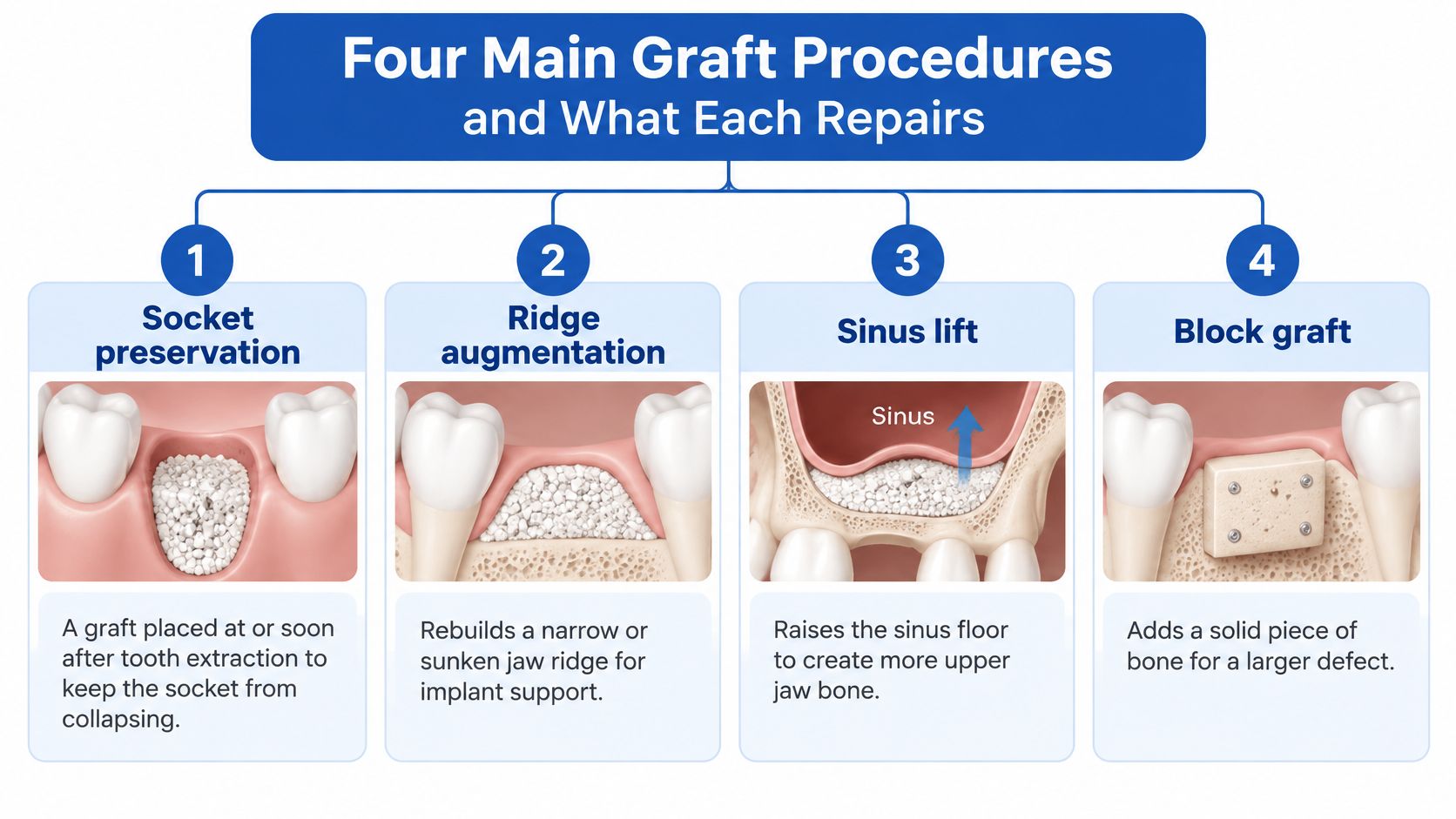
Socket preservation. A graft is placed at or soon after tooth extraction to limit bone shrinkage as the socket heals. It's often simpler and shorter than later reconstruction because the socket walls still exist and the graft mainly fills and protects that space. A membrane may cover the socket to help hold the material in place during early healing.
Ridge augmentation. This procedure rebuilds the width or height of a jawbone ridge that has become narrow or sunken after tooth loss. The periodontist commonly places particulate graft material, shapes it to restore ridge contour, and covers it with a membrane. The goal is a ridge wide and tall enough to surround an implant on all sides.
Block grafts. A solid piece of bone is secured to the jaw when a horizontal or vertical defect is too large for loose particles alone. Donor bone may come from the patient, commonly the chin or retromolar area behind the lower molars, which creates a second surgical site. Block grafts suit larger defects where the added piece must provide structure while new bone forms around it.
Sinus lift. In the upper back jaw, the sinus sits close to where molar roots once were, and bone height may be too limited for an implant. The periodontist lifts the sinus membrane and adds bone below it, using a direct approach through the side of the ridge or an indirect approach through the implant site. More detail appears in the guide to sinus augmentation with a bone graft.
The Donor Site Trade-Off
Harvesting a patient's own bone adds a second wound that must heal, but that bone may suit complex defects. Donor or synthetic materials avoid that harvest wound and may suit other defects, depending on size, location, and healing needs. Procedures are often combined or staged, such as preserving a socket now and augmenting a ridge later. Imaging helps a periodontist confirm which procedure fits the actual defect rather than the name on an advertisement.
What Changes the Final Bill
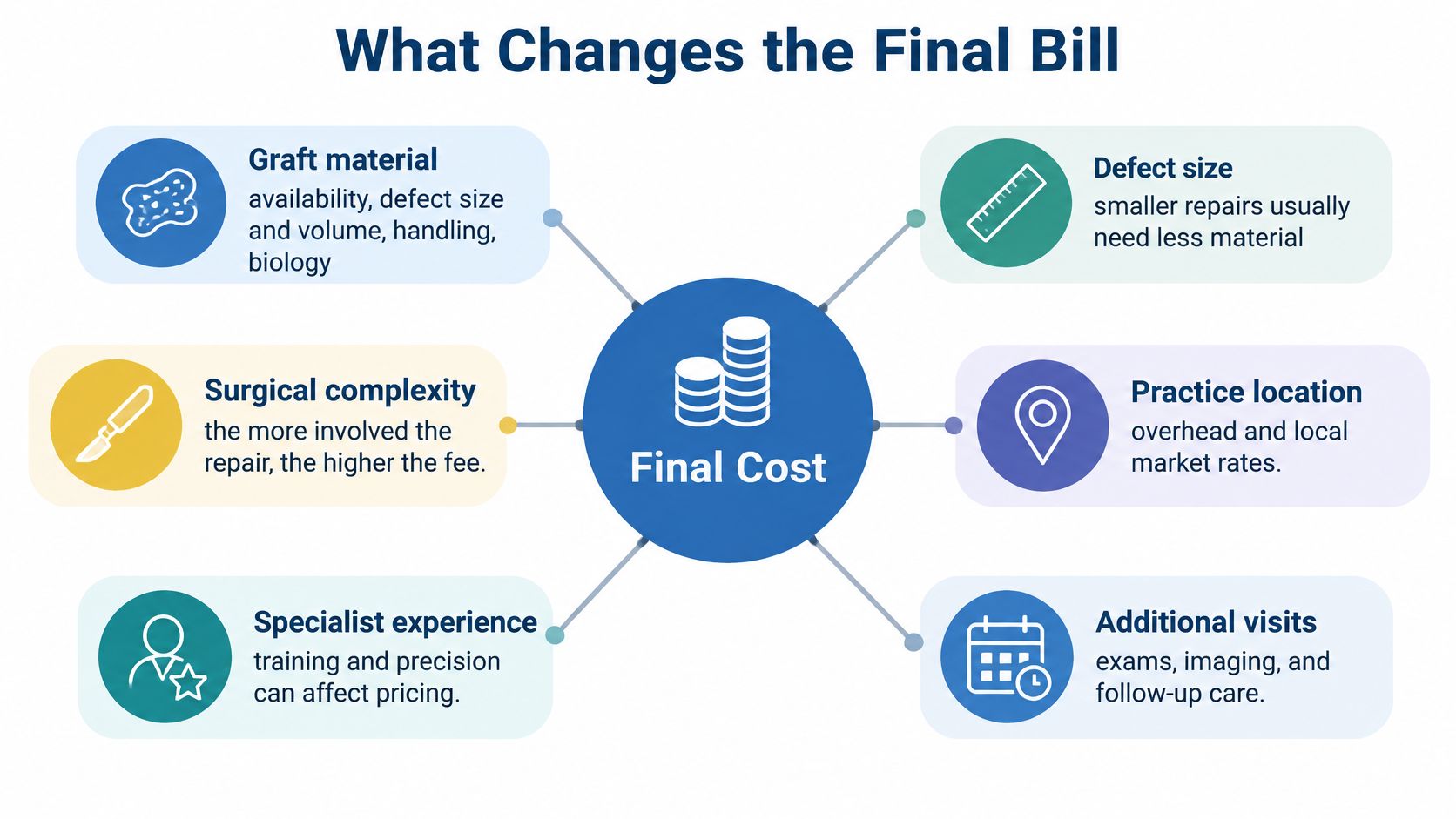
Procedure type and surgical access often move the bill more than the graft material itself. A peer-reviewed review of graft material selection explains that clinicians weigh material availability, defect size, graft dimensions and volume, biomechanics, handling properties, cost, ethical considerations, biological characteristics, and possible complications before choosing what goes into the site. The graft fee also sits inside a larger implant estimate, so what a patient ultimately pays depends on the clinical goal and on how the plan classifies the procedure, not on graft type alone.
Drivers in Rough Order of Impact
- Procedure type: Sinus and block work usually involves more planning and surgery than socket work, so professional time and materials are higher.
- Defect size and volume: A small extraction socket may need a different material and amount than a wide ridge defect, while posterior upper-jaw bone loss may require sinus augmentation rather than a simple socket graft.
- Membrane and surgical access: A barrier membrane, flap design, or additional incisions may add materials and operating time.
- Imaging: i-CAT 3D cone beam imaging measures the defect in three dimensions and may be itemized separately.
- Extraction and anesthesia: Removing a tooth, sedation or anesthesia choices, provider fees, local cost of care, and follow-up appointments all add to the total.
- Incomplete healing: A second graft may be needed if healing doesn't produce enough bone, and a quote should state whether that possibility is included.
The graft material is often a smaller share of the bill than surgery, planning, and follow-up time.
The material on an invoice works like flour on a restaurant check: necessary, but rarely the largest charge. Classification matters in a similar way. A graft performed at the time of extraction may be billed under a different category than one done months later to rebuild a ridge, and plans can treat those categories differently even when the clinical work is comparable.
How Grafting Changes the Implant Timeline
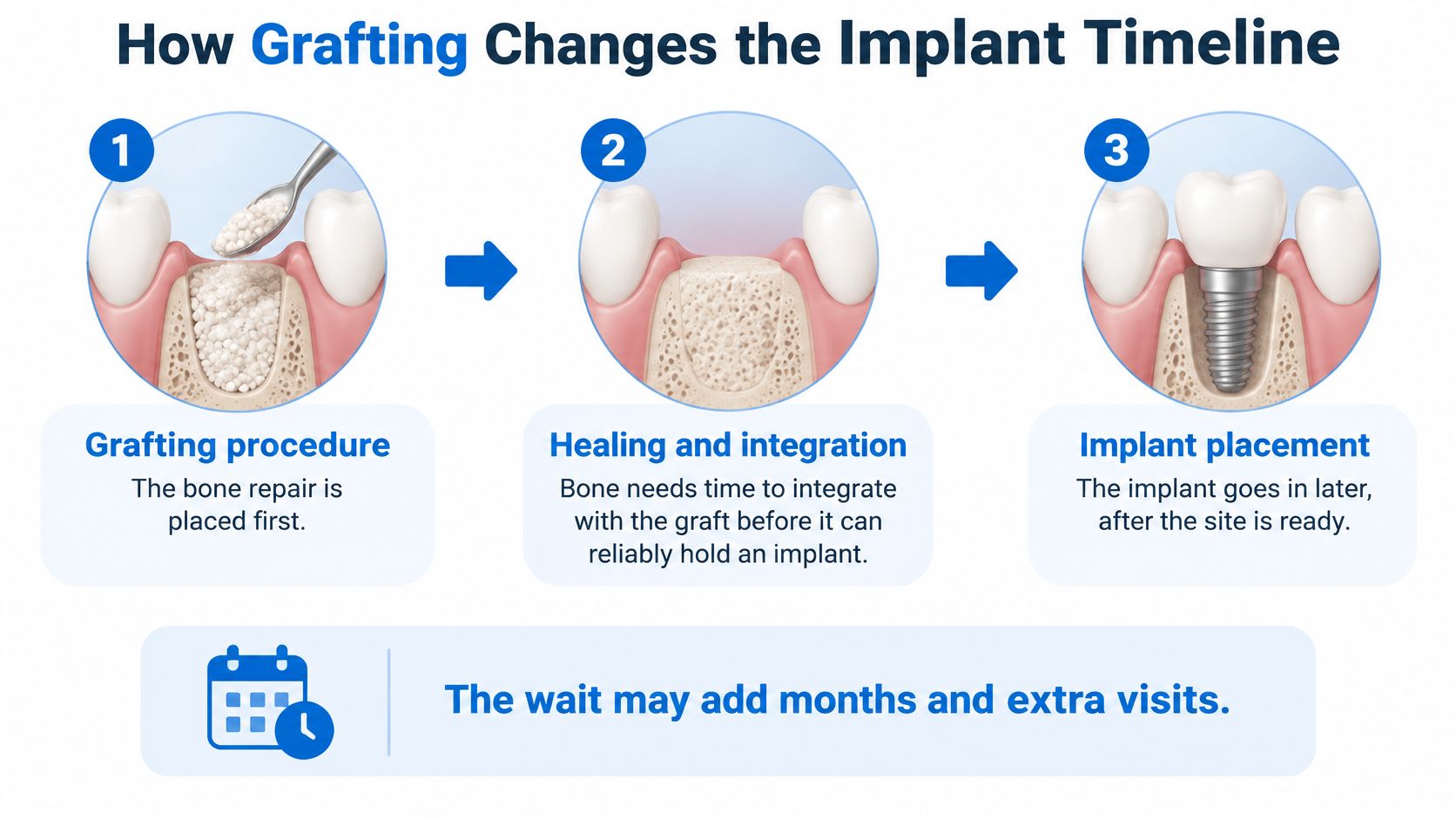
A graft adds a separate healing stage to implant treatment. Bone needs time to grow into the graft material and remodel it into living bone before the site can hold an implant securely. The graft works as a scaffold during that process, and placing an implant before remodeling is far enough along risks poor stability. Grafted cases effectively run on two clocks: the graft's healing clock first, and the implant's integration clock second.
| Scenario | How the wait generally compares | Factors that change it |
|---|---|---|
| Socket preservation after extraction | Shorter than most grafts; some sites allow same-visit placement | Infection, site size, bone quality |
| Ridge augmentation | Moderate to long | Defect size, graft type, membrane healing |
| Block graft | Long; may run longer when vertical gain is needed | Block integration, vertical gain, donor site healing |
| Sinus lift with delayed implant | Long | Remaining bone height, sinus health |
| Sinus lift with simultaneous implant | No separate wait when enough bone is present | Available bone height, planning accuracy |
| Implant without graft | Potentially shortest | Existing bone volume, guided planning |
What Shortens or Extends the Wait
Infection at the site, a larger defect, the graft type chosen, membrane use, smoking, and baseline bone quality all stretch healing time. Before a placement date is set, the periodontist scans the healed site in three dimensions and measures the ridge where the implant will sit. If width or height comes up short for the planned implant, the schedule extends or a second graft enters the discussion. If the measurements are adequate, surgery is booked.
Some extraction sockets support same-visit implant placement when the socket walls and bone quality hold the implant firmly. Some sinus cases allow a graft and implant in one procedure when enough native bone remains, a scenario described in the article on a sinus lift and implant at the same time. Where those shortcuts do not apply, the scan sets the date rather than the calendar. A longer timeline also raises the bill in ways the graft fee alone does not show: additional visits, temporary restorations, and follow-up imaging each appear as separate line items, so the schedule belongs inside the estimate discussion from the start.
What Recovery and Comfort May Look Like
The first few days after graft placement are usually the most uncomfortable stretch of the entire implant process, and even that period is typically handled with the medication plan prescribed before you leave the office. Knowing the shape of recovery ahead of time makes the whole procedure feel smaller.
A Common Sequence
- Before surgery. The periodontist reviews imaging and health history, explains the planned graft, and walks through anesthesia and sedation choices so you know exactly how the appointment will feel.
- Day of surgery. The graft site is closed, often with sutures, and a membrane may be placed over it. Before you leave, the team reviews written instructions covering what to eat, how to rinse, and which activities to pause.
- First days. Expect soreness and swelling at the site, strongest early on and easing as the tissue settles. Take prescribed or recommended medication on the schedule given, choose softer foods, and chew away from the graft while it stabilizes.
- Follow-up. A suture check is a short visit: the periodontist inspects the site, confirms the tissue and membrane are holding, and removes or trims sutures that have not dissolved on their own. Imaging later confirms whether the bone is ready for implant placement.
- Habits and health factors. Smoking slows healing at the graft site, so the team raises it early, while changes can still improve the outcome.
Some sites heal more slowly than others, and no outcome is guaranteed. Recovery questions belong on the same consultation list as cost questions, because the number of visits and the days of modified eating are part of what a graft costs. Weighing that full burden alongside the fee gives a fairer comparison between treatment options.
Deciding Whether and Which Graft You Need
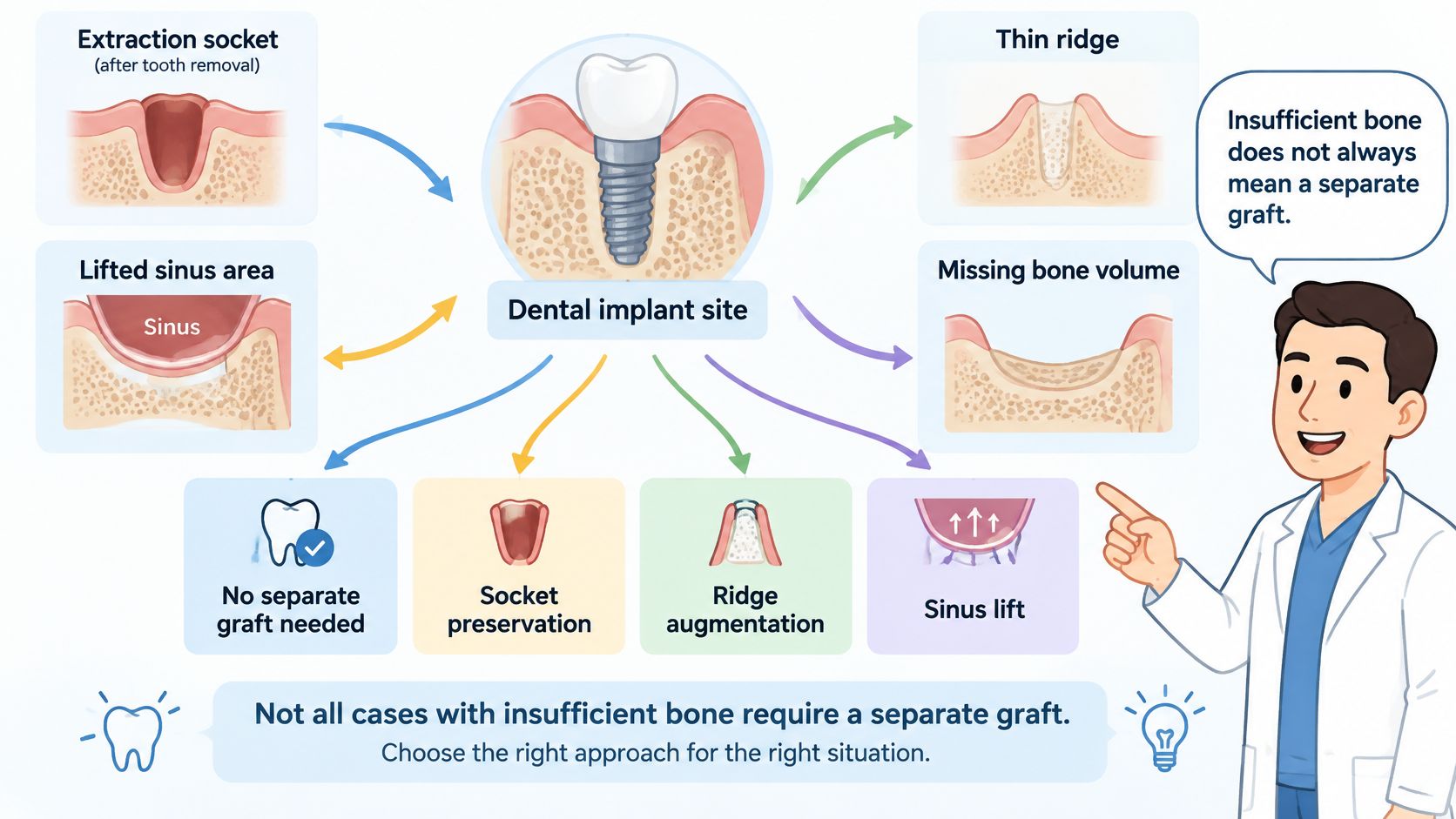
Insufficient bone doesn't automatically mean a separate graft surgery. The clinically relevant question is whether another approach changes the need, the timing, or the total cost. A patient-perspective survey on bone grafting choices reported that 54% accepted bone grafting, 53% preferred synthetic substitutes, and 72% supported guided surgery even at additional cost; among patients open to using their own bone, 72% favored the retromolar region and 32% the chin as a harvest site. Patients weigh invasiveness, material source, predictability, and price together.
Routes That May Change the Plan
Socket preservation at extraction may be less extensive than rebuilding a long-standing defect, though it doesn't guarantee an implant will need no additional augmentation. A different implant position, length, or diameter may use available bone more efficiently in some sites. Staged treatment separates infection control, grafting, and placement so each step heals before the next begins. Sinus augmentation addresses height limits in the upper back jaw, and guided surgery may improve placement accuracy when anatomy is tight: 3D cone beam imaging and dynamic surgical navigation let the periodontist test implant positions against existing bone before surgery.
Material preference matters too. Harvesting a patient's own bone adds a second surgical site, while donor or synthetic materials may reduce harvesting morbidity yet carry different indications and costs. The survey figures above show how differently patients respond to those trade-offs, which is why a consultation should walk through each material option for the specific defect.
Four Common Cases
One extracted tooth, implant planned later. Socket preservation at extraction may be enough if the socket walls are intact and infection is controlled. Follow-up imaging still decides whether minor added grafting is needed at placement.
Several adjacent teeth lost on a narrow ridge. Staged ridge augmentation is more likely because the defect spans a longer distance and may lack both width and height. Building the ridge first may cost more upfront but gives implants bone on all sides.
Thin bone in the back upper jaw. A sinus lift may be discussed when the sinus floor leaves too little height. Placement may be simultaneous or delayed depending on how much native bone remains.
Gum disease with bone loss. Infection control comes first, because grafting into an inflamed site may compromise healing. Treatment may include non-surgical therapy or, in appropriate cases, LANAP laser gum surgery, the only FDA-cleared laser protocol for treating periodontal disease, performed with the PerioLase MVP-7 before implant planning resumes.
Risk check: Avoiding a graft trades one risk for another. A shorter implant in thin bone may cost less now and carry more long-term risk.
Questions for a 3D Imaging Consultation
- Defect shape: Is the defect horizontal, vertical, or both?
- Timing: Can implant placement be simultaneous with grafting?
- Added procedures: What's the chance of additional grafting later?
- Full cost: What's the total under each plan, including failure or revision scenarios?
- Material choice: Why does the proposed material fit this defect?
Cost then becomes a risk-adjusted treatment decision, measured against the defect, the material, and the timeline. The lowest quote is rarely the full answer.
Insurance Limits and Financing Options
Two patients can receive the same graft and owe very different amounts. The difference usually sits in the benefit plan rather than in the surgery itself. Aetna's dental clinical policy states that each plan defines covered services, exclusions, dollar caps, and other limitations, and notes that coverage may be available under dental or medical benefits for certain dental-in-nature oral-surgery procedures.
Why Classification Changes the Bill
A graft performed for extraction-site preservation, for periodontal or traumatic bone loss, or solely to prepare an implant site can fall under different coverage rules even though the surgical work looks similar. Whether a graft is covered depends on how the claim is coded and what the plan allows. Dental plans that cover implants commonly limit annual benefits to about $1,000–$2,000, far below total implant treatment cost, according to a guide to dental insurance coverage for implants. That ceiling typically applies to all dental work in a year, so a crown or filling earlier in the year leaves less room for grafting. Medical necessity and coding context can matter as much as graft technique.
Some employer plans also set frequency limits. One published employer dental policy on bone replacement grafts limits bone grafting at implant placement to one procedure per implant site, grafts of the mandible or maxilla to one procedure per arch per lifetime, and peri-implant defect repair to no more than two covered procedures per implant site over the implant's lifetime. Those figures describe one plan, not an industry standard.
A Plan-Limit Checklist
- Annual maximum: How much the plan pays per year, and how much of it has already been used.
- Deductible and waiting period: What must be paid out of pocket first, and whether major services carry a delay before coverage begins.
- Separate billing: Whether the graft is billed apart from implant placement, and under which benefit, dental or medical.
- Frequency limits: Caps on graft procedures per site, per arch, or per lifetime.
- Preauthorization and network rules: Whether approval is required before surgery, and what out-of-network care pays.
- Re-grafting: What happens financially if healing is incomplete and a second procedure is needed.
A pre-treatment estimate may clarify expected personal responsibility, but a coverage determination is not a guarantee that a claim will be paid. Periodontal Associates of Delaware lists plan participation and financing details on its insurance information page.
Request an Itemized Estimate Before You Commit
Two written estimates are useful only when they describe the same treatment goal. Compare what each plan is intended to repair, whether grafting is meant to preserve the ridge or prepare it for an implant, and which parts of the implant restoration are included. A lower graft fee may not mean a lower total bill if the estimates cover different stages of care.
What to Bring and Ask
- Treatment goal: Ask what the graft is expected to accomplish and how that affects the proposed implant plan.
- Estimate comparison: Ask the office to explain any differences between the two proposed plans, including what is included in each quoted fee.
- Revision terms: Confirm whether a second graft or revision would involve additional fees, and whether it could change the number or timing of visits.
A referral is not needed to schedule an appointment at Periodontal Associates of Delaware. The practice has four locations: Wilmington, Newark, Dover, and Rehoboth Beach. Request an appointment through the appointment request page.
The periodontists at Periodontal Associates of Delaware hold diplomate status with the American Board of Periodontology. A consultation can help clarify whether bone grafting is needed and how the graft fits into the full implant plan. Patients can seek care at the Wilmington, Newark, Dover, or Rehoboth Beach location.
Patients considering bone rebuilding before implant placement can request an assessment from Periodontal Associates of Delaware, a board-certified periodontal practice with locations in Wilmington, Newark, Dover, and Rehoboth Beach. Comparing the treatment goals and included services in written estimates can help clarify how the graft fee relates to the overall implant bill. A consultation is a practical first step toward understanding whether a graft is appropriate and what the proposed plan may cost.