A dentist has just said a crown won't hold because too little tooth shows above the gum. Or a photo shows a wide band of gum and teeth that look short, even though they feel healthy. That is usually when the names crown lengthening and gingivectomy enter the conversation, often in the same sentence, as if they're interchangeable.
They aren't. One removes extra gum only. The other may also reshape bone so a restoration has room to sit without irritating the tissue. The visible edge on surgery day isn't the final edge either, because gum can creep back as it heals. Understanding tissue, bone, and timing makes the choice much clearer, and much less alarming.
Table of Contents
- Crown Lengthening and Gingivectomy Side by Side
- Esthetic Display Versus Restorative Access
- Surgical Steps for Each Procedure
- Healing Time and Gum Rebound
- Risks and What a Guide Cannot Fix
- How to Choose and Request a Visit
Crown Lengthening and Gingivectomy Side by Side
Two situations lead adults to these procedures most often. A smile may show a wide band of gum and teeth that look short or uneven. Or a tooth may be broken, worn, or decayed so far under the gum that a dentist can't find a sound edge, called a margin, for a filling or crown to grip.
The distinction comes down to anatomy. The 60-patient mandibular first-molar study in PMC describes gingivectomy as removal of excess soft tissue only, while crown lengthening may combine gingival excision with an apically positioned flap and ostectomy when the alveolar crest is too close to the intended restorative margin.
The Selection Rule Comes First
A gingivectomy is reasonable only when enough firm, attached gum will remain and bone already leaves room for the tissue that attaches above it. Clinicians call that space supracrestal tissue attachment, long called biologic width. Planning often aims near 3 millimeters from bone to the restoration margin, so the gum can reform a healthy seal instead of staying inflamed.
Choosing the smaller surgery first and hoping bone cooperates reverses the logic. Removing soft tissue without correcting a bone that's too close can compromise biologic width reformation and raise the risk of tissue rebound or persistent inflammation around the margin.
Bone position decides whether a trim is enough. Preference for a smaller cut doesn't change that anatomy.
Crown lengthening versus gingivectomy at a glance
| Feature | Gingivectomy | Crown lengthening |
|---|---|---|
| Tissue removed | Excess gum only | Gum and, when needed, supporting bone |
| Main goal | Reduce excess gum or a soft-tissue pocket when bone position is already acceptable | Expose tooth for a restoration or correct a gummy smile when bone is too close |
| Flap | Usually none | Often a small flap moved toward the root |
| Bone change | None | Ostectomy when the crest is too close to the planned margin |
| Room for biologic width | Must already exist | Created by moving the bone crest, often planned near 3 mm from bone to the margin |
| Rebound risk if bone is ignored | Higher if soft tissue is cut while bone stays too close | Lower when bone and gum are planned together, but some coronal shift is still expected |
| Best first fit | Enough keratinized gum and bone already clear of the margin | Restorative access or smile proportions that need bone moved |
What a Direct Comparison Found
In that 60-patient study, 30 patients received gingivectomy alone and 30 received an apically positioned flap plus ostectomy. At 3 and 6 months, the flap and ostectomy group showed significantly better reestablishment of biologic width than the gingivectomy group, with p < 0.05.
That result doesn't make bone removal better for everyone. It shows why removing gum alone can fall short when bone caused the problem. A tooth with generous bone clearance doesn't need bone taken away to prove a point.
Controlled trials in this area are few, so a standard recipe shouldn't replace measurement. Planning typically includes probing, transgingival assessment or 3D imaging when indicated, and mapping of the planned restoration margin before the less invasive option is selected. Probing tells the periodontist how much pocket and attached gum are present. Margin mapping tells everyone where the finished crown must end.
Say a front tooth has thick gum covering enamel, and probing confirms bone sits well below the planned edge. Gingivectomy may solve it. Say a molar fractured near bone level. Trimming gum alone would leave the crown margin crowded against bone, so crown lengthening is the more honest plan.
Individual results vary, and a periodontist should confirm the plan after examining the tooth, gum, and bone together. Crown lengthening and gingivectomy are tools for different anatomy, not two prices for the same job.
Esthetic Display Versus Restorative Access
The right starting question isn't which procedure name sounds smaller. It's what job the tooth must do. Esthetic cases ask how much gum shows and whether teeth look proportionate. Restorative cases ask whether a dentist can place a durable margin on sound tooth and keep that margin cleanable.
When the Concern Is a Gummy Smile
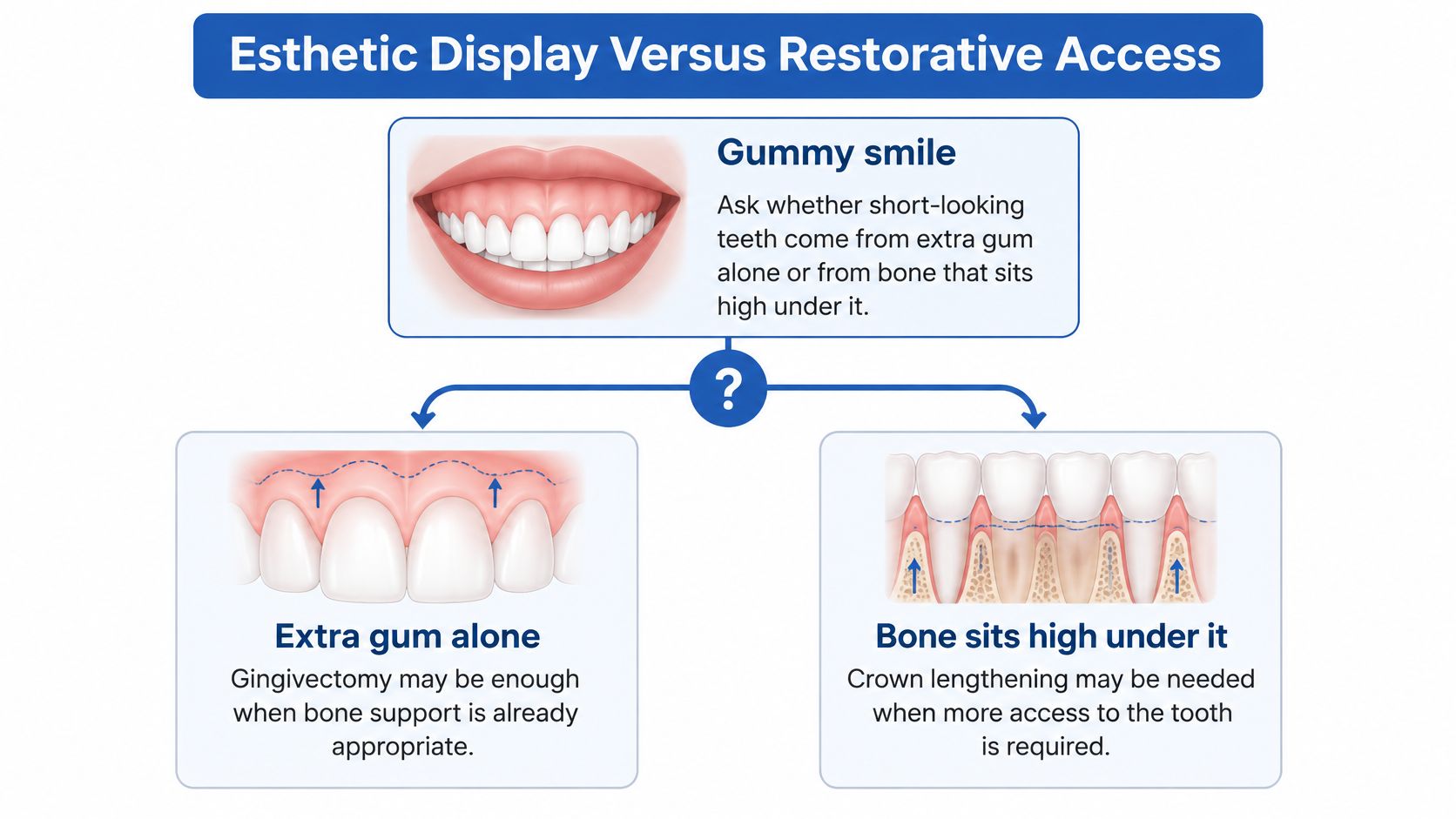
Short-looking teeth can come from extra gum alone or from bone sitting high under otherwise normal gum. Those look similar in a mirror, which is why photos alone can't choose the surgery. Probing and imaging separate them.
The 2024 systematic review and meta-analysis in PMC analyzed 633 patients, with 228 receiving surgical treatment, 396 nonsurgical treatment, and 9 receiving both. At 12 months, surgical treatment produced a mean reduction in gingival display of 2.81 mm, with a 95% confidence interval of 1.94 to 3.69 mm, whereas nonsurgical treatment produced 0.04 mm, with a 95% confidence interval of -0.11 to 0.19 mm.
Temporary approaches may soften a mild display, but they don't move bone or permanently remove excess tissue. When tooth proportions need structural correction, surgery is the durable category. Even then, that same review literature shows crown lengthening isn't one uniform operation. It may mean gingivectomy alone when keratinized tissue is sufficient and the crest is appropriately positioned, or flap elevation and bone removal when the crest lies too close to the cementoenamel junction.
When the Concern Is Saving a Tooth
A broken, worn, or severely decayed tooth needs its margin on sound, dry, reachable tooth structure. If decay or fracture extends under the gum, a crown placed there traps plaque and irritates tissue. Exposing more tooth can make restoration possible and cleaning realistic.
Front teeth with a low lip line, thick gum, and adequate bone clearance may need only gingivectomy for appearance. A molar fractured below the gum with the crest near the break usually needs restorative crown lengthening. Readers worried about tissue changes around an existing restoration can review why gums may recede around a crown before assuming reshaping is the answer.
The smaller surgery is the right surgery only when the bone already agrees with the margin.
Which procedure fits the situation
| Situation | Usually preferred | Why |
|---|---|---|
| Gummy smile, thick gum, bone already far enough from the margin | Gingivectomy | Only soft tissue is in the way |
| Gummy smile with short teeth and a high bone crest | Esthetic crown lengthening | Gum and bone both need to move or the edge rebounds |
| Tooth broken or worn below the gum for a crown | Restorative crown lengthening | The margin needs access and a clean biologic width |
| Deep cavity with enough attached gum and bone clearance | Gingivectomy | Extra gum blocks the filling but bone does not |
| Uneven front gumline | Often a mix, planned tooth by tooth | One tooth may need bone moved while a neighbor needs only a trim |
| Hopeless tooth or active deep pockets | Not cosmetic lengthening first | Disease control, or extraction and possible implant planning, may be safer |
When Neither Procedure Should Come First
Active gum disease changes the order. Bleeding, swelling, and deep pockets should be controlled before elective reshaping, because inflamed tissue doesn't heal to a predictable edge. At Periodontal Associates of Delaware, LANAP laser gum surgery with the FDA-cleared PerioLase MVP-7 may be used to treat periodontal infection when clinically appropriate.
A tooth that can't be restored presents a different fork. Extraction with ridge preservation may protect bone for the future. When an implant is appropriate, planning may involve i-CAT 3D cone beam imaging and X-Nav dynamic surgical navigation.
The exam therefore maps three things before anyone picks the smaller cut. It locates the planned margin, measures bone, and checks how much attached gum would remain. Crown lengthening and gingivectomy both change a gumline, but only one may fit the structure underneath.
Surgical Steps for Each Procedure
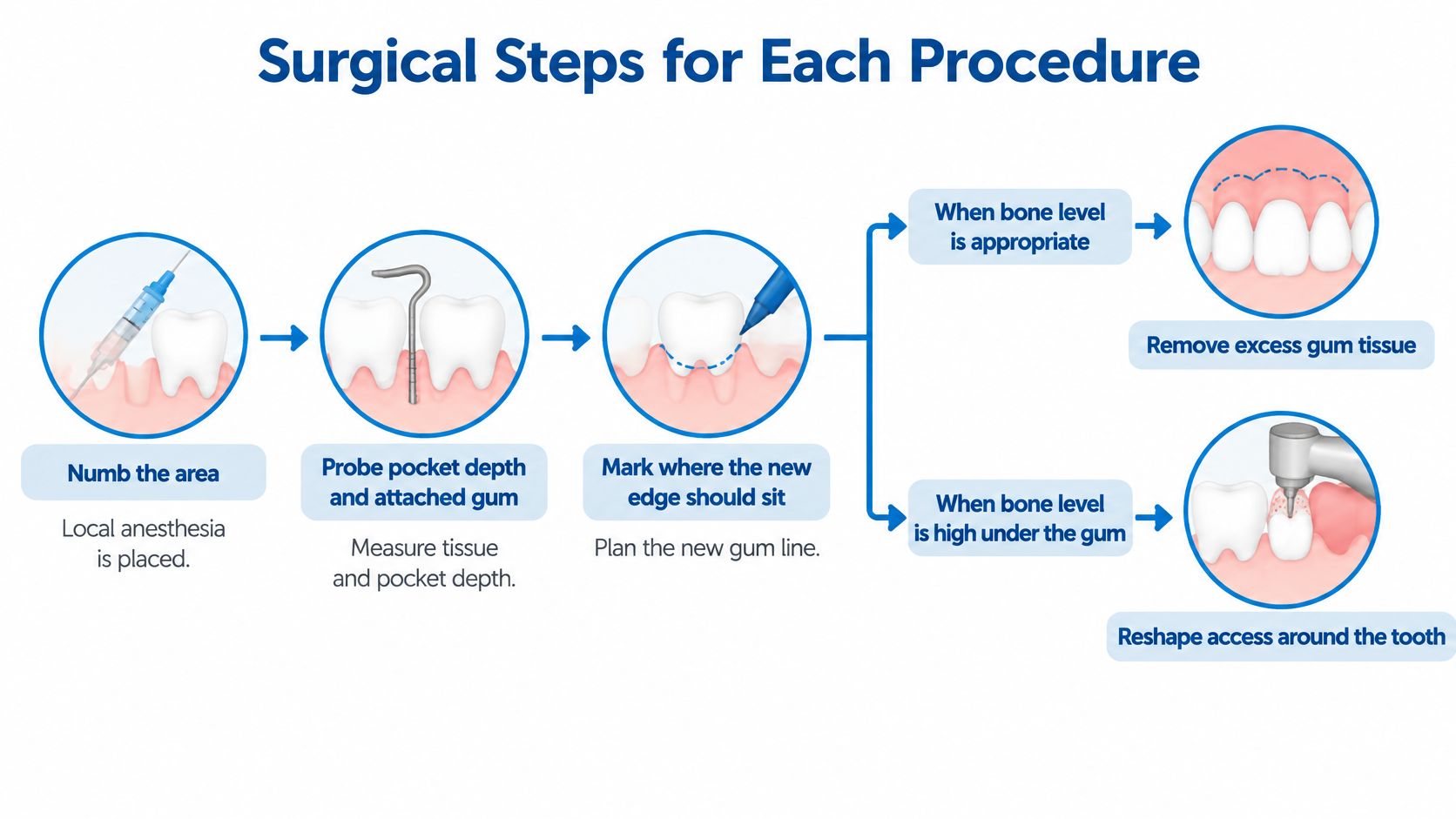
Most visits start the same way, and that shared start matters more than the instrument used later. The area is numbed with local anesthesia. The periodontist probes pocket depth and the width of attached gum, then marks where the new edge should sit.
When bone level is unclear, i-CAT 3D cone beam imaging at Periodontal Associates of Delaware may show the crest before any flap is raised. Anxious patients can ask during consultation what comfort options are available for a specific case. No visit should be described as pain-free, and no result should be promised in advance.
Gingivectomy, Step by Step
- Mark the excess gum with a probe or template, so removal follows a plan rather than guesswork.
- Remove only that soft tissue with a blade, laser, or electrosurgery, leaving a band of firm gum behind.
- Shape the edge so it follows the tooth contour and matches the neighboring gumline as closely as anatomy allows.
- Control bleeding and place a dressing if it helps protect the area and support hygiene.
- Review brushing instructions and schedule a short follow-up to confirm the surface is healing cleanly.
Because bone is untouched, this is the shorter operation. It's still surgery, and trimming too much attached gum can leave tissue that's harder to keep healthy.
Crown Lengthening, Step by Step
- Agree on the final margin with the restoring dentist, because surgery serves that future crown or filling.
- Raise a small flap so gum and bone can be seen directly instead of estimated.
- Remove excess gum that blocks access to sound tooth.
- Reshape bone if the crest is too close, removing a measured amount so supracrestal tissue can reform, often aiming near 3 millimeters from bone to the planned margin.
- Move the flap toward the root and suture, placing the gum edge where healing should begin.
- Protect the site, use a temporary crown if needed, and delay the final crown until the edge matures.
Readers comparing bone reshaping terms can see what osseous surgery involves for related context. A surgical guide may help trace a planned line in selected cases. Diagnosis still comes from probing, imaging, and direct inspection.
Some people return to desk work within a few days. Chewing hard food on the site and vigorous brushing wait until the periodontist confirms tissue is ready. Crown lengthening and gingivectomy differ most at step four, because bone either changes or it doesn't.
Healing Time and Gum Rebound
Can the gum grow back? That's the question patients ask, and the honest answer is that gum often moves somewhat as it heals. The look on surgery day is a starting point, not the finished edge.
After gingivectomy alone, the surface may look settled within days to about two weeks. The margin usually needs about 4 to 6 weeks before anyone judges it. Surface closure and tissue maturation aren't the same event.
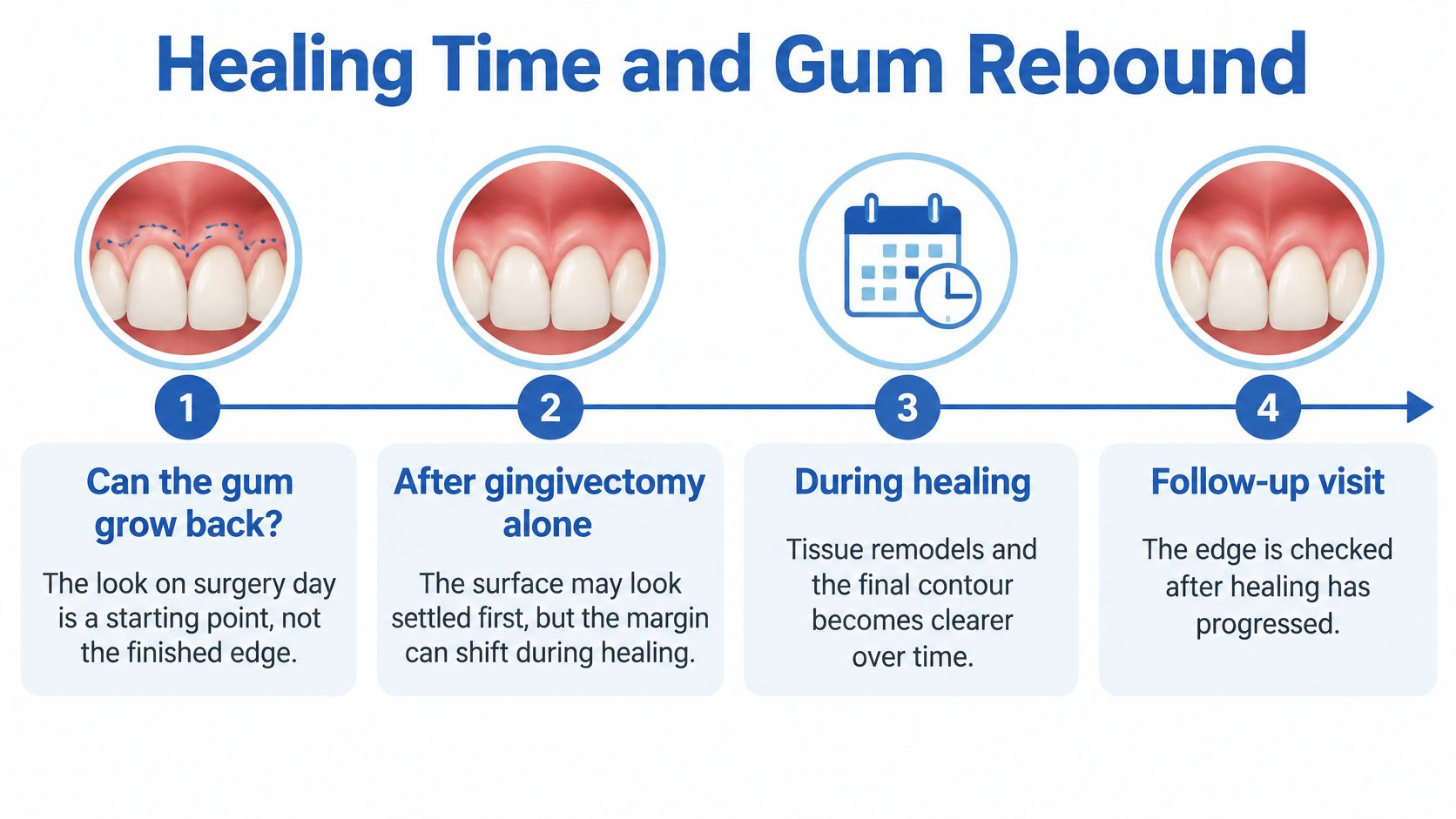
When a flap is raised and bone is exposed, many clinicians wait 8 to 12 weeks before a final crown impression. After bone removal, soft tissue contours may keep changing for at least 6 months. That waiting period protects the restoration from a margin placed against tissue that's still moving.
What Rebound Looks Like in Numbers
The 12-month clinical wound-healing study in Clinical Oral Investigations found surgery initially increased crown length by an average of 3.7 ± 0.8 mm interproximally and 4.1 ± 0.9 mm buccally and lingually. During healing, the gingival margin migrated coronally by 3.2 ± 0.8 mm interproximally and 2.9 ± 0.6 mm buccally and lingually, leaving only 0.5 ± 0.6 mm interproximally and 1.2 ± 0.7 mm buccally and lingually at 12 months relative to the immediate postoperative measurement.
Those numbers explain why a good plan overcorrects on paper and documents expected rebound during consent. They also explain why final margin placement waits for maturation. Judging success in the mirror on day one sets everyone up for disappointment.
When the gum edge is ready to judge
| Stage | Gingivectomy only | Flap and bone removal |
|---|---|---|
| Surface comfort | Often days to about 2 weeks | Similar early soreness, with a deeper surgical site |
| Time before the edge is meaningful | About 4 to 6 weeks | Often 8 to 12 weeks; may keep settling at least 6 months |
| Immediate tooth exposure in one 12-month study | Not this operation | About 3.7 mm between teeth and 4.1 mm on the cheek or tongue side |
| How far the gum moved back by 12 months | Thick tissue tends to shift more than thin tissue | About 3.2 mm between teeth and 2.9 mm on the outer surfaces |
| Exposure still present at 12 months versus day of surgery | Set by the bone clearance already present | About 0.5 mm between teeth and 1.2 mm on the outer surfaces |
Rebound Isn't the Same as Disease Coming Back
A separate 12-month esthetic crown-lengthening study found generally stable margins at 3, 6, and 12 months. It still noted some coronal migration and increased papilla dimensions, meaning the small triangle of gum between teeth can fill and change shape over time. Photographs at follow-up visits capture that progress better than memory.
Planned upward creep in thick gum isn't automatically failed surgery. Bleeding, swelling, bad odor, or a margin that stays sore suggests inflammation or a missed diagnosis and needs a new exam. Readers can review whether gums grow back for the broader distinction between healing and regrowth.
Thick periodontal tissue tends to rebound more, while thin tissue may show root surface sooner. Smoking and poor plaque control may also affect maturation. A practical plan uses a temporary restoration, scheduled photos, and a review before the dentist sets the final margin, without promising that the gum won't move.
Risks and What a Guide Cannot Fix
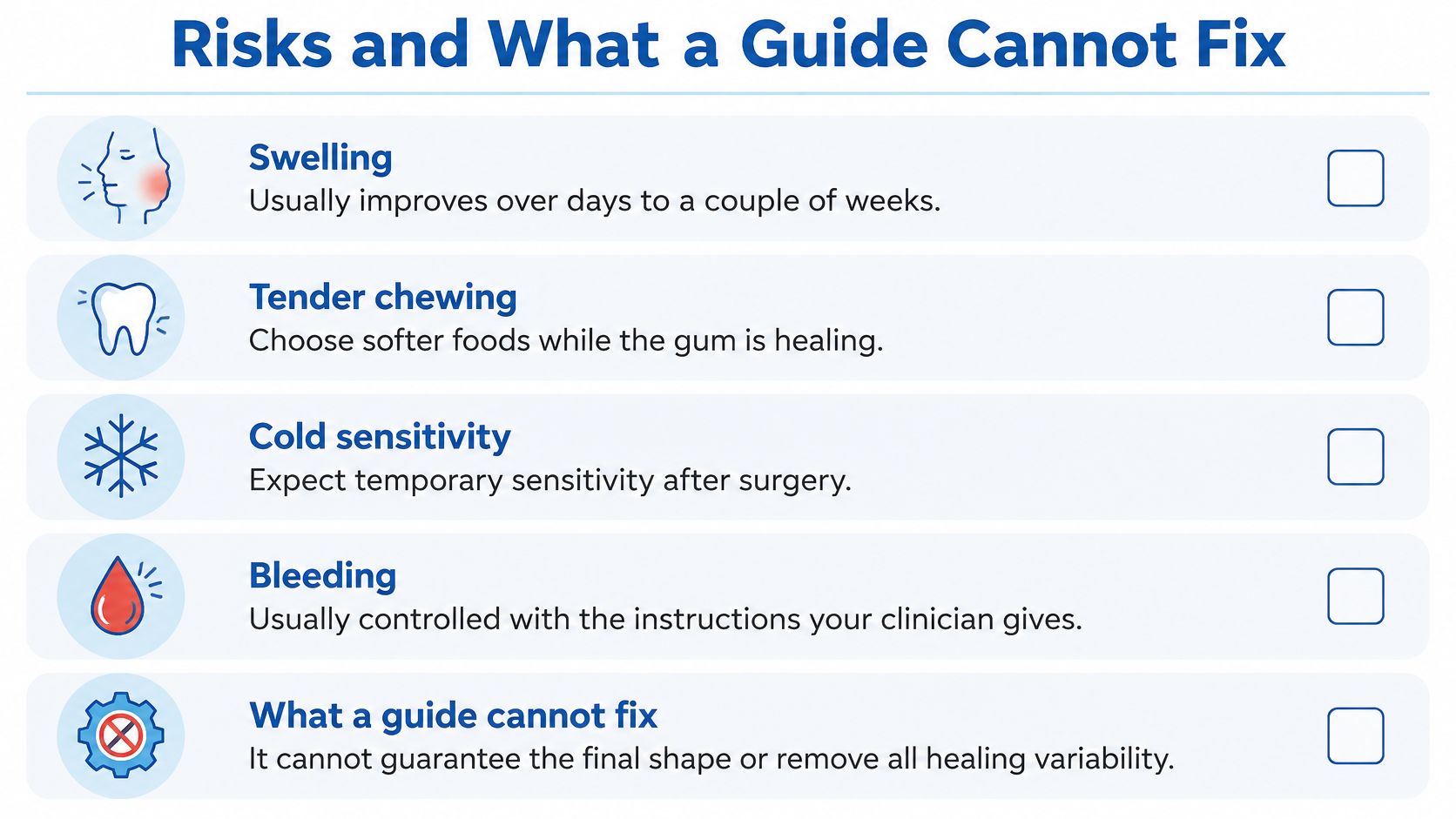
Many patients have swelling, tender chewing, and cold sensitivity for days to a couple of weeks. Softer foods, gentle cleaning as directed, and not poking the site help during that window. Sensitivity often eases as tissue matures, but persistent pain deserves a call.
Bleeding is usually controlled before a patient leaves. A clot can restart if the site is bumped, rinsed hard, or disturbed by stiff brushing. Following written instructions matters more than bravery.
Trade-Offs Patients Should Hear Before Surgery
Removing tissue between teeth can leave a dark triangle if the papilla doesn't fill back in. Taking too much bone can expose root, make a tooth look long, or leave less structure to hold a crown. Leaving bone too close can bring inflammation back around the margin and threaten the restoration.
A small revision is sometimes discussed after healing, not on day one. Smoking, missed cleanings, and treating infected gums as if they were only extra tissue raise every risk listed here. Crown lengthening and gingivectomy can't outrun untreated periodontal disease.
Digital Does Not Mean Automatic
The 2025 investigation indexed in PubMed found increased soft-tissue thickness increased discrepancies in both guided gingivectomy and osteotomy, while surgical templates with integrated supporting planes improved accuracy compared with a conventional double-guide design. A separate 2025 case report described an open-source workflow combining intraoral scanning and CBCT with a 3D-printed guide, documenting improved symmetry, elongated clinical crowns, no postoperative hypersensitivity, and reduced surgical time, while emphasizing broader clinical studies remain necessary.
Accuracy still depends on CBCT registration, scan quality, guide stability, bone visibility, and surgical judgment. A guide may help most when several front teeth need millimeter-level symmetry or coordinated hard and soft tissue reduction. It can't predict rebound, replace biologic width assessment, or make every smile identical.
Useful questions include these:
- Where is the bone relative to the planned margin?
- How much attached gum must stay behind?
- When can the final crown be made safely?
- What's the plan if the edge creeps up during healing?
A guide executes a diagnosis. It doesn't create one.
How to Choose and Request a Visit
Choose gingivectomy when the exam shows extra gum, a remaining band of firm tissue, and bone that already clears the planned edge. Choose crown lengthening when a crown or filling needs more sound tooth, or when a gummy smile won't stay corrected unless bone moves with the gum.
Pause if gums bleed easily, pockets are deep, or the tooth may not be restorable. Disease control, or a different plan entirely, may need to come first. That's not delay for its own sake. It's how a stable edge becomes possible.
What to Bring and What Happens Next
Bring the general dentist's restorative goal, recent x-rays if available, and a photo showing the smile concern. A periodontal visit typically includes probing and, when bone level will change the choice, i-CAT 3D imaging. The periodontist can then explain which procedure may fit, how long to wait before a final crown, and what rebound is reasonable to expect.
At Periodontal Associates of Delaware, board-certified periodontists see patients at three offices in Wilmington, Newark, and Dover. Care serves adults across New Castle and Kent Counties, including Pike Creek, Hockessin, Bear, Middletown, and surrounding areas.
Individual results vary, and no article can replace an in-person periodontal exam. Adults weighing crown lengthening and gingivectomy can request an appointment at the nearest Wilmington, Newark, or Dover office to have bone, gum, and the planned restoration measured together.
Periodontal Associates of Delaware provides periodontal evaluation and surgical care, including assessment for crown lengthening and gingivectomy, at offices in Wilmington, Newark, and Dover. Adults who want tissue, bone, and restorative goals reviewed before choosing a procedure can visit Periodontal Associates of Delaware to request a consultation at the most convenient location.