Can periodontal disease cause bad breath? Yes. Periodontal disease can cause persistent bad breath, and gum inflammation is one of the more common sources of odor that keeps coming back after brushing, mints, or rinses.
Breath works better as a clue than as a grading tool. A periodontal pocket acts like a warm, low-oxygen trap where bacteria can keep producing gas after the tooth surfaces look clean. Mints and rinses can perfume the surface for a short time. The flavor fades first. Tongue coating and other oral sources can add to the same smell, which is why odor can suggest inflammation without naming a stage or proving treatment has finished.
The useful question is which source, or which mix of sources, fits a particular mouth. When breath stays stubborn despite a clean-looking smile, the answer deserves a look below the gumline as well as at the tongue.
Table of Contents
- Can Periodontal Disease Cause Bad Breath
- How Inflamed Gum Pockets Create Odor
- How Bad Breath Changes With Disease Severity
- How to Tell Gum-Pocket Odor From Other Causes
- How Periodontal Treatment May Improve Breath
- Request a Periodontal Exam for Ongoing Bad Breath
Can Periodontal Disease Cause Bad Breath
A 2023 study found halitosis more often among participants with gum disease than among healthy controls. The pattern was especially common with gingivitis, though the rates differ depending on whether the comparison starts with gum health or with people who already have bad breath.
How often halitosis shows up with gum disease
| Group | Halitosis rate | Share of halitosis cases |
|---|---|---|
| Healthy controls | 3% | 9.4% |
| Gingivitis | 39.5% | 53.1% |
| Periodontitis | 42.9% | 37.5% |
| Any periodontal disease | Higher than healthy controls (p = 0.005) | 90.6% |
Source: 2023 Scientific Reports study.
What the comparison shows
The two columns describe different things. “Halitosis rate” shows how often odor occurred within each group. “Share of halitosis cases” shows how participants with odor were distributed across gum-health groups. In the study, 90.6% of participants with halitosis had some form of periodontal disease.
These figures describe groups, not an individual diagnosis. Gum inflammation can contribute to odor, while tongue coating and other oral sources may contribute at the same time.
Why smell still can't make the diagnosis
Odor can prompt a closer look, but its strength cannot show whether inflammation is limited to the gums or whether deeper periodontal changes are present.
Odor cannot measure pocket depth, attachment loss, or bone support.
A periodontal examination checks bleeding, pocket depth, attachment loss, and bone support. These findings help identify the condition beneath the gumline. Ongoing bad breath is a reason to consider an exam, particularly when it comes with bleeding on brushing or food trapping.
How Inflamed Gum Pockets Create Odor
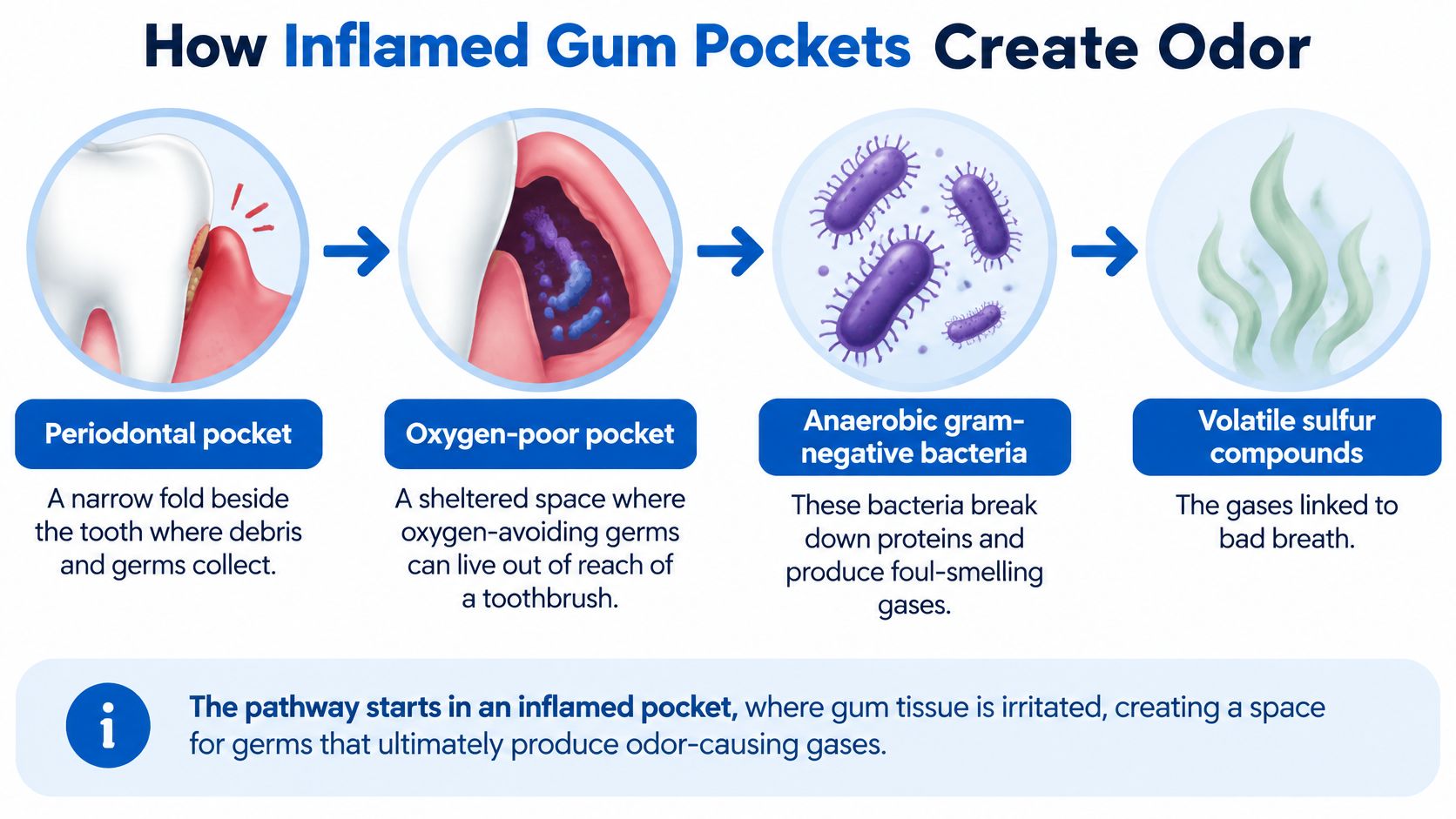
A periodontal pocket works like a narrow fold beside a tooth. Food debris, plaque, and fluid from inflamed tissue collect in that fold, and the deeper it gets, the harder it is for a toothbrush or rinse to reach the bottom. Oxygen stays low in that sheltered space, which suits the bacteria most tied to odor.
The pathway from protein to gas
Anaerobic gram-negative bacteria live where oxygen is scarce. In a pocket, they feed on sulfur-containing amino acids from plaque, gingival crevicular fluid, and inflamed tissue. As they break those proteins down, they release gases that leave the pocket in exhaled air.
Three gases do most of the work:
- Hydrogen sulfide: Often described as a rotten egg smell, and one of the main VSCs measured in halitosis.
- Methyl mercaptan: Another major sulfur gas from pocket bacteria, closely tied to periodontal sources.
- Dimethyl sulfide: Present to a lesser extent, so it usually plays a smaller role than the first two.
A clinical comparison in PMC research on periodontal disease and halitosis reported average hydrogen sulfide of 14.97 parts per billion in healthy controls, compared with 100.51 parts per billion in people with gingivitis and 91.57 parts per billion in people with periodontitis. The same study reported periodontal disease as a significant predictor of halitosis, with an odds ratio of 3.607.
An odds ratio needs careful reading. It means the odds of halitosis were substantially higher in the periodontal disease group in that study. It doesn't prove that every case of bad breath is gum disease, and it doesn't sort one person's mouth by itself.
Why surface cleaning can miss the source
Say an adult brushes twice a day, uses a flavored rinse, and still notices odor by midmorning, along with pink foam in the sink. The brush may be doing its job on the crown while debris stays below the gumline. The rinse flavors the mouth, then fades, while the pocket keeps producing gas.
Deeper pockets make that mismatch worse. More depth means more room for bacterial bulk, more inflamed surface that can bleed, and more protein available to break down. Readers who want the mechanics of that space can review how pocketing in teeth develops and why a probe measurement matters more than a mirror check.
A periodontal visit separates this pathway from look-alikes. The clinician records pocket depths, scores bleeding, reviews plaque, and looks at tongue coating, then weighs dry mouth or a recent food smell against those findings. The smell itself is gas from bacterial protein breakdown. It isn't a character flaw, and it isn't proof that someone failed at brushing the parts of the teeth that show.
How Bad Breath Changes With Disease Severity
Volatile sulfur compounds by periodontal severity
| Group | Average VSC (ppb) | What the number suggests |
|---|---|---|
| No clinical attachment loss | 147.42 | Lower measured odor |
| Mild chronic periodontitis | 194.37 | Odor rises as attachment loss begins |
| Moderate chronic periodontitis | 226.03 | Higher gas with deeper disease |
| Severe chronic periodontitis | 263.33 ± 27.44 | Highest average; p < 0.001 across severity |
| Ages 15 to 29 | 161.79 | Lower average in younger adults |
| Older than 59 | 282.89 | Higher average; age may mark accumulated risk |
A dose-response pattern
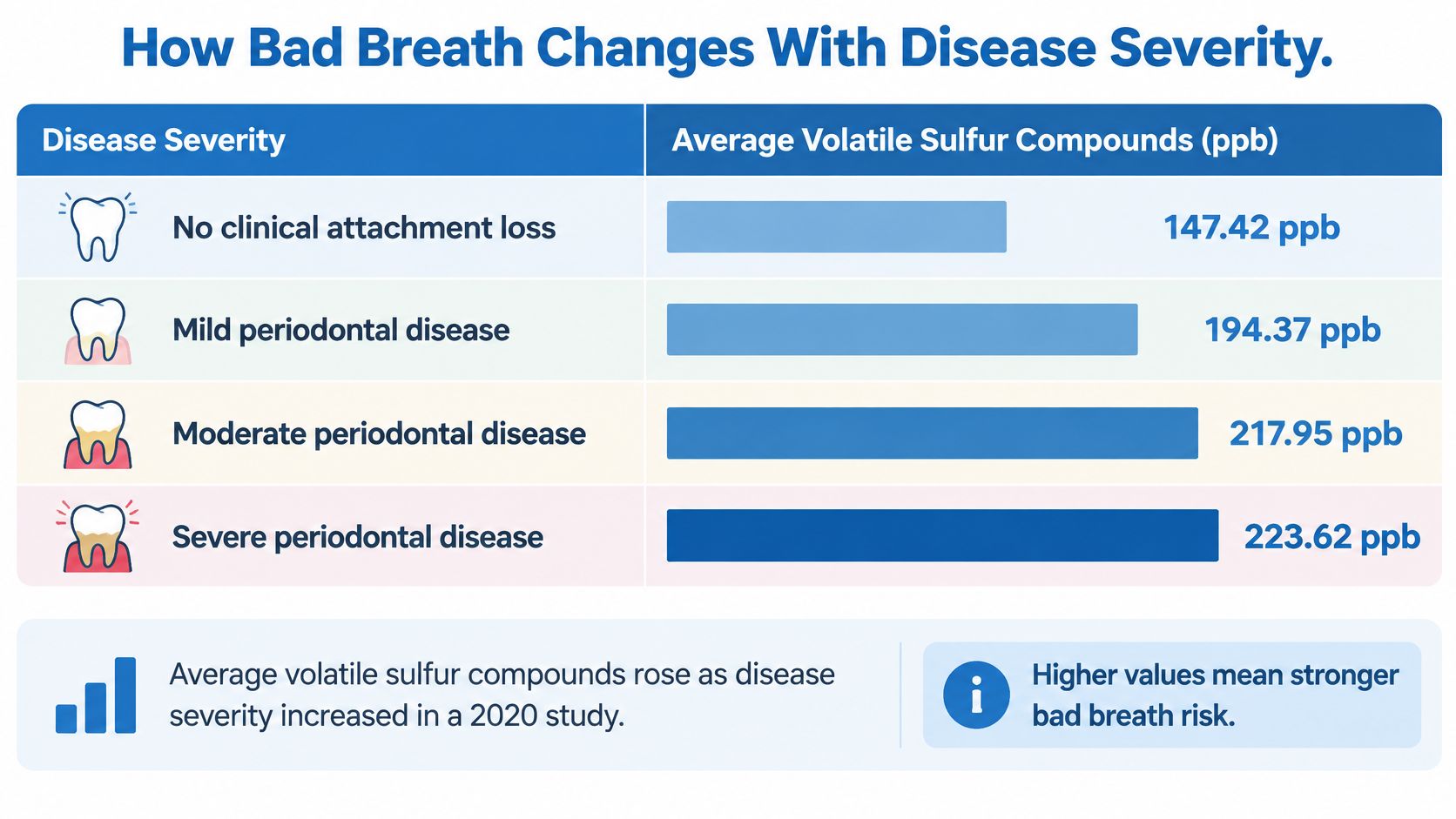
A 2020 clinical study measured volatile sulfur compounds in groups sorted by periodontitis severity, and the averages in the table climb steadily from one group to the next. The gap between the healthiest participants and the most severe group was large enough to reach statistical significance.
Clinicians call that kind of stepwise rise a dose-response pattern. As disease gets more severe, pockets tend to deepen, bacterial bulk tends to grow, bleeding becomes more likely, and the total inflamed surface inside the pockets gets larger. Each change gives odor-producing bacteria more shelter or more protein to break down, so a higher gas reading fits the biology. Rising odor works like a gauge climbing with engine load: the reading reflects how much is happening underneath, not just at the surface.
The same logic explains why early gum inflammation is worth attention. A reader comparing the levels of gingivitis with later attachment loss can see why bleeding and swelling deserve action before pockets deepen and support is lost.
Age raises the average without being the cause
In the same 2020 study of VSC levels by periodontitis severity, averages rose from 161.79 ppb in participants aged 15 to 29 to 282.89 ppb among those older than 59. Age alone shouldn't take the blame for that gap. Older adults have had more years to accumulate periodontal risk, restorations, dry mouth from medicines, and other oral health factors that can raise the same meter.
Practical rule: A rising smell plus bleeding, swelling, recession, looseness, or food packing calls for a periodontal chart, not another month of mints.
Signs a person can notice at home still matter, even though they can't replace measurements. Bleeding on brushing, puffy gums, teeth that look longer from recession, teeth that feel loose, and food that packs between teeth all fit worsening periodontal health. Paired with ongoing odor, they strengthen the case for an exam.
One caution keeps these numbers honest. Tongue coating can push a reading up even in a mouth whose pockets are shallow, which is why an exam looks at the tongue surface alongside the pocket chart. Severity and odor tend to move together, so a high reading isn't automatically a deep pocket, and a mild reading doesn't clear one. Both sources can also be present at once, which is why smell alone can suggest gum trouble but never stage it.
How to Tell Gum-Pocket Odor From Other Causes
Several odor sources can be active in the same mouth at once, so the first job is locating the source rather than assuming one. A systematic review in Oral Diseases found that 80 to 90% of halitosis is intraoral, with coated tongue, periodontal disease, and poor oral hygiene among the leading contributors. Within that intraoral share, tongue coating is often the single most frequent source in patient studies, which is why odor by itself can overstate what the gums are doing.
What else can keep bad breath going
| Possible source | Typical clue | Check that sorts it out |
|---|---|---|
| Periodontal pockets | Bleeding, swelling, deep pockets, loose teeth | Pocket chart, bleeding score, bone support |
| Tongue coating | Smell from the back of the tongue; improves after scraping | Tongue exam plus a trial of tongue cleaning |
| Dry mouth | Sticky mouth and strong morning odor | Saliva and medication review |
| Food traps, decay, dentures, or leaky fillings | Localized smell or food packing | Dental exam of teeth and appliances |
| Tonsils, reflux, or other medical sources | Odor remains after oral sources are controlled | Medical referral once the mouth is cleared |
Matching the clue to the check
Bleeding, swelling, deep pockets, or loose teeth point toward a pocket source. A pocket chart, bleeding score, and review of bone support sort that out, because those findings show whether inflamed space below the gumline could shelter odor-producing bacteria.
Odor that seems strongest from the back of the tongue and eases after scraping points toward coating. Tongue cleaning on its own can bring odor readings down, so a clear improvement after a few days of cleaning tells the clinician something real. It says nothing about the gums, since coating and periodontal disease often coexist.
A sticky mouth with strong morning odor points in a different direction. Saliva helps clear debris, so reduced flow lets odor build overnight and after long stretches without drinking. A saliva and medication review fits that pattern, since many common medicines dry the mouth.
A smell tied to one spot needs a local look. Food packing, decay, unclean dentures, or a leaky filling can hold debris in one place, and pocket treatment won't fix a broken filling or a denture that needs cleaning or adjustment. A dental exam of the teeth, restorations, and appliances is the right check there.
Three everyday scenes
Morning breath that fades after breakfast and brushing usually fits dry mouth plus an overnight coated tongue. Saliva flow drops during sleep, debris sits longer, and odor builds. Once eating, drinking, and cleaning restart flow and clear the surface, the smell tends to settle.
Odor that returns within hours of mints, with blood on the toothbrush, fits an inflamed pocket better. A mint works like fragrance sprayed near a drain: it covers the air without clearing the pipe. Plaque and inflamed debris below the gumline keep producing gas, so the source is still there when the flavor wears off.
A smell around one drifting tooth where food keeps packing fits local bone loss and a food trap. As support changes, teeth can shift, contacts can open, and debris collects in the new gap. That pattern needs both a periodontal measurement and a look at the contact between the teeth.
A simple log that helps, without diagnosing
A two-week log gives a periodontist a useful starting point. Note when odor peaks, whether the gums bleed, whether the mouth feels dry, and whether tongue cleaning changes anything. Note food packing and sore spots too, since location often matters more than strength.
The log doesn't diagnose. Self-perception of breath is unreliable, because people adapt to their own odor, and smell alone can't stage periodontal disease. Clinicians may pair an oral exam and periodontal charting with organoleptic scoring, sulfide monitoring, or gas chromatography when an objective odor measure would help.
If odor persists after oral sources are controlled, the search widens. Tonsil disease, reflux, and sinus or throat infection belong with a physician once the mouth has been cleared. Working in that order prevents two mistakes at once: treating the gums alone when the tongue is the main source, and chasing medical causes while an active pocket goes unmeasured.
How Periodontal Treatment May Improve Breath
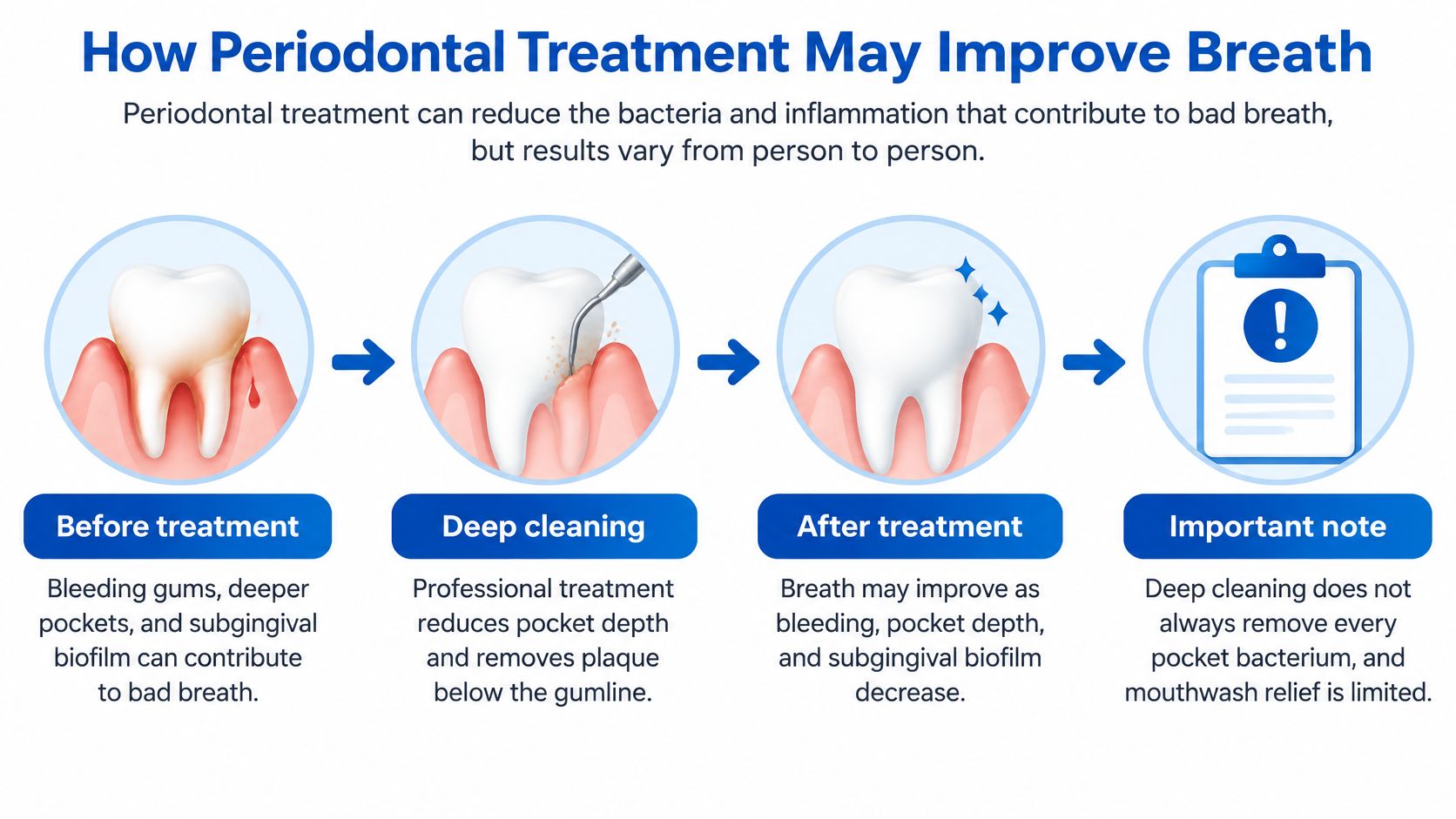
A patient who finishes deep cleaning often expects the smell to vanish that week. Sometimes it does improve quickly. Breath tracks how well treatment shrinks bleeding, pocket depth, and subgingival biofilm, and mouthwash relief on its own is usually temporary. Care shrinks the bacterial reservoir and calms inflammation, which reaches the gas source that mints and rinses only cover.
The care sequence, in order
- Periodontal exam: The clinician records pocket depths, bleeding, recession, mobility, and plaque. i-CAT 3D cone beam imaging may be used when bone loss or future implant planning needs a clearer view, since a surface exam can't show bone shape.
- Non-surgical therapy: Scaling and root planing plus home cleaning instruction target the bacterial film on the root below the gumline. In a study summarized in PMC research on periodontitis and halitosis treatment, mean total VSC levels in 80 patients with chronic periodontitis fell from 89 ± 16.3 ppb before nonsurgical periodontal therapy to 55 ± 9.7 ppb one month after treatment.
- Daily biofilm control: Interdental cleaning and tongue cleaning stay in the plan, because the same evidence base shows hygiene instruction lowered organoleptic scores and VSCs, and adding nonsurgical periodontal therapy then reduced pocket depth, bleeding on probing, methyl mercaptan, and measured malodor further over six weeks.
- Treatment for pockets that stay active: If pockets remain active after non-surgical care, the periodontist may discuss how the LANAP procedure works with the FDA-cleared PerioLase MVP-7, or traditional osseous surgery when that fits the diagnosis. LANAP is the only FDA-cleared laser protocol for treating periodontal disease. It regenerates bone and tissue without scalpels or sutures, and most LANAP patients return to normal activity within 24 hours. Results still vary, and no method is pain-free or guaranteed.
- Reassessment: The follow-up visit rechecks pockets, bleeding, plaque, tongue coating, and whether odor returned. That visit decides whether the mouth is stable, needs closer maintenance, or still has a residual source to treat.
Why treating real disease beats masking it
A systematic review and meta-analysis found meaningfully higher odds of halitosis in people with periodontitis, both when odor was judged by organoleptic assessment and when volatile sulfur compounds were measured directly. The practical reading: when periodontitis is present, treating the pockets addresses a documented odor source instead of covering it. Improvement deserves the same check as diagnosis, confirmed by measurements rather than a week's impression of fresher breath.
Probiotics and oral microbiota transplantation remain research directions under study. They shouldn't delay mechanical biofilm removal when active pockets, bleeding, and attachment loss are already documented.
Anxiety about gum surgery is common, and the order of care addresses it. Non-surgical care is usually the first step. Surgery, including LANAP laser gum surgery, is considered only when active pockets remain after reassessment, and options are weighed together after the exam. No outcome, cure, or pain level can be promised, and persistent odor after therapy warrants a fresh look for residual pockets, dry mouth, tongue coating, tonsillar disease, reflux, or other medical causes.
Request a Periodontal Exam for Ongoing Bad Breath
A clear decision rule helps. Bad breath that lasts more than a couple of weeks deserves a periodontal exam, especially with bleeding gums, tenderness, recession, loose teeth, food trapping, or a history of bone loss. Waiting while those signs continue lets an active pocket stay unmeasured.
The background rates explain why clinicians take ongoing odor seriously. CDC fast facts on gum disease, drawing on National Health and Nutrition Examination Survey surveillance, report that nearly half of U.S. adults aged 30 years and older have periodontitis, with severe disease in about 8% of adults; the same surveillance estimated 47.2% overall, including about 8.7% with mild disease, 30.0% with moderate disease, and 8.5% with severe disease.
Those figures carry a narrower lesson than "bad breath equals gum disease." Periodontitis is common enough, and deep pockets shelter odor-producing bacteria well enough, that persistent halitosis with gum symptoms deserves measurement. Smell alone still cannot stage the disease, because tongue coating, dry mouth, and other oral sources often share the blame. A board-certified periodontist can tell whether pockets drive the odor or whether the tongue, dryness, or a tooth problem should be handled first.
Periodontal Associates of Delaware has board-certified periodontists who hold diplomate status with the American Board of Periodontology, with four offices in Wilmington, Newark, Dover, and Rehoboth Beach serving patients across Delaware, including Pike Creek and Hockessin. A referral is not needed, and most major insurance plans are accepted, though coverage for any one person cannot be promised in advance. Care is matched to the diagnosis and may range from non-surgical therapy to surgery when indicated.
Individual results vary, and no outcome, cure, pain level, or cost can be promised. Readers with ongoing bad breath and gum symptoms can request an appointment at the Wilmington, Newark, Dover, or Rehoboth Beach office and bring notes on bleeding, dryness, food trapping, and what tongue cleaning changes.
Periodontal Associates of Delaware provides periodontal examinations that measure pockets, bleeding, recession, and tooth support, so persistent bad breath can be traced to gum disease, tongue coating, dryness, or a mix of sources rather than guessed at. Adults in Wilmington, Newark, Dover, Rehoboth Beach, and surrounding Delaware communities who want that measured answer can visit Periodontal Associates of Delaware to request an appointment at the nearest office.