A person may notice bottom gum recession while brushing, eating ice cream, or checking a smile in the mirror. One lower front tooth can look longer than its neighbor, or a sharp cold sensation may come from a spot that never caused trouble before. That change can be unsettling, especially when it appears without pain.
Patients in Wilmington, Newark, Dover, Pike Creek, Hockessin, Bear, Middletown, and surrounding communities often wonder whether the gum will grow back or whether surgery is inevitable. The answer depends on the cause, the thickness of the gum tissue, the position of the tooth, and the health of the supporting bone. A careful periodontal evaluation can separate a stable, mild defect from active inflammation or tissue loss that needs treatment.
Table of Contents
- Understanding Bottom Gum Recession in Delaware Patients
- Why Lower Gum Recession Happens More Often
- Prevention Strategies for Lower Gum Health
- Treatment Options for Localized Gum Recession
- Advanced Technology in Periodontal Care
- Overcoming Fear of Gum Surgery
- When to See a Periodontist About Gum Recession
- Frequently Asked Questions About Gum Recession
- Can bottom gum recession reverse on its own?
- Does mild recession always need surgery?
- How long does treatment take?
- What activities should be avoided after a gum procedure?
- Does insurance cover periodontal treatment?
- Is gum disease the same as gum recession?
- Can lower-incisor recession be treated predictably?
Understanding Bottom Gum Recession in Delaware Patients
Bottom gum recession means that gum tissue has moved away from its previous position on the lower teeth, exposing more of the tooth root. The lower front teeth are a common place to notice this change because the gum and bone in that region may be thin, and the area can receive repeated brushing pressure or collect deposits near the gumline.
The visible signs can be subtle. A lower tooth may appear longer, the gumline may look uneven, or a small notch may be felt where the crown meets the root. Exposed root surfaces can also react to cold foods, sweet drinks, or touch because roots don't have the same enamel covering as the visible crown.
A reassuring distinction: recession isn't automatically the same as active gum disease, but both conditions can occur together and require different parts of an examination.
A foundational U.S. population analysis found that 23.8 million people had at least one tooth surface with 3 mm or more of gingival recession, representing 22.5% of the surveyed adult population. The same analysis found that recession often appeared alongside other periodontal risk markers, including gingival bleeding, calculus, and subgingival calculus. These findings help explain why a lower gum change deserves evaluation even when the affected tooth doesn't hurt. Review the population analysis of gingival recession and periodontal findings
Age also influences the likelihood of recession. One review reported recession in 37.8% of adults aged 30 to 39, rising to 90.4% of adults aged 80 to 90, with the extent of affected teeth also increasing across those age groups. Read the review of age-related gingival recession
The practical message for adults across New Castle and Kent Counties is simple. A longer-looking lower tooth doesn't mean the tooth is growing, and a painless change doesn't mean it can be ignored. Periodontists evaluate these cases regularly, with the aim of identifying the cause and choosing the least extensive treatment that protects the tooth.
Why Lower Gum Recession Happens More Often
The lower front gumline often has less room for error. A tooth that sits close to the outer edge of its supporting bone may have a thin layer of gum tissue over it. Like soil covering a plant root, that tissue protects the surface beneath it. Repeated scraping, inflammation, or pressure can gradually remove that protection.
A thin or inadequate gingival phenotype is a major risk factor. Thin tissue is less resistant to mechanical injury and inflammation than thicker tissue. Tooth position can add to the problem when a lower incisor angles outward, shifts after orthodontic treatment, or receives unusual force from the bite.
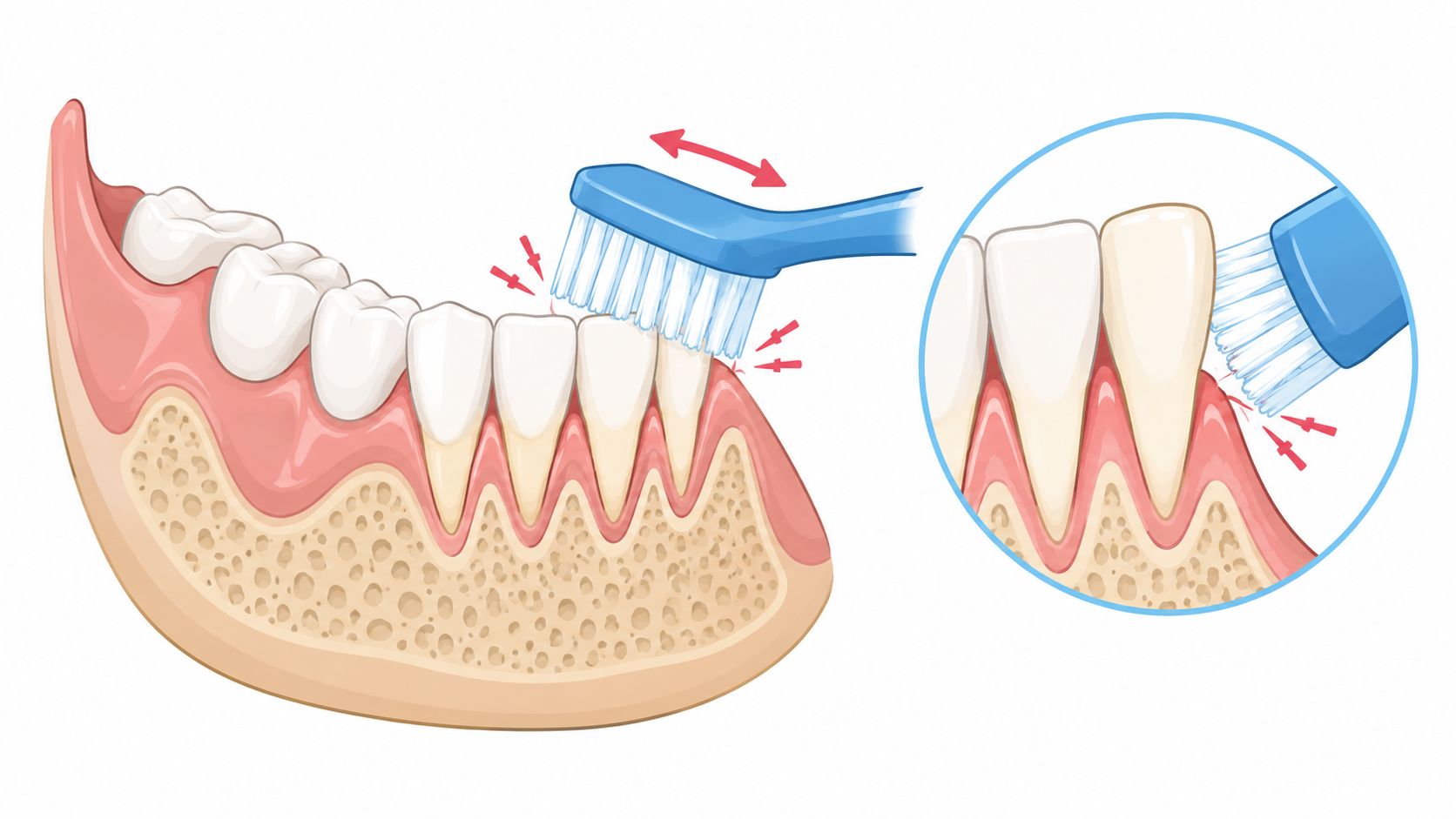
Plaque and brushing often work together rather than acting as separate explanations. Plaque-related inflammation makes the gumline more vulnerable, while forceful horizontal brushing can traumatize already delicate tissue. In one clinical study, plaque accumulation was identified as the most common etiologic factor at 44.1%, followed by faulty toothbrushing at 42.7%. Smoking, malocclusion, a high frenum attachment, and inadequate attached gingiva were also identified as contributing factors. Review the clinical evidence on causes of gingival recession
Mechanical causes deserve careful attention
A hard-bristled brush, excessive pressure, or a back-and-forth scrubbing motion can repeatedly injure the same lower teeth. The dominant hand may also make one side receive more force. Other repetitive habits, including nail biting or contact from an oral appliance or piercing, can add localized trauma.
Tooth grinding is a separate mechanical concern. It doesn't explain every case of recession, but clenching and grinding may increase stress around teeth that already have thin tissue or an unfavorable position. Patients who notice jaw fatigue, worn tooth edges, or morning soreness can discuss whether grinding may contribute to receding gums during an evaluation.
Plaque can be easy to miss
The tongue-side surfaces of the lower front teeth may collect calculus because of nearby saliva flow. Home brushing can remove soft plaque, but hardened calculus requires professional removal. If inflammation persists around a thin lower gumline, the tissue may continue to lose support even when the visible recession looks mild.
The cause is often mixed. A periodontist may find thin tissue, brushing trauma, plaque accumulation, and tooth position contributing to the same defect. That is why treating only sensitivity or changing only toothpaste may not stop progression.
Prevention Strategies for Lower Gum Health
Prevention starts with reducing two forms of stress: physical trauma and bacterial irritation. Patients don't need to stop cleaning the lower teeth. They need to clean them with better control.
Change the brushing pattern
A soft-bristled brush and a light grip are appropriate starting points. The brush should contact the gumline without being forced into it. Small circular or gentle angled strokes are preferable to aggressive horizontal scrubbing. An electric brush with pressure feedback may help patients who routinely press too hard, but technique matters more than the brush type.
The goal isn't to make the gumline feel scraped clean. The goal is to remove plaque while preserving the tissue that protects the root.
Clean between teeth without cutting the gums
Floss should slide gently below the contact point and curve around each tooth in a controlled C shape. Snapping it into the gums can cause bleeding and soreness. Patients with tight spaces, bridges, or limited hand control may need an appropriately sized interdental cleaner selected with professional guidance.
Bleeding shouldn't be dismissed as a reason to stop cleaning. Persistent bleeding can indicate inflammation, while rough technique can cause avoidable trauma. A dental professional can help determine which problem is present.
Keep professional maintenance on schedule
Calculus cannot be brushed away at home. Dental cleanings and periodontal maintenance remove deposits that continue to irritate the gumline and allow the clinical team to compare gum levels over time. Patients with a history of periodontal disease may need a more individualized maintenance plan than patients with isolated brushing-related recession.
Orthodontic history also matters. Tooth movement can alter the position of a lower incisor within its supporting bone. A patient who notices recession after orthodontic treatment, or after a tooth has shifted, should have the tooth position and tissue thickness evaluated rather than relying on home care alone.
Address habits and health risks
- Reduce tobacco exposure: Smoking can interfere with periodontal health and healing.
- Watch for bite-related stress: Clenching, grinding, or a tooth that hits prematurely may need assessment.
- Protect sensitive roots: Fluoride toothpaste and desensitizing products may reduce discomfort, but they don't replace diagnosis.
- Monitor visible changes: A new notch, increasing sensitivity, or a changing gumline warrants professional review.
These measures may stabilize early recession, but they can't rebuild tissue that has already been lost. Individual results vary, and prevention works best when home care is paired with periodontal monitoring.
Treatment Options for Localized Gum Recession
Treatment begins with a question: Is the recession stable, or is an active cause still damaging the area? A periodontist may assess gum thickness, recession depth, root anatomy, plaque levels, bite forces, tooth position, and the supporting bone before recommending a procedure.
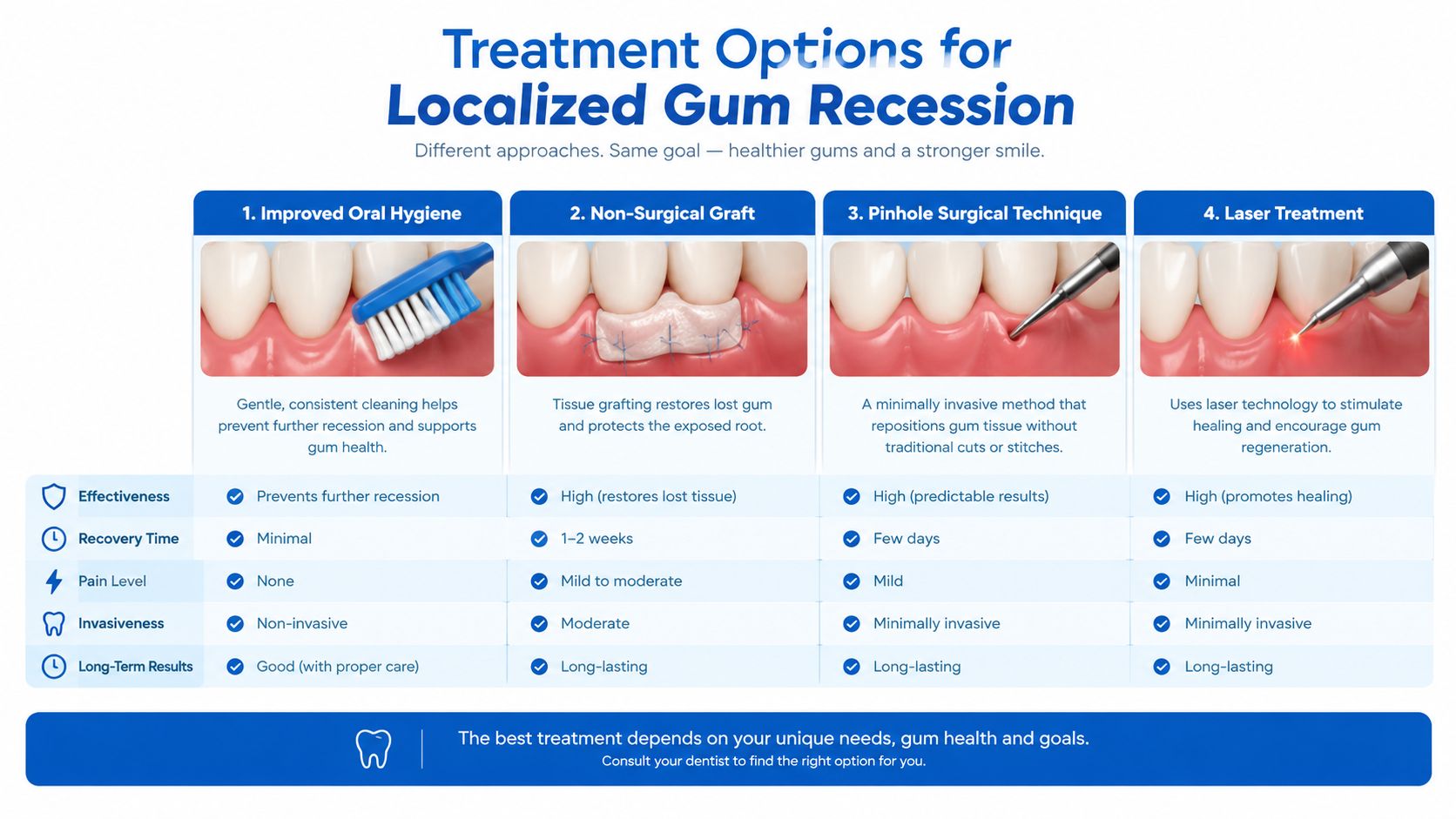
For a small, stable defect, non-surgical care may be enough. That can include professional plaque and calculus removal, brushing instruction, sensitivity control, and correction of local irritants. This approach protects the remaining tissue but won't physically move the gum back over an exposed root.
Comparing procedural approaches
A connective tissue graft adds durable soft tissue to a thin or receded area and may cover part of the exposed root. It remains one of the most predictable root-coverage approaches overall, but lower-incisor cases can be less predictable when the tissue is thin, the supporting bone is limited, or orthodontic movement has altered the site.
A coronally advanced flap moves existing gum tissue toward the root when the local anatomy allows it. Guided tissue regeneration may be considered in selected defects. These procedures involve different surgical designs, healing requirements, and tissue sources, so the correct choice depends on the defect rather than the name of the technique.
Selected patients may also be considered for a pinhole-style approach or laser-assisted periodontal care. These methods aren't interchangeable with grafting, and they aren't appropriate for every recession pattern. A discussion about a frenectomy and its relationship to gum recession may be relevant when a high or tight frenum attachment pulls on the lower gumline.
The available evidence provides useful benchmarks without guaranteeing an individual result. A 2024 systematic review reported mean root coverage of 82.6% and complete root coverage of 62.7% across 26 studies. The same evidence summary reported average root coverage of 88% for multiple recessions treated with VISTA and complete root coverage of 67%. Review evidence on root-coverage procedures
The trade-off is clear. Non-surgical care is less invasive but cannot replace lost tissue. Surgery may improve root coverage and tissue thickness, but healing, comfort, donor-site needs, and predictability vary by patient and tooth.
Advanced Technology in Periodontal Care
A lower tooth can show exposed root while the underlying bone remains hidden. That distinction matters because recession may reflect thin or missing bone on the cheek or tongue side, tooth position, periodontal breakdown, or a combination of mechanical stresses. The gumline alone cannot identify which factor is driving the problem.
Two-dimensional dental images can miss these defects when structures overlap. Cone-beam computed tomography can show buccal and lingual bone, support three-dimensional ridge evaluation and linear measurements, identify nearby anatomy, and assist with surgical guide fabrication. Review the role of cone-beam imaging in periodontal and implant assessment
Imaging supports a better decision
Periodontal Associates of Delaware uses i-CAT 3D cone beam imaging when three-dimensional information could change diagnosis or treatment planning. The scan does not determine treatment by itself. It adds detail to the clinical examination when a lower tooth has bone loss, sits near the edge of the ridge, has been moved orthodontically, or may later require implant treatment.
The practical question is whether the visible recession matches the supporting bone. A thin bony plate can affect the safety and predictability of moving a tooth, planning an implant, or selecting tissue treatment. Imaging helps the periodontist assess those trade-offs before recommending care.
Navigation and laser care have different roles
X-Nav dynamic surgical navigation guides implant placement when a lower tooth has already been lost to periodontal breakdown. The planned surgical path accounts for available bone and nearby anatomy, including the same thin ridge that may have contributed to recession. It supports control during complex implant treatment, but it does not replace periodontal diagnosis or belong in every recession case.
LANAP laser gum surgery using the FDA-cleared PerioLase MVP-7 may be considered for selected periodontal disease cases. Laser care targets diseased periodontal tissues and infection-related problems, while soft tissue grafting adds or repositions tissue for root coverage. These approaches serve different purposes. Patients comparing protocols can review laser gum treatment cost and what it includes before scheduling.
Ask how each technology changes the diagnosis or treatment plan. A device matters only when it provides information or surgical control that fits the specific mouth.
Overcoming Fear of Gum Surgery
Fear of gum surgery often begins with uncertainty. Patients may picture a long procedure, significant pain, or a recovery that interferes with work and family responsibilities. Those concerns deserve a direct conversation, not dismissal.
Periodontal procedures are performed with local anesthesia, so the treatment area is numbed during care. Afterward, patients may experience tenderness, swelling, or sensitivity depending on the procedure and the extent of treatment. Many patients manage recovery with the instructions provided by the clinical team, but comfort and healing aren't identical for everyone.
A practical expectation: the consultation should explain what will happen before, during, and after treatment, including restrictions, medication instructions, follow-up, and signs that require a call.
Minimally invasive techniques may be suitable in selected cases and may reduce the amount of tissue disturbance. Laser-assisted care can be useful when periodontal infection is part of the problem. Neither approach guarantees a painless experience or eliminates the need for careful aftercare.
Preparing makes the experience more manageable
Patients can reduce uncertainty by asking:
- What is causing the recession? Brushing trauma, inflammation, tooth position, thin tissue, and bite forces require different responses.
- What happens if treatment is delayed? A clinician can explain whether the site appears stable or vulnerable to progression.
- Which procedure is being recommended? Patients should understand whether the plan involves hygiene care, a graft, a flap, a laser protocol, or observation.
- What will recovery involve? The answer may include diet changes, brushing instructions, activity limits, and follow-up visits.
An anxious patient can also tell the periodontal team about previous dental experiences, sensitivity, or difficulty tolerating treatment. Individual results vary, and no responsible clinician can promise a specific degree of root coverage, recovery speed, or long-term stability. A consultation gives the patient enough information to make a decision without guessing.
When to See a Periodontist About Gum Recession
A visible change in the lower gumline deserves attention when it is new, increasing, or associated with other symptoms. Patients should request an evaluation for a lower tooth that looks longer, sensitivity that persists or worsens, bleeding during brushing, a notch near the root, or tenderness around the gumline.
Prompt assessment is especially useful when recession appears to develop quickly, several lower teeth are changing, or a tooth feels loose. Those signs may reflect more than isolated tissue thinning. A periodontist can check for inflammation, periodontal pocketing, bone loss, tooth mobility, bite-related forces, and local irritants.
What the consultation may include
A periodontal visit typically combines the patient's history with measurements around the teeth. The clinician may document gum levels, evaluate bleeding and pocket depths, inspect the thickness of the tissue, assess the bite, and review previous orthodontic or periodontal treatment.
Three-dimensional imaging isn't necessary for every recession case. It may be considered when the supporting bone, tooth position, implant planning, or a suspected defect can't be understood fully through a clinical examination and standard images. The purpose is to answer a specific diagnostic question, not to add testing without reason.
Patients across New Castle and Kent Counties can seek periodontal care through offices in Wilmington, Newark, and Dover. That multi-location access can make it easier to coordinate evaluation, periodontal treatment, maintenance, and referrals with a general dentist or orthodontist.
Early care doesn't guarantee that treatment will be simple, but it may identify the cause before more tissue or supporting bone is lost. Waiting for pain can be misleading because recession and periodontal disease may progress with little discomfort. Individual results vary, so a periodontist should assess the site rather than relying on a mirror examination.
Frequently Asked Questions About Gum Recession
Can bottom gum recession reverse on its own?
Gum tissue that has physically receded generally doesn't grow back without treatment. Non-surgical care can reduce inflammation, control plaque, protect exposed roots, and help prevent further progression. A soft tissue graft or another root-coverage procedure may be considered when tissue restoration is appropriate.
Does mild recession always need surgery?
No. A stable, shallow defect without active inflammation or troublesome sensitivity may be monitored. Treatment becomes more relevant when recession is progressing, the root is vulnerable, sensitivity persists, tissue is too thin to protect the tooth, or the appearance concerns the patient. The clinical cause matters more than the word “mild.”
How long does treatment take?
The timeline depends on whether care involves home-care changes, professional cleaning, periodontal therapy, grafting, or another procedure. Surgical treatment also includes a healing and follow-up period. A periodontist can provide a patient-specific schedule after examining the lower gumline. Individual results vary.
What activities should be avoided after a gum procedure?
Patients may receive instructions to avoid disturbing the treated site, follow a modified diet, limit certain physical activities, and use prescribed or recommended rinses and medications. The restrictions depend on the procedure and the patient's health. The treating team's written instructions should take priority over general online advice.
Does insurance cover periodontal treatment?
Coverage varies by plan, diagnosis, procedure, and contract terms. Patients should ask the periodontal office to review available benefits, but benefit information isn't a guarantee of payment. The final responsibility may depend on the individual insurance policy.
Is gum disease the same as gum recession?
No. Gum disease involves inflammation and infection affecting the tissues that support teeth. Recession describes the position of the gumline and the exposure of more root surface. They can occur together, but a patient may have recession from trauma or thin tissue without active disease, or gum disease with less obvious recession. The examination determines which problems are present.
Can lower-incisor recession be treated predictably?
Lower front teeth can be challenging because thin tissue, limited bone, tooth position, and previous orthodontic movement may reduce predictability. Connective tissue grafting remains a widely used option for suitable cases, but no procedure guarantees complete coverage or permanent stability. A patient-specific evaluation is necessary before choosing treatment.
Periodontal Associates of Delaware provides periodontal evaluations, non-surgical gum therapy, LANAP care, soft tissue grafting, and implant-related treatment planning through offices in Wilmington, Newark, and Dover. Adults with bottom gum recession, root sensitivity, bleeding, or suspected bone loss can request an appointment at the nearest location through the appointment request page.