Published estimates for crown lengthening on a single tooth run roughly $500 to $2,000 for the surgery alone, and the crown is billed separately. Those figures aren't quotes for a specific tooth, because a gum-only procedure and surgery with bone reshaping aren't the same treatment, even when both carry the same name.
Table of Contents
- What Crown Lengthening Costs Before the Crown
- Reported Crown Lengthening Price Benchmarks
- Which Procedure Scope Changes the Price
- How Insurance Classification Changes Your Bill
- Reading an Itemized Estimate Line by Line
- When Crown Lengthening Is Worth the Cost
- Request a Written Estimate Before You Schedule
What Crown Lengthening Costs Before the Crown
Crown lengthening reshapes gum tissue, and sometimes the supporting bone, to expose sound tooth structure. That exposure may let a crown seat on a solid margin and seal against the tooth instead of ending too close to the bone. In other cases, treatment evens an uneven gum line or reduces a gummy smile.
Two goals, one procedure name
Restorative crown lengthening addresses a tooth broken or decayed below the gumline. The goal is enough exposed structure for a durable restoration. Esthetic crown lengthening focuses on appearance, often across several front teeth. It may involve similar surgical steps, but insurers and offices don't treat the purpose as interchangeable.
The surgical fee is also only one line in the complete budget. Consultation, periodontal examination, imaging, a temporary restoration, follow-up visits, a buildup, and the definitive crown may each carry separate charges. A low surgery estimate can therefore look deceptively close to the final cost when restorative work hasn't been added.
Three factors explain most variation in crown lengthening cost:
- Surgical scope: Gum reshaping alone differs from flap surgery with bone recontouring.
- Insurance classification: Restorative treatment may be reviewed differently from cosmetic treatment.
- Adjunctive services: Imaging, sedation, temporaries, and follow-up care may not be included in a headline fee.
Periodontal Associates of Delaware sees patients at offices in Wilmington, Newark, and Dover. A reliable estimate follows a periodontal examination of the tooth, gums, bone, and planned restoration. Individual results and fees vary, so a periodontist should evaluate the site before treatment is scheduled.
Reported Crown Lengthening Price Benchmarks
Published figures look orderly in a table, but the rows come from different pricing systems. A discount schedule doesn't prove that surgery costs less, and a university clinic fee isn't a private practice quote.
| Source | Pricing system | Reported figure |
|---|---|---|
| Coast Dental | Non-member retail fee schedule | About $902 |
| Boston University | 2024 clinic schedule, hard-tissue crown lengthening | $1,032 |
| Delta Dental of Colorado | Patient Direct discount schedule, effective November 2025 | $558 |
| Patient quotations | Single tooth, reported | About $650 to $750 |
| Dental Treatment Guide (cited by Colgate, 2024) | Estimated consumer price | $1,000 to $2,000 |
| CostHelper Health (cited by Colgate, 2024) | Estimated consumer price | $1,000 to $3,000 |
| CDT D4249 fee schedule, general dentist | 2026 dental benefits fee schedule | $543 |
| CDT D4249 fee schedule, specialist | 2026 dental benefits fee schedule | $642 |
| Cash price range | Fee analysis, uninsured | About $600 to $2,000 |
| Insurer-allowed amount | Fee analysis, allowed amounts | About $935 to $1,460 |
A neutral cost compilation lists approximately $902 on Coast Dental's non-member fee schedule, $1,032 for hard-tissue crown lengthening on Boston University's 2024 clinic schedule, and $558 on Delta Dental of Colorado's Patient Direct discount schedule effective November 2025. The same compilation reports patient quotations of roughly $650 to $750 for a single tooth. Those figures reflect a retail schedule, a university clinic schedule, a negotiated discount, and individual quotations, so ranking them as competing prices for identical surgery misreads what each number represents.
Consumer estimates sit higher. In 2024, Colgate cited estimated crown-lengthening costs of $1,000 to $2,000 from Dental Treatment Guide and $1,000 to $3,000 from CostHelper Health. A broad consumer range may combine different regions, provider types, numbers of teeth, and levels of bone surgery. It can help a patient avoid sticker shock, but it can't predict the fee for one molar in Delaware.
How to compare two figures without mixing systems
Benefits benchmarks add another layer. One schedule may describe patient responsibility under a specified plan. A cash range describes amounts charged outside that arrangement, while an insurer-allowed amount reflects a payer's contracted calculation. The higher number isn't automatically inflated, and the lower number isn't automatically available. Contract status, specialty, geography, and whether bone is removed can explain much of the gap.
Three checks keep comparisons honest:
- Match the setting: Compare university, discount, contracted, and standard private practice figures separately.
- Match the provider type: A specialist benchmark shouldn't be treated as a general dentist benchmark.
- Match the unit: Confirm whether the amount is per tooth, per site, per quadrant, or per visit.
A benchmark is useful only when the pricing system behind it matches the patient's actual treatment setting.
That discipline also helps when a treatment plan includes related surgery. Readers comparing periodontal procedures can review how a separate estimate is structured in this guide to bone grafting for dental implants cost, then apply the same setting, provider, and unit checks to crown lengthening.
Which Procedure Scope Changes the Price
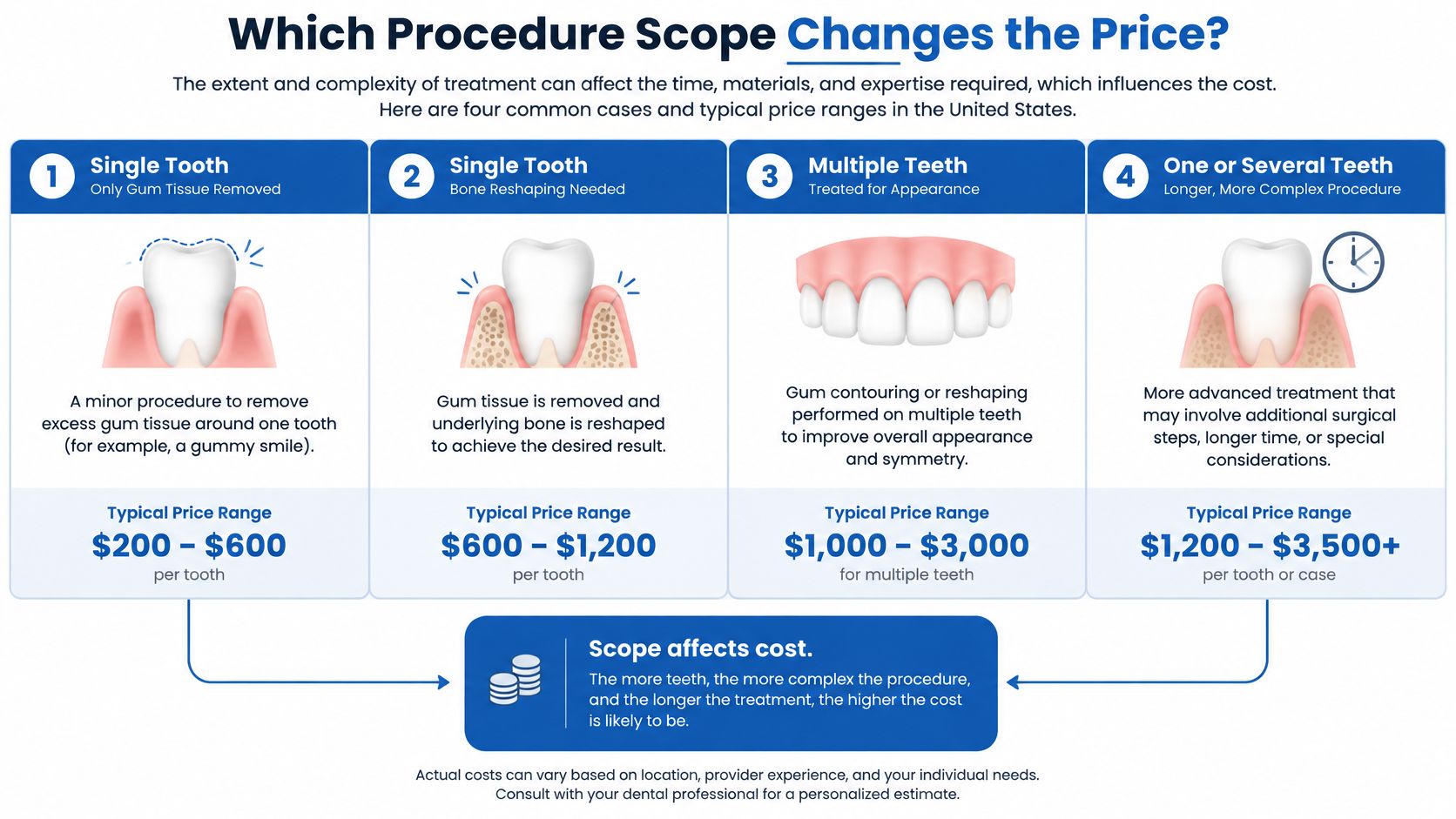
Scope changes time, technique, healing visits, and risk management. That's why two estimates can both be reasonable while describing materially different surgery.
| Case | What the surgery involves | Relative cost |
|---|---|---|
| Single tooth, gum tissue only | Soft tissue reshaped to expose sound tooth structure | Lowest of the four cases |
| Single tooth, bone reshaping needed | Flap surgery, bone removal, sutures and healing checks | Higher than gum-only |
| Multiple teeth, esthetic goal | Several sites contoured in one plan, often with staged visits | Highest total, may be staged |
| Restorative exposure for a crown | Exposure to seat the crown with an adequate margin | Mid to higher range, insurance review possible if medically necessary |
When gum reshaping is enough
A soft-tissue-only procedure may be sufficient when excess gum covers adequate tooth structure and the bone crest already allows enough room for the restoration. Treatment can focus on reshaping the gum contour. When bone sits too close to the planned margin, removing gum alone risks rebound or chronic inflammation because the tissue needs space to attach in a stable position.
A clinical review describes the usual restorative target as approximately 3 mm between the restoration margin and the alveolar crest, and reports that conventional crown lengthening typically removes about 3 to 4 mm of bone, measured from the existing crown margin or the cementoenamel junction when the tooth is unrestored. Creating that space protects the supracrestal tissue attachment, formerly called biologic width. It also adds flap elevation, bone reshaping or removal, suturing, and healing checks.
European Federation of Periodontology guidance summarized in a periodontology article identifies an apically positioned flap with osseous resection as generally indicated when the alveolar bone crest is less than 3 mm from the desired gingival margin. The precise approach still depends on anatomy, tooth position, esthetic requirements, and the planned restoration.
Other drivers that move an estimate
- Number of teeth: Each added site increases operating time, materials, and follow-up assessment.
- Surgical access: A back tooth, limited opening, roots close together, or a deep fracture can complicate access.
- Esthetic demands: Front teeth require careful symmetry because small contour differences show in a smile.
- Restorative goal: A crown margin, buildup, and temporary restoration must coordinate with surgical healing.
- Regional specialist pricing: Local labor, facility, and referral patterns affect private fees.
The distinction between gum removal and more complete surgical exposure is explained further in this overview of crown lengthening and gingivectomy. As a practical rule, more bone recontouring and more treated sites push an estimate toward the higher end of published ranges.
How Insurance Classification Changes Your Bill
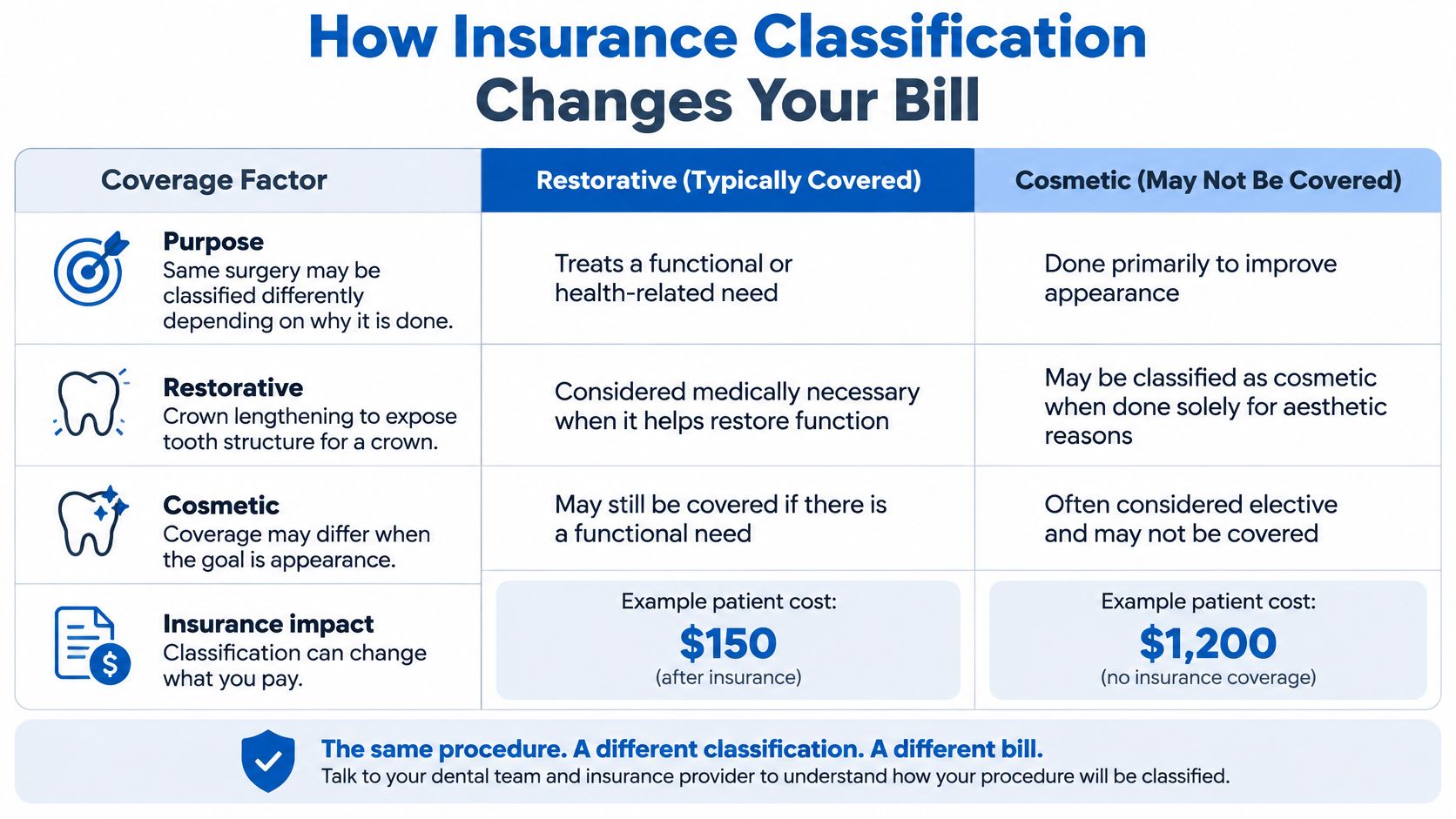
A patient can receive similar surgery for two different reasons and face completely different out-of-pocket costs. Classification is often the turning point.
| Coverage factor | Medically necessary restoration | Cosmetic gummy smile |
|---|---|---|
| Typical classification | Periodontal or major dental service | Cosmetic |
| Reported reimbursement | About 50 percent after deductible, where the plan covers it | Commonly excluded |
| Exclusions | Some plans exclude it even when needed for a crown | Often excluded by the plan |
| Frequency rule (example plan) | One procedure per quadrant or site in 36 months | No benefit when cosmetic exclusion applies |
| Annual maximum effect | Surgery, buildup and crown may use much of the yearly benefit | Patient pays outside the annual maximum |
Purpose can outweigh the surgical fee
An insurance-oriented cost review states that plans covering the procedure often reimburse around 50% after the deductible, although some policies exclude crown lengthening even when it's needed to make a crown possible. Crown lengthening performed to expose tooth structure for a medically necessary restoration may be processed as a periodontal or major dental service. Treatment performed solely to improve a gummy smile is commonly classified as cosmetic and excluded.
Annual maximums create a second constraint. Surgery alone may fit within a yearly benefit, but the buildup and final crown are usually part of the same treatment sequence. Together, those services may consume much or all of the remaining benefit, especially after cleanings, fillings, or other major care earlier in the year. Timing across benefit years may matter for some nonurgent restorations, though clinical urgency comes first.
Frequency limits create a third. A 2025 UnitedHealthcare StudentResources dental booklet lists crown lengthening as limited to one procedure per quadrant or site during a consecutive 36-month period. That example doesn't establish rules for other plans. Benefits differ by diagnosis, network status, waiting periods, exclusions, authorization requirements, and whether the plan labels treatment restorative, periodontal, or cosmetic.
Pretreatment checks that reveal the real bill
Patients should request a written pretreatment estimate and confirm:
- Diagnosis and procedure codes: The clinical reason should match the submitted documentation.
- Bone removal: The plan should know whether hard tissue surgery is part of treatment.
- Preauthorization: Some plans require approval before surgery.
- Deductible and coinsurance: Percentages apply only after eligibility and allowed amounts are set.
- Annual maximum: Remaining benefit may be smaller than the combined surgical and restorative total.
- Separate restorative charges: The crown and buildup need their own benefit check.
Plan participation and documentation requirements can be reviewed through the practice's insurance information before scheduling. The central point is blunt: asking whether crown lengthening is covered isn't specific enough. The useful question asks how the plan classifies this diagnosis, at this site, under the remaining benefits.
Reading an Itemized Estimate Line by Line
A useful estimate separates services instead of hiding them in one bundled number. Separation lets patients compare scopes, verify benefits, and see which costs belong to surgery rather than restoration.
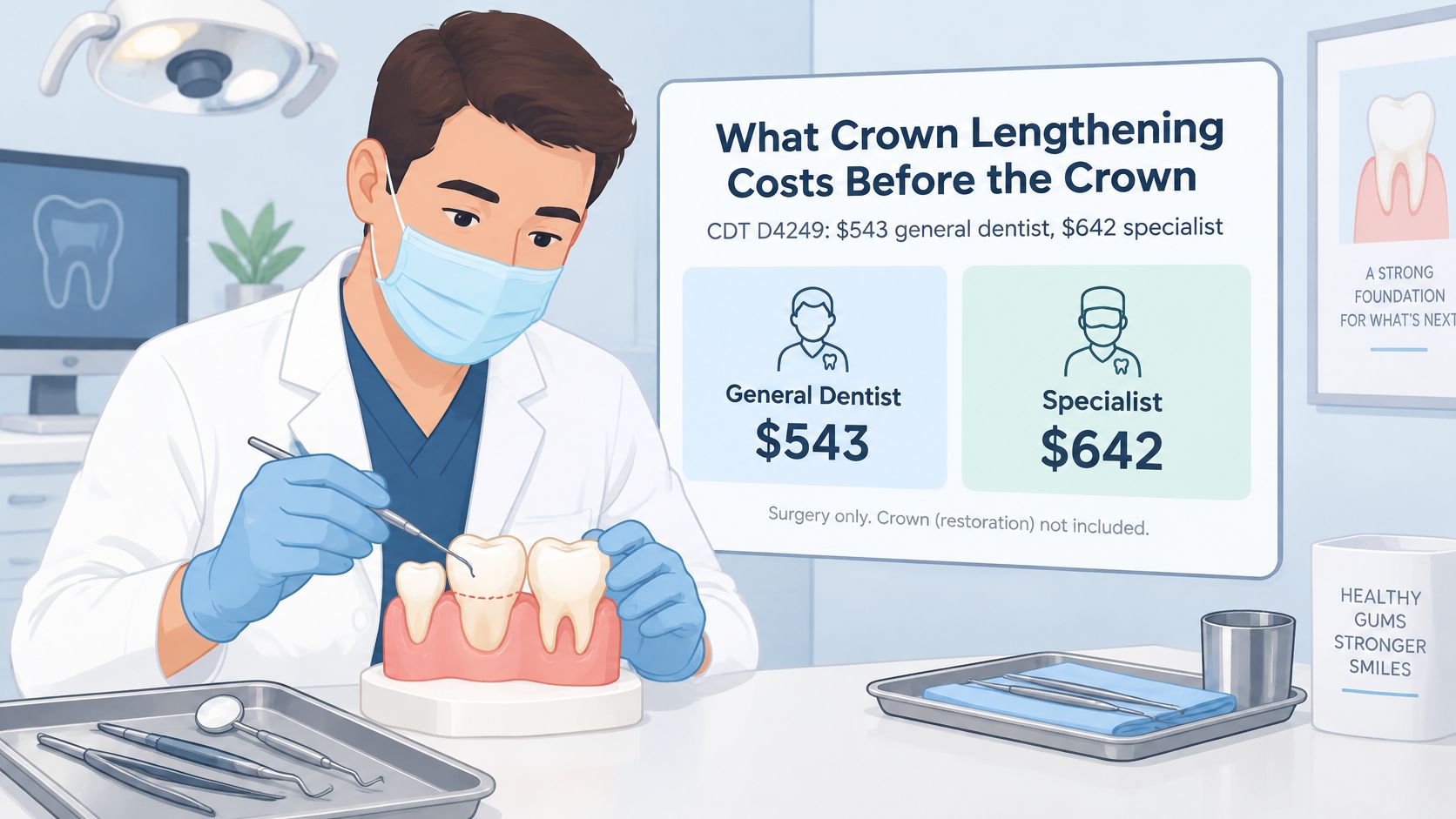
A 2026 dental-benefits fee schedule lists CDT D4249 clinical crown lengthening involving hard tissue at $543 for a general dentist and $642 for a specialist, while another published fee analysis estimates cash prices of approximately $600 to $2,000 and insurer-allowed amounts of roughly $935 to $1,460. Those figures aren't interchangeable. The schedule represents a specified plan's patient responsibility, while cash and allowed ranges use different pricing and payer methods.
Lines patients should expect to see
- Consultation and periodontal examination: Probing, charting, restorative assessment, and treatment planning.
- Diagnostic imaging: Radiographs or i-CAT 3D cone beam imaging when three-dimensional planning is clinically indicated.
- Sedation: Listed only when planned, with the type and fee identified.
- Surgical fee: The crown lengthening procedure itself, typically by tooth, site, or quadrant as the code and plan require.
- Temporary restoration: Protection of the tooth while tissues heal, when needed.
- Follow-up visits: Suture removal, healing checks, and communication with the restorative dentist.
- Definitive crown and buildup: Restorative fees that don't belong inside the surgery charge.
The estimate should identify CDT D4249 when applicable and state whether it reflects a contracted, discounted, university, or standard private-practice charge. Periodontal Associates of Delaware also uses the FDA-cleared PerioLase MVP-7 laser and X-Nav dynamic surgical navigation for relevant periodontal and implant care, but a crown lengthening estimate should name only the technology used for that patient's plan.
Seven questions before acceptance
- Which code is used for the surgery?
- Is bone removal included?
- How many teeth or sites are covered?
- Which charges may be insurance eligible?
- What deductible, coinsurance, and annual maximum were applied?
- Are follow-up visits included?
- What's the expected total once the crown is added?
Periodontal Associates of Delaware offers flexible financing, so patients who consider financing should compare the monthly payment, total paid over time, deferred interest terms, and any fees before agreeing. Keeping the written estimate allows comparison with the insurer's explanation of benefits after treatment.
When Crown Lengthening Is Worth the Cost
Value depends on the reason for surgery, the condition of the tooth, and the quality of the restoration that surgery makes possible. Price alone can't answer that question.
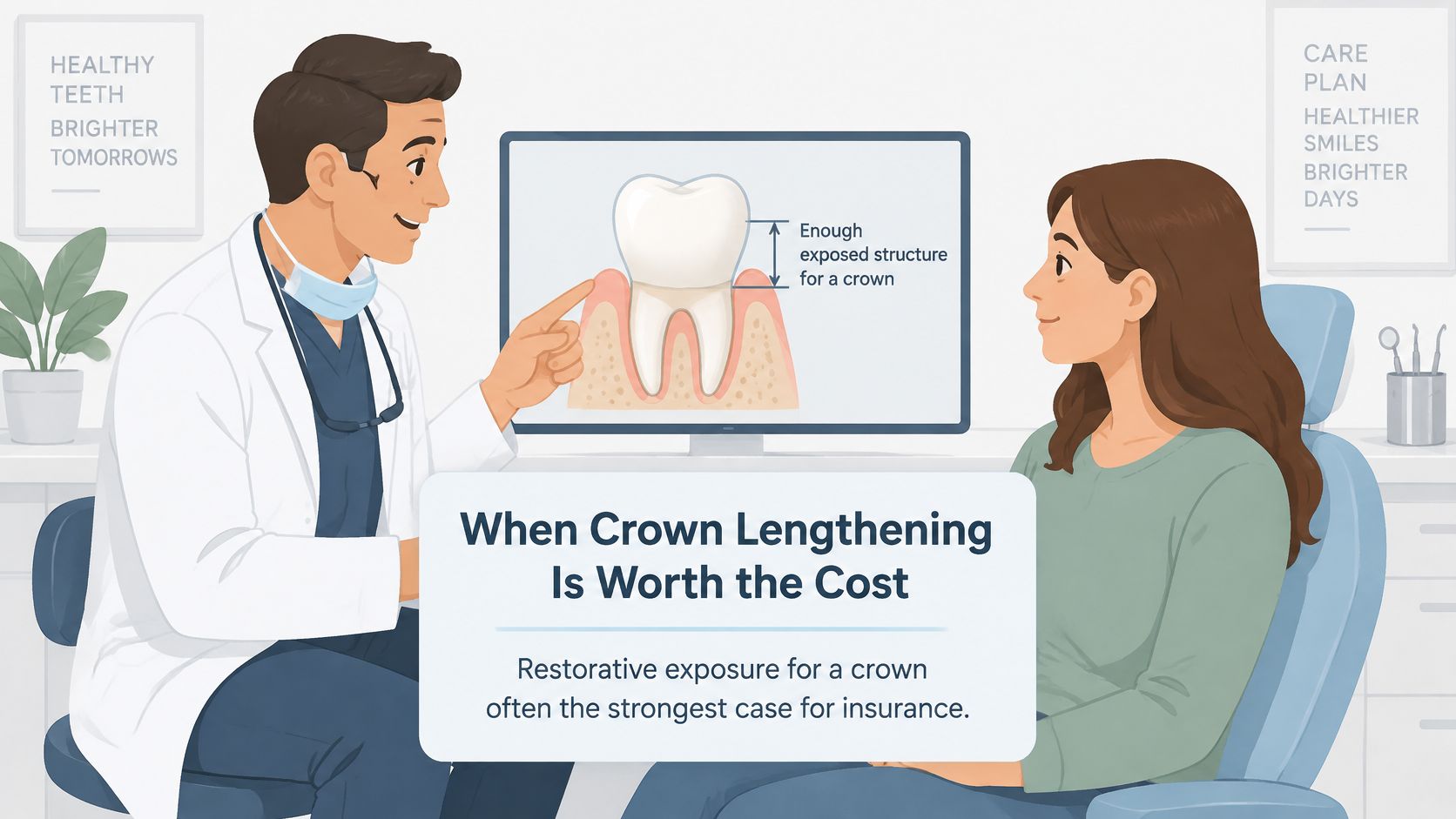
Restorative exposure for a crown
This is usually the clearest clinical case. A tooth fractured or decayed below the gumline may not hold a predictable crown until sound structure is exposed. If the root, bone support, and remaining tooth are favorable, crown lengthening may preserve a natural tooth and create a maintainable margin. It also has the strongest case for insurance review because the diagnosis is tied to a necessary restoration, although coverage still isn't assured.
The analysis changes when the tooth has a poor long-term outlook. Exposing more root doesn't repair a cracked root, severe mobility, or inadequate bone support. A periodontist and restorative dentist should agree that the tooth is worth restoring before surgical cost is added to the crown cost.
Esthetic correction on one or several teeth
A single uneven gum margin is a personal value decision. The patient weighs appearance, symmetry, sensitivity risk, healing time, and total cost. Multi-tooth esthetic contouring is more complex and may be staged to manage healing and spread expense across visits. Staging can improve planning, but patients should ask whether it adds separate visit, imaging, or temporary restoration fees.
A gum-only approach may be enough in selected cases. Bone reshaping costs more, yet it may be required for stable tissue position and a restoration margin that stays healthy. Choosing the cheaper scope when anatomy requires the broader procedure can lead to repeat treatment, which erases the apparent savings.
Risks belong in the value calculation
A StatPearls review cites a large retrospective study from an academic periodontal clinic in which postoperative dentinal hypersensitivity occurred in 5.7% of cases, excessive pain in 4.1%, and postoperative bleeding in 3.5%, while characterizing complications as uncommon overall. The same source notes that teeth treated with osseous crown lengthening and nearby teeth may show gingival recession after healing. Those findings don't predict an individual result, but possible sensitivity, tissue change, periodontal maintenance, and restorative adjustment deserve discussion before surgery.
Insurance classification can change the out-of-pocket total more than the surgery fee itself.
A three-question value test keeps the decision grounded:
- Does the crown need this exposure? If a sound margin can't be created without surgery, skipping it may compromise the restoration.
- What's the complete episode cost? Surgery, buildup, crown, follow-up, maintenance, and possible adjustments belong in one budget.
- What are the alternatives? Extraction, implant replacement, orthodontic extrusion, or no treatment may be clinically relevant in selected cases, and each carries different costs and maintenance.
A personalized evaluation should assess periodontal health, root form, bone support, smile line, and the planned restoration. The best value isn't always the lowest surgical estimate. It's the option that gives the tooth a realistic, maintainable path without hiding predictable restorative expenses.
Request a Written Estimate Before You Schedule
An online average can't determine whether bone removal is needed, how many sites require treatment, or whether the final crown can succeed. A periodontal examination answers those questions and turns a benchmark into a treatment-specific estimate.
Patients should bring current insurance information, any referral or restorative plan from the general dentist, and a list of medications and health conditions. The insurance checklist and estimate questions help keep the conversation specific. Asking which services are included before treatment is much easier than reconstructing a bundled charge afterward.
Periodontal Associates of Delaware is a board-certified periodontal practice with offices in Wilmington, Newark, and Dover, serving patients across New Castle and Kent Counties. Additional periodontal procedures offered include crown lengthening, sinus augmentation, ridge augmentation, frenectomy, canine exposure, extraction site preservation, and cosmetic periodontal surgery. i-CAT 3D cone beam imaging supports diagnostic planning when indicated, and patients may ask whether financing options fit a proposed plan.
Individual results and costs vary, and no estimate can promise a clinical outcome or insurance payment. Adults in Wilmington, Newark, Pike Creek, Hockessin, Bear, Middletown, Dover, and surrounding areas can request an appointment at the nearest of the Wilmington, Newark, or Dover offices for a personal evaluation and written estimate.
For adults comparing crown lengthening cost, Periodontal Associates of Delaware provides board-certified periodontal evaluation across Wilmington, Newark, and Dover, including assessment of whether gum reshaping or bone recontouring is needed before a crown. Request an appointment at the nearest office to receive an itemized estimate based on the specific tooth, proposed surgery, and restorative plan.