Sinus augmentation cost in the U.S. commonly runs about $1,500 to $5,000 per side, and bilateral treatment often reaches $3,000 to $10,000 before implant placement. That's the realistic ballpark for many adults who first hear they need a sinus lift.
A patient often learns this at the same moment they were expecting a simple implant plan, which makes the estimate feel sudden and expensive. In practice, the procedure is a separate surgical step that creates the bone height an upper back tooth needs so the implant can be placed safely later.
Table of Contents
- Why Your Dentist Just Mentioned a Sinus Lift
- The Main Factors That Drive Sinus Augmentation Cost
- Lateral Window vs Crestal Lift and What Each Costs
- What a Typical Sinus Lift Quote Actually Includes
- How Graft Material and Surgical Setting Change the Bill
- The Hidden Cost of Complications and Rework
- Insurance, Financing, and Your Delaware Treatment Path
Why Your Dentist Just Mentioned a Sinus Lift
A 58-year-old patient in Wilmington may come in expecting one upper molar implant and leave with a very different plan. The reason is usually simple: the floor of the sinus sits too close to the ridge, and there isn't enough bone to anchor the implant fixture with confidence.
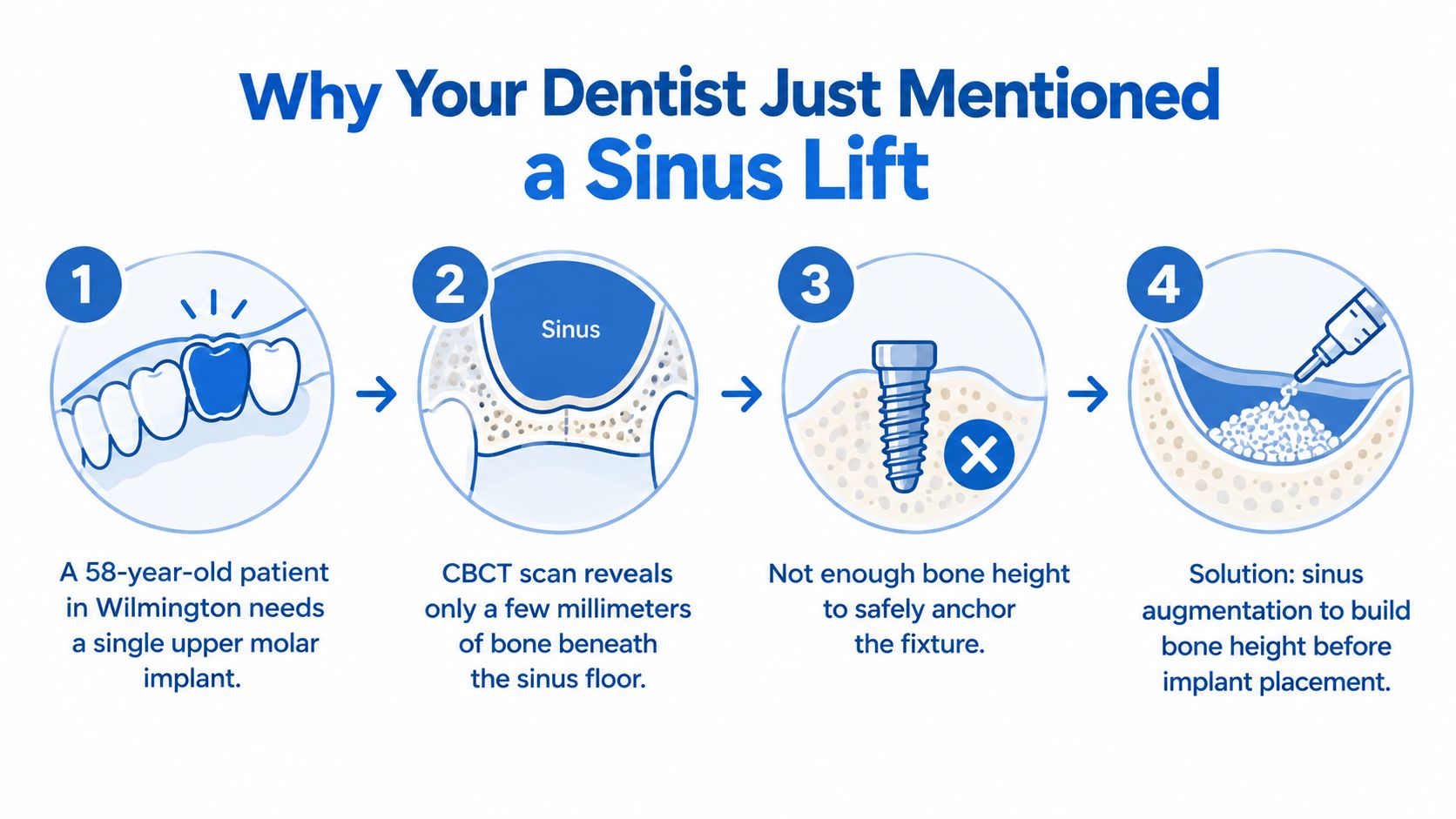
Sinus augmentation, also called a sinus lift, is a bone-building procedure. The periodontist gently lifts the sinus membrane and places graft material underneath it so new bone can form in the upper jaw. That extra height gives the implant the support it needs later.
Why the sinus gets in the way
The upper molars and premolars sit just below the sinus cavity. When a tooth has been missing for a while, the ridge can shrink and the space under the sinus can become even tighter. That is why a person who lost a back upper tooth years ago often needs more than a straightforward implant.
The sinus lift is billed separately from the implant, abutment, and crown because it is its own operation. It has its own imaging, materials, surgery time, and healing period. The final bill can rise if more than one site is treated or if the grafting plan is more involved.
Practical rule: if the bone is too thin to hold the implant, the sinus lift becomes a foundation step, not an optional add-on.
What to watch for next
The price you see is usually shaped by four moving parts.
- Surgical approach affects how much tissue is opened and how much graft is needed.
- Graft material changes both the supply cost and the surgical time.
- Number of sides treated can turn a single-site fee into a bilateral case.
- Case complexity can add extraction work, extra grafting, or delayed implant timing.
That is why one patient's estimate can look modest while another patient's quote climbs quickly. The surgery may sound similar on paper, but the clinical setup is often very different.
The Main Factors That Drive Sinus Augmentation Cost
The biggest mistake patients make is treating sinus augmentation like a flat fee. It isn't. The estimate usually reflects a chain of choices, and each choice shifts the total in a predictable way.
Technique, graft, and the number of sites
A lateral-window procedure usually costs more than a crestal lift because it takes more surgical time and more graft volume. A crestal, or internal, lift is often used when only a small amount of added height is needed, while the lateral approach is reserved for thinner bone and more demanding anatomy. The broader U.S. market commonly places sinus augmentation at $1,500 to $5,000 per side, and technique is a major reason the range is so wide.
Graft choice also matters. A simpler graft material can keep the estimate lower, while more complex harvesting or premium materials push the fee up. When the case is bilateral, the price usually rises because both sides need treatment, imaging review, and follow-up.
A low quote often means a narrow procedure scope, not necessarily a better overall value.
The cost drivers side by side
| Cost Driver | Lower-End Impact | Upper-End Impact |
|---|---|---|
| Surgical technique | Crestal or internal lift, smaller fee band | Lateral-window lift, larger fee band |
| Graft material | Simpler, stocked graft option | More complex or harvested graft option |
| Number of sites | One side treated | Both sides treated |
| Case complexity | Straightforward ridge height gain | Extraction, extra grafting, or staged care |
The important takeaway is that cost usually scales with surgical depth, not with a single label on the treatment plan. A quote that looks higher at first may include more of the work that the patient needs.
Lateral Window vs Crestal Lift and What Each Costs
Two patients can both hear “sinus lift” and still need very different surgeries. That's why the approach matters so much to the final bill.
The lateral window lift opens a small window in the side of the upper jaw so the membrane can be visualized and lifted directly. It is usually chosen when the remaining bone is too limited for a simpler approach. In the U.S., this type is often quoted around $2,000 to $3,500 per side, and some broader patient guides place the overall sinus augmentation range higher when grafting and complexity are included.
The crestal, or internal, lift is performed through the implant site. It's less invasive, usually better suited to mild height deficiencies, and can sometimes be bundled into the implant fee. One cited source places this type around $800 to $1,500, while other patient-facing guides put it more commonly in the $1,500 to $3,000 band depending on the case (NewMouth, Dentaly).
How the approaches compare
| Feature | Lateral Window Lift | Crestal / Internal Lift |
|---|---|---|
| Access | Side of the maxilla | Through the implant socket |
| Invasiveness | More invasive | Less invasive |
| Typical use | Very limited bone height | Mild to moderate bone deficiency |
| Typical fee band | Higher | Lower to mid-range |
| Healing profile | Often more involved | Usually simpler |
What usually drives the choice
The lateral approach is more common when the back upper jaw has very little residual bone. The internal approach makes sense when there's enough bone to support the implant while the lift is performed. If advanced imaging shows the ridge is borderline, the periodontist may choose the method that offers more predictable support.
Some practices also refine these procedures with piezoelectric instruments and computer-guided surgery. Those tools can improve predictability, but they may also affect the fee because they add planning and technology to the visit. For Delaware patients comparing estimates, the question is not just "Which lift?" It's "Which lift matches the anatomy and the rest of the treatment plan?"
What a Typical Sinus Lift Quote Actually Includes
Many patients compare one number against another and assume the higher estimate is overpriced. Often, the difference is just what the quote includes.
A typical sinus augmentation estimate may cover the consultation, CBCT imaging, anesthesia or IV sedation, the surgery itself, graft material, a membrane, sutures, and follow-up visits until healing is checked. The line items can be bundled into one fee or broken apart into separate charges. A printed estimate helps a patient see whether the office is quoting the surgery only or the whole surgical episode.
Common inclusions and add-ons
| Line Item | Typically Included | Commonly Added On |
|---|---|---|
| Consultation | Yes | |
| CBCT imaging | Often | |
| Local anesthesia | Often | |
| IV sedation | Sometimes | |
| Surgical procedure | Yes | |
| Bone graft material | Often | |
| Membrane | Often | |
| Sutures and follow-up | Often | |
| Tooth extraction | Often added | |
| Implant placement | Often added or separate | |
| Custom surgical guide | Often added | |
| PRF membrane | Often added | |
| Prescription medications | Often added |
A low headline number can be misleading if imaging or sedation is excluded. That's especially important for anxious adults who may need a calmer experience, because the sedation line can materially change the estimate.
Good question to ask: does the quote include the whole surgical phase, or only the grafting procedure itself?
The practice team should be able to separate surgical, grafting, and ancillary fees in writing. That makes it easier to compare estimates from different Delaware offices without guessing what is hidden inside the total. Patients who are already seeing a periodontist for gum disease or implant planning can also ask how this procedure fits with broader care, including laser gum treatment cost, if gum therapy is part of the sequence.
How Graft Material and Surgical Setting Change the Bill
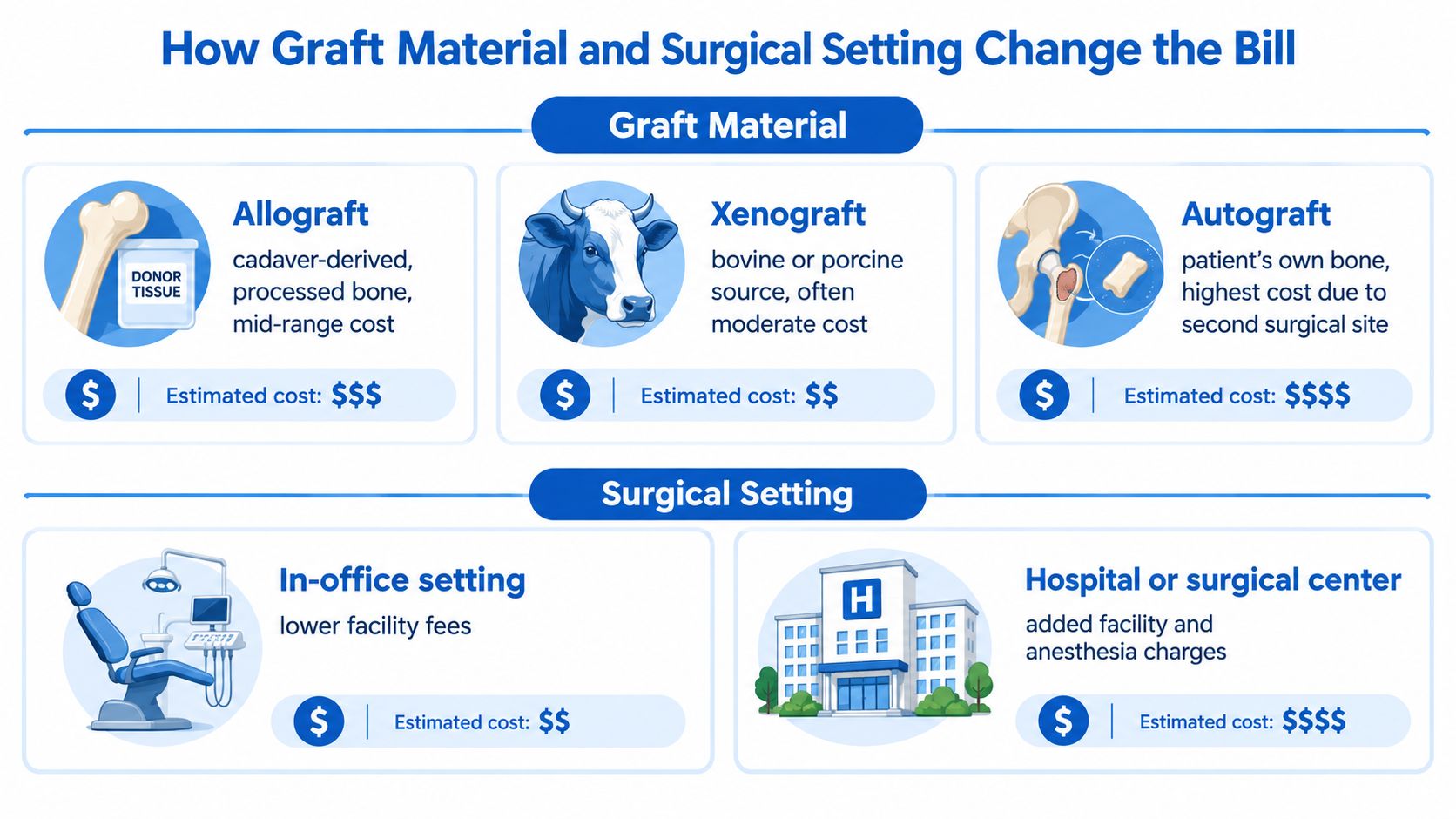
The graft source can matter as much as the lift itself. In some cases, the periodontist uses bone from the patient, and in others the graft comes from processed donor tissue or a synthetic material. The more involved the source, the more the cost tends to rise.
A historical cost study from Lund University reported a mean hospital cost of €3,447 for maxillary sinus augmentation with iliac autograft, excluding administration, and found that local-policlinic alternatives with or without bone substitutes cost about 42% as much (Lund University). The same study also estimated production loss for workers at 41% of total cost, or €9,285 in the analyzed setting (Lund University). That is a reminder that the bill is not just what happens chairside.
Why the setting matters
In-office periodontal surgery usually has lower facility overhead than a hospital-based case. That makes the plan more predictable for many patients who can be treated comfortably under local anesthesia with sedation. A hospital or surgical center can be the right setting for some medically complex cases, but the added facility and anesthesia structure often increases the total.
The graft source works the same way. Autogenous bone means a second surgical site, which adds time and recovery. Allograft and xenograft options are often simpler to use. Synthetic materials can be the least invasive from a harvest standpoint, though the right choice still depends on anatomy and healing goals.
The practice's use of advanced imaging and navigation technology helps the surgeon map the case before the first incision is made. That can support more precise graft placement and reduce surprises that would otherwise show up during surgery.
The cheapest setup on paper is not always the least expensive once healing time, donor-site work, and facility charges are counted.
For Delaware patients, the useful question is whether the estimate reflects a single-office outpatient protocol or a more resource-heavy surgical path. That difference often explains why two seemingly similar plans can land in different ranges.
The Hidden Cost of Complications and Rework
A low fee can look attractive right up until the case needs a second visit. That is where the true cost of sinus augmentation becomes clearer.
The most recognized procedural risk is membrane perforation. If the sinus lining tears, the surgeon may need to repair it, add extra graft material, or delay the implant stage so the area can heal. Consumer-facing cost guides still note that perforation can push a patient into a longer treatment path, and that extra time means more appointments and more monitoring.
Why delay changes the bill
When the implant cannot be placed right away, the patient may need staged care. That can mean another round of imaging, another follow-up period, and sometimes a temporary solution while the site matures. If grafting fails or infection develops, the treatment can move from a single surgical episode to a full revision plan.
The historical cost study is useful here because it shows how quickly the economic burden extends beyond the operating room. The surgical fee is only one part of the total. Time off work, repeat visits, and additional procedures can become the larger issue.
- Membrane perforation: may require repair, extra grafting, or delayed healing.
- Delayed implant placement: adds months of healing visits.
- Graft failure or rework: can force a second surgery.
- Revision care: increases the final total in ways the first quote may not show.
The newer patient guides also emphasize that lower upfront pricing can be misleading when complications or staged treatment are likely. That's why 3D CBCT planning and careful surgical navigation matter. They don't guarantee a perfect outcome, but they can make the plan more precise before the graft is ever placed.
A useful checklist before approving any estimate is simple:
- Ask whether the plan assumes a one-stage or staged approach.
- Confirm whether imaging, sedation, and follow-up are included.
- Ask how a membrane tear would change the fee.
- Request the office's written estimate for revision or rework scenarios.
That checklist helps an anxious patient compare total risk, not just the first invoice.
Insurance, Financing, and Your Delaware Treatment Path
Insurance often creates the most confusion because dental and medical coverage treat sinus augmentation differently. In many cases, the procedure is classified as a dental or implant-related preparatory step, so health insurance may not apply and dental benefits may cover only part of the bill.
For many plans, the most realistic expectation is partial dental reimbursement after the annual maximum is reached. The out-of-pocket balance can still be meaningful once imaging and grafting are added. A financing plan can help spread that burden over time, and reviewing the practice's accepted insurance plans at Periodontal Associates of Delaware's insurance resource can clarify what portion of the estimate may be covered.
What Delaware patients should ask for
- A coded pre-treatment estimate that uses the correct periodontal procedure code.
- A medical-cross-over letter if the case involves documented sinus pathology or trauma.
- A line-by-line breakdown showing whether implant placement is included or separate.
- A financing schedule that shows the monthly amount before the patient signs.
Third-party financing and in-house payment plans can make treatment easier to manage, but they should never replace a clear estimate. The goal is to avoid surprise costs once the surgical phase begins.
Practical rule: ask the office to separate the lift, the implant, and the restorative work before you make a payment decision.
For adults across Wilmington, Newark, Pike Creek, Hockessin, Bear, Middletown, Dover, and nearby communities, understanding what insurance will and will not cover is the first step toward a realistic treatment budget. Periodontal Associates of Delaware offers sinus augmentation, implant planning, and related periodontal care across Wilmington, Newark, and Dover, so the estimate can be reviewed line by line before treatment begins.